
Jordan Park in St. Petersburg in Pinellas County, Florida — The American South (South Atlantic)
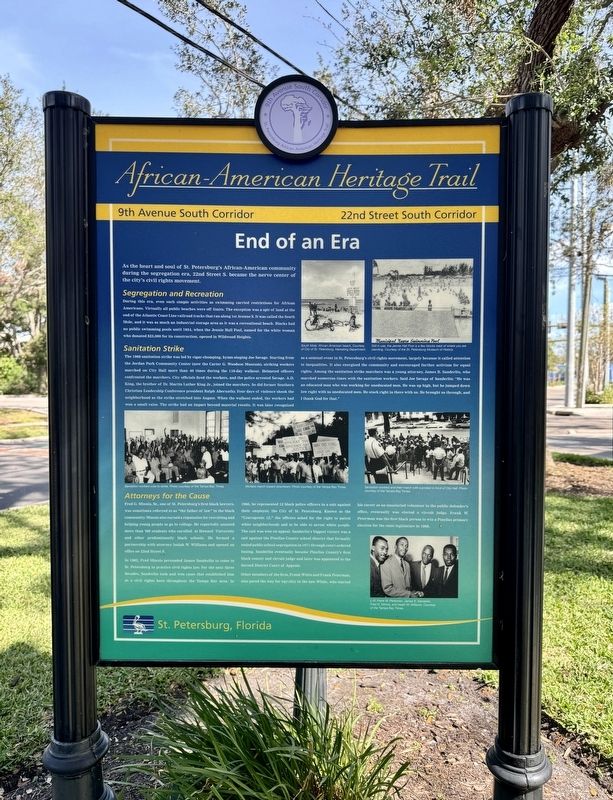
End of an Era
9th Avenue South Corridor • 22nd Street South Corridor
| — | St. Petersburg African-American Heritage Trail | — |
Photographed by Brandon D Cross
1. End of an Era Marker
As the heart and soul of St. Petersburg's African-American community during the segregation era, 22nd Street S. became the nerve center of the city's civil rights movement.
Segregation and Recreation
During this era, even such simple activities as swimming carried restrictions for African Americans. Virtually all public beaches were off limits. The exception was a spit of land at the end of the Atlantic Coast Line railroad tracks that ran along 1st Avenue S. It was called the South Mole, and it was as much an industrial storage area as it was a recreational beach. Blacks had no public swimming pools until 1954, when the Jennie Hall Pool, named for the white woman who donated $25,000 for its construction, opened in Wildwood Heights.
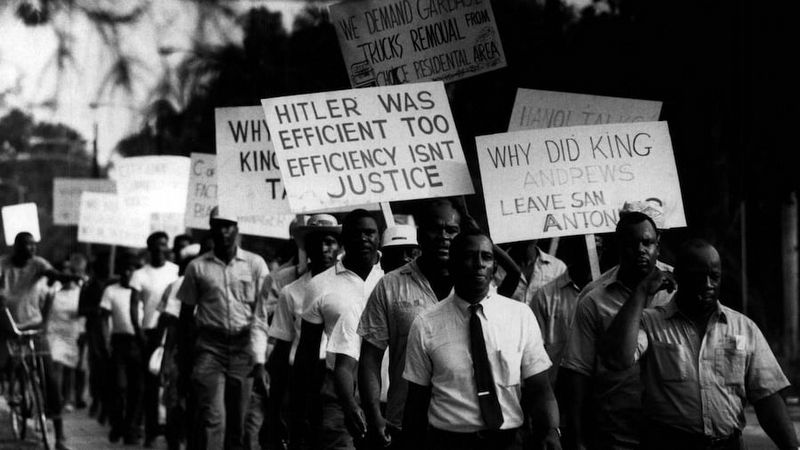
Sanitation Strike
The 1968 sanitation strike was led by cigar-chomping, hymn-singing Joe Savage. Starting from the Jordan Park Community Center (now the Carter G. Woodson Museum), striking workers marched on City Hall more than 40 times during the 116-day walkout. Helmeted officers confronted the marchers. City officials fired the workers, and the police arrested Savage. A.D. King,
this page online
Attorneys for the Cause
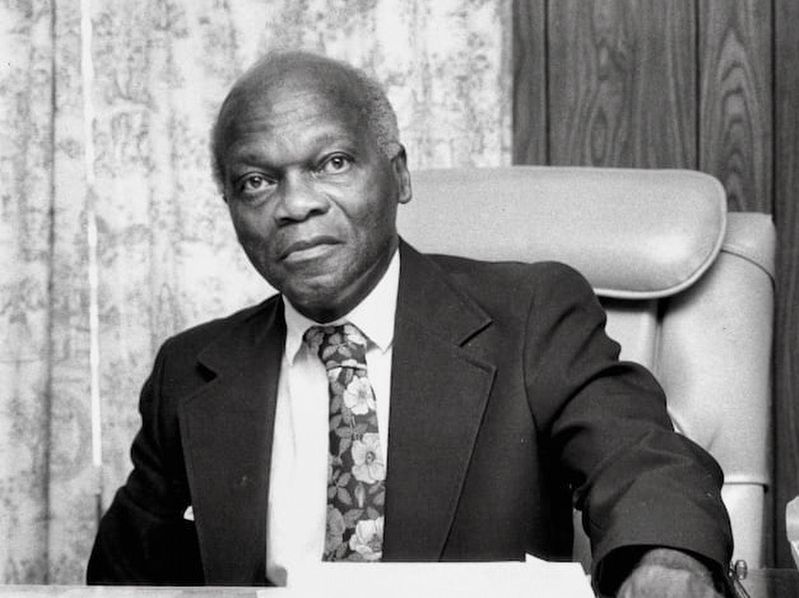
Fred G. Minnis, Sr., one of St. Petersburg's first black lawyers, was sometimes referred to as "the father of law” in the black community. Minnis also earned a reputation for recruiting and
Photographed by Brandon D Cross
2. End of an Era Marker
In 1962, Fred Minnis persuaded James Sanderlin to come to St. Petersburg to practice civil rights law. For the next three decades, Sanderlin took and won cases that established him as a civil rights hero throughout the Tampa Bay Area. In 1966, he represented 12 black police officers in a suit against their employer, the City of St. Petersburg. Known as the "Courageous 12," the officers asked for the right to patrol white neighborhoods and to be able to arrest white people. The suit was won on appeal. Sanderlin's biggest victory was a suit against the Pinellas County school district that formally ended public school segregation in 1971 through court-ordered busing. Sanderlin eventually became Pinellas County's first black county and circuit judge and later was appointed to the Second District Court of Appeals.
Other members of the firm, Frank White and Frank Peterman, also paved
Tampa Bay Times/ Public Domain
3. 1968 St. Petersburg Sanitation Strike
(captions)
South Mole, African-American beach. Courtesy of the City of St. Petersburg, Marketing Department.
Still in use, the Jennie Hall pool is a few blocks west where you are standing. Courtesy of the St. Petersburg Museum of History.
Sanitation workers vote to strike. Photo courtesy of the Tampa Bay Times.
Workers march toward downtown. Photo courtesy of the Tampa Bay Times.
Sanitation workers and their march with a protest in front of City Hall. Photo courtesy the Tampa Bay Times.
L-R: Frank Peterman , James E. Sanderlin, Fred G. Minnis, and Isaiah W. Williams. Courtesy of the Tampa Bay Times.
Erected by National Park Service, Florida Department of State, the City of St. Petersburg and the Dr. Carter G. Woodson African American History Museum.
Topics. This historical marker is listed in these topic lists: African Americans
Tampa Bay Times/ Public Domain
4. Fred G. Minnis, "the father of law”
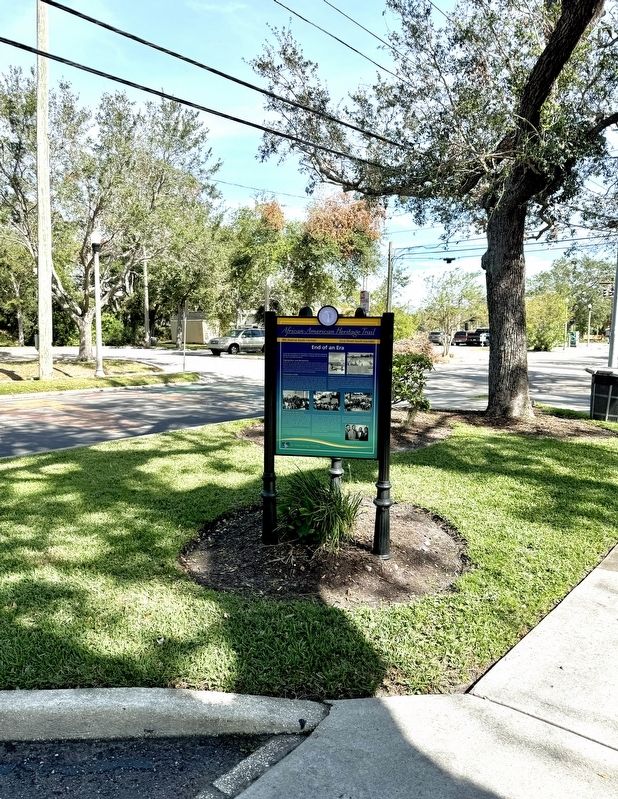
Location. 27° 45.662′ N, 82° 39.826′ W. Marker is in St. Petersburg, Florida, in Pinellas County. It is in Jordan Park. It is at the intersection of 9th Avenue South and Johnny Mack Place, on the left when traveling west on 9th Avenue South. The marker is located in front of the Dr. Carter G. Woodson African American History Museum. Touch for map. Marker is at or near this postal address: 2240 9th Avenue S, Saint Petersburg FL 33712, United States of America. Touch for directions.

Regionally, this marker is on Florida’s Gulf Coast and on Tampa Bay. It is also in the American South and on the Gulf Coast. Globally, it is in the North Atlantic Region, North America, a Gulf of Mexico state, the Western Hemisphere, the Western World, and the Anglosphere. Historically, it finds itself in what was once New Spain, the territory of the Mississippian Culture, one of the Confederate States of America, and the Antebellum South.
Other nearby markers. At least 8 other markers are within walking distance of this marker: 9th Avenue South Corridor (here, next to this marker); The Beginning (here, next to this marker); Building 22nd Street S. (about 400 feet away, measured in a direct line); 22nd Street South Corridor (about 400 feet away); a different marker also named 9th Avenue South Corridor (about 500 feet away); Pioneer Schools (about 500 feet away); Civic Associations (about 500 feet away); In the Name of “Progress” (about 600 feet away). Touch for a list and map of all markers in St. Petersburg.
Also see . . .
1. An Empty Victory: The St. Petersburg Sanitation Strike, 1968. (Submitted on November 27, 2024, by Brandon D Cross of Flagler Beach, Florida.)
2. St. Petersburg leaders recall legacy of Fred G. Minnis, ‘the Dean of Black attorneys’. (Submitted on November 27, 2024, by Brandon D Cross of Flagler Beach, Florida.)
3. Stay Out, The Water’s Fine: Desegregating Municipal Swimming Facilities In St. Petersburg, Florida. (Submitted on November 27, 2024, by Brandon D Cross of Flagler Beach, Florida.)
Credits. This page was last revised on November 10, 2025. It was originally submitted on November 27, 2024, by Brandon D Cross of Flagler Beach, Florida. This page has been viewed 301 times since then and 89 times this year. Last updated on November 10, 2025, by Carl Gordon Moore Jr. of North East, Maryland. Photos: 1, 2, 3, 4. submitted on November 27, 2024, by Brandon D Cross of Flagler Beach, Florida. • Devry Becker Jones was the editor who published this page.
