Near Williamsburg in James City County, Virginia — The American South (Mid-Atlantic)
Wowinchapuncke
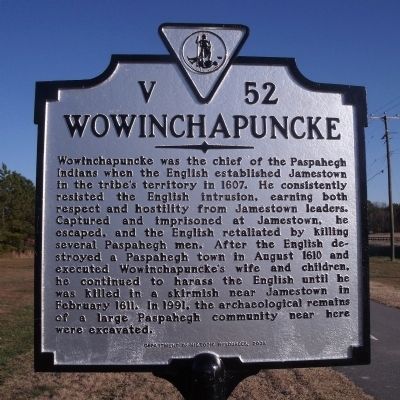
Photographed by Bernard Fisher, January 7, 2010
1. Wowinchapuncke Marker
Erected 2008 by Department of Historic Resources. (Marker Number V-52.)
Topics and series. This historical marker is listed in these topic lists: Colonial Era • Indigenous Peoples and Communities. In addition, it is included in the Virginia Department of Historic Resources (DHR) series list. A significant historical month for this entry is February 1611.
Location. 37° 15.898′ N, 76° 52.234′ W. Marker is near Williamsburg, Virginia, in James City County. It is on John Tyler
this page online

Regionally, this marker is on Virginia’s Peninsula, in Coastal Virginia, and in the Hampton Roads Metropolitan Area. It is also in the American South, specifically in the Upper South, in the Tidewater, and on the Eastern Seaboard. Globally, it is in the North Atlantic Region, North America, the Western Hemisphere, the Western World, and the Anglosphere. Historically, it finds itself in what was once the territory of the Mississippian Culture, one of the original Thirteen Colonies, one of the Confederate States of America, and the Antebellum South.
Other nearby markers. At least 8 other markers are within 5 miles of this marker, measured as the crow flies: Paspahegh (about 600 feet away, measured in a direct line); Piney Grove and E. A. Saunders (approx. 3.9 miles away); Paspahegh Indians (approx. 3.9 miles away); Ospreys (approx. 4½ miles away); a different marker
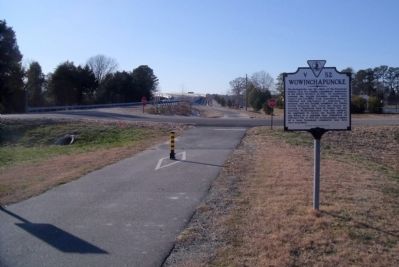
Photographed by Bernard Fisher, January 7, 2010
2. Wowinchapuncke Marker (facing west)
Other markers no longer nearby. Sir William Berkeley (was approx. 4 miles away but has been confirmed missing); Bacon's Rebellion (was approx. 4.6 miles away but has been permanently removed).
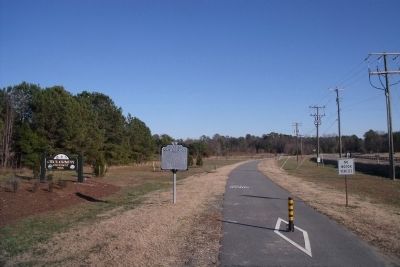
Photographed by Bernard Fisher, January 7, 2010
3. Wowinchapuncke Marker (facing east)
Credits. This page was last revised on November 9, 2021. It was originally submitted on January 10, 2010, by Bernard Fisher of Richmond, Virginia. This page has been viewed 1,543 times since then and 69 times this year. Photos: 1, 2, 3. submitted on January 10, 2010, by Bernard Fisher of Richmond, Virginia.
