Englewood in Sarasota County, Florida — The American South (South Atlantic)
Indian Mound Park
Paulson Point Midden
| — | take a walk into the past | — |
Photographed by Brandon D Cross
1. Indian Mound Park Marker
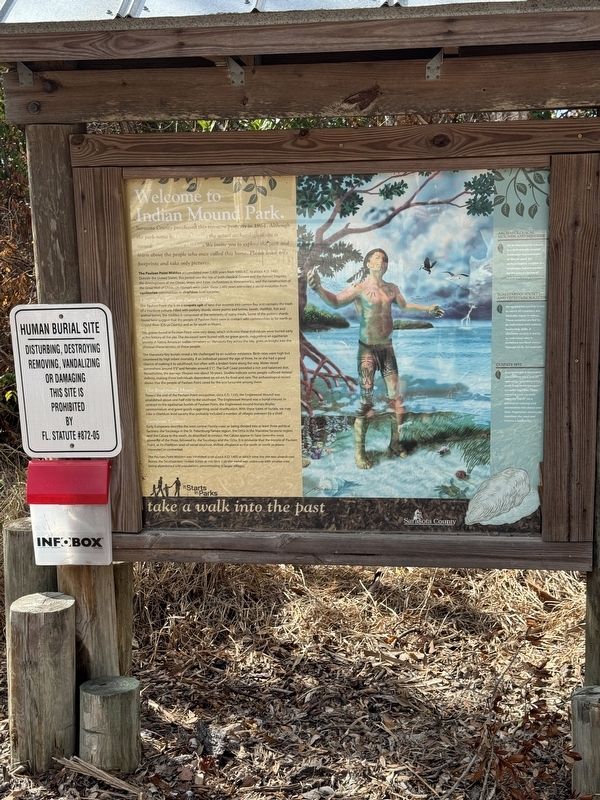
Sarasota County purchased this ten-acre property in 1964. Although the park name is Indian Mound, the actual archaeological site is named Paulson Point Midden. We invite you to explore the park and learn about the people who once called this home. Please leave only footprints and take only pictures
The Paulson Point Midden accumulated over 2400 years from 1000 B.C. to about A.D. 1400. Outside the United States, this period saw the rise of both classical Greece and the Roman Empires, the development of the Olmec, Maya, and Aztec civilizations in Mesoamerica, and the construction of the Great Wall of China, On Florida's west coast, these 2,400 years witnessed a social evolution from egalitarian communities to chiefdom level societies.
Life on the Paulson Point Midden
The Paulsen Point site is on a cuspate spit of land that extends into Lemon Bay and contains the trash of a maritime culture. Filled with pottery shards, stone points and knives, beads, shellfish, fish and animal bones, the midden is composed of the remnants of many meals. Some of the pottery shards found here suggest that the people of
this page online
The graves found at Paulsen Point were very deep, which indicates these individuals were buried early in the history of the site. The deceased were buried with no grave goods, suggesting an egalitarian society. A Native American indian cemetery on Manasota Key across the bay, gives us insight into the physical characteristics of these people.
The Manasota Key burials reveal a life challenged by an outdoor existence. Birth rates were high but countered by high infant mortality. If an individual passed the age of three, he or she had a good chance of making it to adulthood, but often with a broken bone along the way. Males stood somewhere around 5'5" and females around 5'1”. The Gulf Coast provided a rich and balanced diet. Nonetheless, the average lifespan was about 30-years. Studies indicate some people suffered skeletal defects, making these individuals dependent on others for food and care. The archaeological record shows that the people of Paulsen Point cared for the less fortunate among them.
The Englewood Mound
Photographed by Brandon D Cross
2. Indian Mound Park Marker
Toward the end of the Paulsen Point occupation, circa A.D. 1350, the Englewood Mound was established about one-half mile to the southeast. The Englewood Mound was a burial mound. In contrast to the egalitarian burials of Paulsen Point, the Englewood mound burials display ceremonialism and grave goods suggesting social stratification. With these types of burials, we may infer a chiefdom level society that probably included a number of villages overseen by a chief.
European Contact
Early Europeans describe the west central Florida coast as being divided into at least three political factions: the Tocobaga in the St. Petersburg/Tampa region, the Uzita in the Manatee/Sarasota region, and the Calusa to the south. As described at contact, the Calusa appear to have been the most powerful of the three, followed by the Tocobaga and the Uzita, It is probable that the people of Paulsen Point, at its chiefdom level of social structure, shifted allegiance to the north or south as power expanded or contracted.
The Paulsen Point Midden was inhabited until about A.D. 1400 at which time the site was abandoned Across the Southeastern United States at this time a similar trend was underway with smaller sites being abandoned and populations concentrating in larger villages.
Archaeological Mounds and Middens
An archaeological mound is a deliberately created landscape feature made of dirt and sand. An archaeological midden is a landscape feature created by the accumulation of trash from living activities.
Egalitarian Society and Chiefdom Societies
An egalitarian society Is one in which all members are basically equal in status. There societies are led by an individual with natural leadership skills. A chiefdom society is led by an individual who is somehow ascribed status; through birth, for example.
Cuspate Spit A cuspate spit is formed as a prevailing wind and an opposing secondary wind push long shore transport currents together. These merging sand currents typically “catch” on a geological outcrop and accumulate into dunes over time. Vegetation eventually stabilizes the sand and creates a landform.
Erected by Sarasota County.
Topics. This historical marker is listed in these topic lists: Anthropology & Archaeology • Indigenous Peoples and Communities • Parks & Recreational Areas. A significant historical year for this entry is 1964.
Location. 26° 57.412′ N, 82° 21.774′ W. Marker is in Englewood, Florida, in Sarasota County. It is on Winson Avenue 0.2 miles south of West Fray Street, on the right when traveling south. The marker is located within Indian Mound Park. Touch for map. Marker is at or near this postal address: 210 Winson Ave, Englewood FL 34223, United States of America. Touch for directions.

Regionally, this marker is on the Gulf Coast. It is also in the American South and on the Gulf Coast. Globally, it is in the North Atlantic Region, North America, a Gulf of Mexico state, the Western Hemisphere, the Western World, and the Anglosphere. Historically, it finds itself in what was once New Spain, the territory of the Mississippian Culture, one of the Confederate States of America, and the Antebellum South.
Other nearby markers. At least 8 other markers are within 2 miles of this marker, measured as the crow flies: The Paulson Point Midden (within shouting distance of this marker); Historic Englewood (approx. 0.4 miles away); Historic Dearborn Street (approx. 0.4 miles away); Commander Clyde E. Lassen, United States Navy (approx. 0.4 miles away); Lemon Bay Woman’s Club (approx. half a mile away); Lemon Bay Cemetery (approx. 0.7 miles away); Green Street Church and Museum (approx. 0.7 miles away); Bass Biological Labs/Cookie House (approx. 1.9 miles away). Touch for a list and map of all markers in Englewood.
Also see . . .
1. Mound at “Paulson Point, Englewood” - DiamondLegacyAmerica.org. (Submitted on January 15, 2025, by Brandon D Cross of Flagler Beach, Florida.)
2. Indian Mound Park - Paulson Point. (Submitted on January 15, 2025, by Brandon D Cross of Flagler Beach, Florida.)
Credits. This page was last revised on January 19, 2025. It was originally submitted on January 15, 2025, by Brandon D Cross of Flagler Beach, Florida. This page has been viewed 388 times since then and 85 times this year. Photos: 1, 2. submitted on January 15, 2025, by Brandon D Cross of Flagler Beach, Florida. • J. J. Prats was the editor who published this page.
