
Westbrook in Lower Connecticut River Valley Region, Connecticut — The American Northeast (New England)
Salt Meadow Trail System
Points of Interest
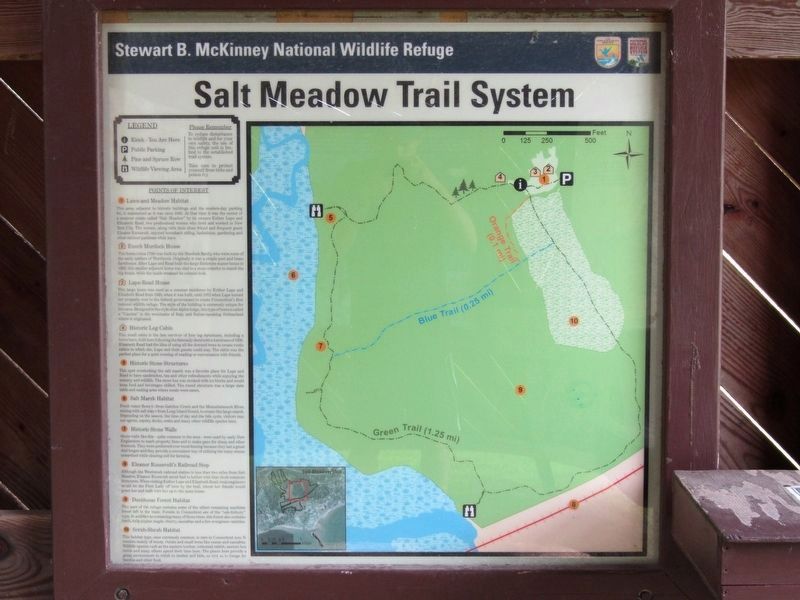
Photographed by Conrad Ward, August 4, 2024
1. Salt Meadow Trail System Map
1 Lawn and Meadow Habitat
This area, adjacent to historic buildings and the modern-day parking lot, is maintained as it was circa 1940. At that time it was the center of a summer estate called "Salt Meadow" by its owners Esther Lape and Elizabeth Read, two professional women who lived and worked in New York City. The women, along with their close friend and frequent guest Eleanor Roosevelt, enjoyed horseback riding, badminton, gardening and other outdoor pastimes while here.
2 Enoch Murdock House
This home (circa 1750) was built by the Murdock family, who were some of the early settlers of Westbrook. Originally it was a simple post and beam farmhouse. After Lape and Read built the large fieldstone manor house in 1929, this smaller adjacent home was clad in a stone exterior to match the big house, while the inside retained its colonial look.
3 Lape-Read House
This large home was used as a summer residence by Esther Lape and Elizabeth Read from 1929, when it was built, until 1972 when Lape turned her property over to the federal government to create Connecticut's first national wildlife refuge. The style of
this page online
4 Historic Log Cabin
This small cabin is the last survivor of four log structures, including a horse barn, built here following the famously destructive hurricane of 1938. Elizabeth Read had the idea of using all the downed trees to create rustic cabins in which she, Lape and their guests could stay. The cabin was the perfect place for a quiet evening of reading or conversation with friends.
5 Historic Stone Structures
This spot overlooking the salt marsh was a favorite place for Lape and Read to have sandwiches, tea and other refreshments while enjoying the scenery and wildlife. The stone box was stocked with ice blocks and would keep food and beverages chilled. The round structure was a large slate table and seating area where meals were eaten.
6 Salt Marsh Habitat
Fresh water flows in from Gatchen Creek and the Menunketesuck River, mixing with salt water from Long Island Sound, to create this large marsh. Depending
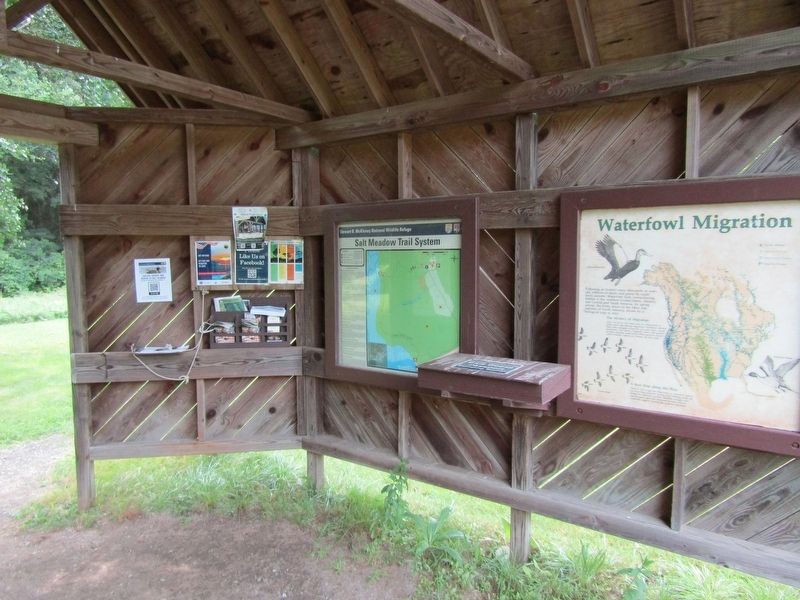
Photographed by Conrad Ward, August 4, 2024
2. Salt Meadow Trail System Map
7 Historic Stone Walls
Stone walls like this - quite common to the area - were used by early New Englanders to mark property lines and to make pens for sheep and other livestock. They were preferred over wood fencing because they last a great deal longer and they provide a convenient way of utilizing the many stones unearthed while clearing soil for farming.
8 Eleanor Roosevelt's Railroad Stop
Although the Westbrook railroad station is less than two miles from Salt Meadow, Eleanor Roosevelt never had to bother with that short commute from town. When visiting Esther Lape and Elizabeth Read, train engineers would let the First Lady off here by the trail, where her friends would greet her and walk with her up to the main house.
9 Deciduous Forest Habitat
This part of the refuge contains some of the oldest remaining maritime forest left in the state. Forests in Connecticut are of the "oak-hickory" type. In addition to containing many of those trees, this forest also contains birch, tulip poplar, maple, cherry, sassafras and a few evergreen varieties.
10 Scrub-Shrub Habitat
This habitat type, once extremely common, is rare in Connecticut now. It consists mainly of woody shrubs and small trees like sumac and sassafras. Wildlife species such as the eastern towhee, cottontail rabbit, eastern box turtle and many others spend their time here. The plants here provide a great environment in which to shelter and hide, as well as to forage for berries and other food.
Erected by Stewart B. McKinney National Wildlife Refuge (U.S. Fish and Wildlife Service / Department of the Interior).
Topics. This historical marker is listed in these topic lists: Architecture • Environment • Parks & Recreational Areas • Women.
Location. 41° 17.219′ N, 72° 28.365′ W. Marker is in Westbrook in Lower Connecticut River Valley Region, Connecticut. It can be reached from Old Clinton Road half a mile north of Hammock Road, on the left when traveling north. Located in the Stewart B. McKinney National Wildlife Refuge. Touch for map. Marker is in this post office area: Westbrook CT 06498, United States of America. Touch for directions.

Regionally, this marker is in the Connecticut River Valley and on the Connecticut Shoreline. It is also in the American Northeast, in New England, and on the Eastern Seaboard. Globally, it is in the North Atlantic Region, North America, the Western Hemisphere, the Western World, and the Anglosphere. Historically, it finds itself in what was once Middlesex County and also one of the original Thirteen Colonies.
Other nearby markers. At least 8 other markers are within 2 miles of this marker, measured as the crow flies: Lape-Read House (within shouting distance of this marker); Enoch Murdock House (within shouting distance of this marker); The Westbrook Barrier Islands (approx. one mile away); Welcome to Kirtland Landing (approx. one mile away); Rev. Worthington & Rev. Devotion (approx. 1.2 miles away); Jude (approx. 1.2 miles away); Toby Bardo (approx. 1.2 miles away); Westbrook (approx. 1.2 miles away). Touch for a list and map of all markers in Westbrook.
Also see . . . Stewart B. McKinney National Wildlife Refuge. (Submitted on January 24, 2025, by Michael Herrick of Southbury, Connecticut.)
Credits. This page was last revised on May 19, 2026. It was originally submitted on January 19, 2025, by Conrad Ward of Guilford, Connecticut. This page has been viewed 133 times since then and 15 times this year. Photos: 1, 2. submitted on January 19, 2025, by Conrad Ward of Guilford, Connecticut. • Michael Herrick was the editor who published this page.
