Winchester, Virginia — The American South (Mid-Atlantic)
Fort Loudoun
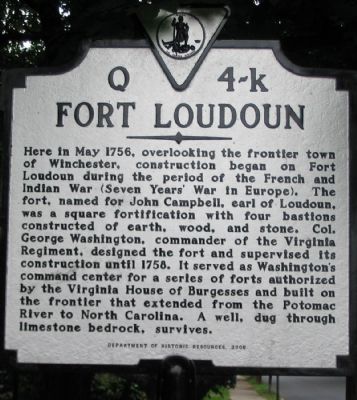
Photographed by Craig Swain, August 26, 2007
1. Fort Loudoun Marker
Erected 2006 by Department of Historic Resources. (Marker Number Q 4-k.)
Topics and series. This historical marker is listed in these topic lists: Colonial Era • Forts and Castles • War, French and Indian. In addition, it is included in the Virginia Department of Historic Resources (DHR) series list. A significant historical month for this entry is May 1756.
Location. 39° 11.341′ N, 78° 9.833′ W. Marker is in Winchester, Virginia. It is at the intersection
this page online

Regionally, this marker is in Virginia’s Shenandoah Valley. It is also in the American South, specifically in the Upper South, and in the Mid-Atlantic. Globally, it is in North America, the Western Hemisphere, the Western World, and the Anglosphere. Historically, it finds itself in what was once the territory of the Mississippian Culture, one of the original Thirteen Colonies, one of the Confederate States of America, and the Antebellum South.
Other nearby markers. At least 10 other markers are within walking distance of this marker: A different marker also named Fort Loudoun (a few steps from this marker); Washington's Well (a few steps from this marker); Site of Fort Loudoun (within shouting distance of this marker); a different marker also named Jackson's Headquarters (about 400 feet away); a different marker
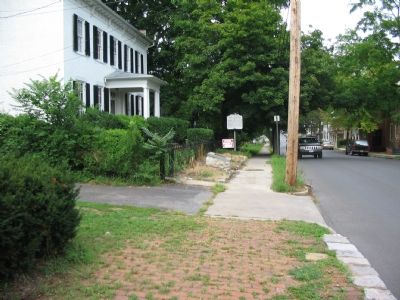
Photographed by Craig Swain, August 26, 2007
2. Site of Markers for Fort Loudoun along Loudoun Street
Other markers no longer nearby. Jackson’s Headquarters (was about 400 feet away, measured in a direct line but has been replaced with another marker now near it); Loyal Quaker and Brave Slave (was about 700 feet away but has been replaced with another marker now near it).
Related markers. Click here for a list of markers that are related to this marker. To better understand the relationship, study each marker in the order shown.
Also see . . . Fort Loudoun - One of Washington's Forts. Includes photographs of the well mentioned on the marker. (Submitted on September 23, 2007, by Craig Swain of Leesburg, Virginia.)
Additional commentary.
1. Fort Loudoun - A Popular Name
The name Loudoun was applied to several frontier forts during the
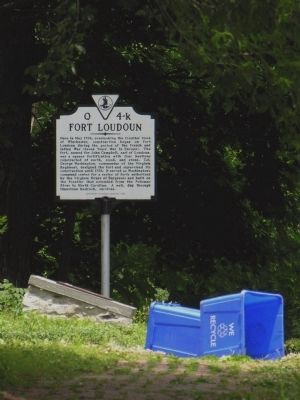
Photographed by Allen C. Browne, June 14, 2010
3. Two Fort Loudoun Markers
— Submitted September 23, 2007, by Craig Swain of Leesburg, Virginia.
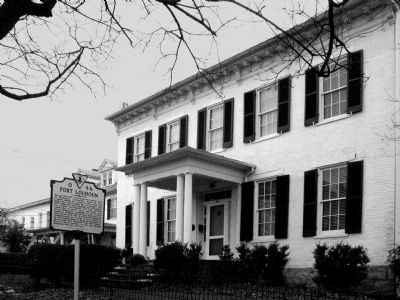
Photographed by Allen C. Browne, March 28, 2009
4. Fort Loudoun Marker

Photographed by Bradley Owen, July 23, 2025
5. Fort Loudoun Marker/You Are Here
You are standing at the site of the northern rampart of George Washington's Fort Loudoun, 1756-1763. The red lines in the sidewalks and street mark the outline of the 18 ft. thick rampart walls. The lines approximately 140 ft. to the South mark the location of the southern rampart of the fort.
French & Indian War Foundation (fiwf.org)
French & Indian War Foundation (fiwf.org)

Photographed by Bradley Owen, July 23, 2025
6. Fort Loudoun Marker
Credits. This page was last revised on August 3, 2025. It was originally submitted on September 23, 2007, by Craig Swain of Leesburg, Virginia. This page has been viewed 2,544 times since then and 45 times this year. Photos: 1, 2. submitted on September 23, 2007, by Craig Swain of Leesburg, Virginia. 3, 4. submitted on May 9, 2014, by Allen C. Browne of Silver Spring, Maryland. 5, 6. submitted on August 3, 2025, by Bradley Owen of Morgantown, West Virginia. • J. J. Prats was the editor who published this page.
