Nolita in Manhattan in New York County, New York — The American Northeast (Mid-Atlantic)
Who Was Petrosino?
Photographed by Devry Becker Jones (CC0), January 17, 2025
1. Who Was Petrosino? Marker
Inscription.
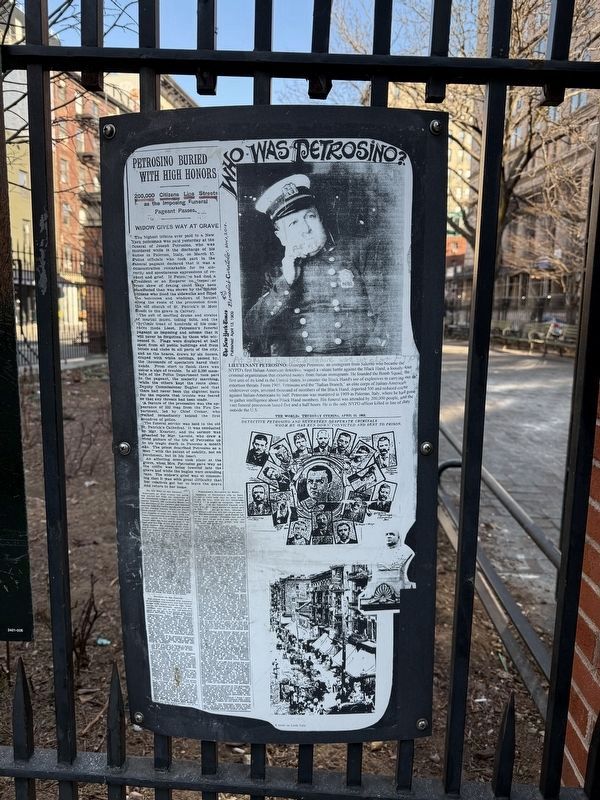
Who Was Petrosino?. . , Lieutenant Petrosino: Giuseppi Petrosino, an immigrant from Salerno who became the NYPD's first Italian-American detective, waged a valiant battle against the Black Hand, a loosely-knit criminal organization that extorted money from Italian immigrants. He founded the Bomb Squad, the first unit of its kind in the United States, to counter the Black Hand's use of explosives in carrying out its explosive threats. From 1905, Petrosino and the "Italian Branch," an elite corps of Italian-American undercover cops, arrested thousands of members of the Black Hand, deported 500 and reduced crime against Italian-Americans by half. Petrosino was murdered in 1909 in Palermo, Italy, where he had gone to gather intelligence about Black Hand members. His funeral was attended by 200,000 people, and the vast funeral procession lasted I've and a half hours. He is the only NYPD officer killed in line of duty outside the U.S.,
Petrosino Buried with High Honors , 200,000 Citizens Line Streets as the imposing Funeral Pageant Passes., Widow Gives Way at Grave , The New York Times , Published: April 13, 1909. , The highest tribute ever paid to a New York policeman was paid yesterday at the funeral of Joseph Petrosino, who was paid yesterday at the funeral of Joseph Petrosino, who was murdered while in the discharge of his duties in Palermo, Italy, on March 12. Police officials who took part in the funeral pageant declared that it was a demonstration remarkable for its sincerity and spontaneous expressions of respect and grief. If Petrosino had died a President or an Emperor no deeper or truer show of feeling could have been manifested than was shown by the 200,000 citizens who lined the sidewalks and filled the balconies and windows of houses along the route of the procession from the old church of St. Patrick's in Mott Street to the grave in Calvary., The roll of muffled drums and strains of martial music, tolling bells, and the rhythmic tread of hundreds of his comrades made Lieut. Petrosino's funeral pageant so imposing and solemn that it will never be forgotten by those who witnessed it. Flags were displayed at half mast from all public buildings and from hotels and clubs in all parts of the city, and as the hearse, drawn by six horses, draped with white nettings, passed by, the thousands of spectators bared their heads. From start to finish there was never a sign of trouble. In all 3,200 members of the Police Department took part in the pageant, the majority marching, while the others kept the route clear. Deputy Commissioner Bugher said that there had never been the there had never been the slightest basis for the reports that trouble was feared or that any threats had been made., A feature of the procession was the appearance of 333 men from the Fire Department, led by Chief Croker, who walked immediately behind the first squadron of police., The funeral service was held in the Old St. Patrick's Cathedral. It was conducted by Mgr. Kearney, and the Sherman was preached by Mgr. Lavellι, who drew a vivid picture of the life of Petrosino up to his tragic death in Palermo a month ago. The priest described Petrosino as a man "with the patent of nobility, not on parchment but in his heart., An affecting scene took place at the grave, when Mrs. Petrosino gave way as the coffin was being lowered into the grave and while the bugles were sounding taps. The widow's grief was so consuming that it was with great difficulty that her relatives got her to leave the grave and return to her home.,
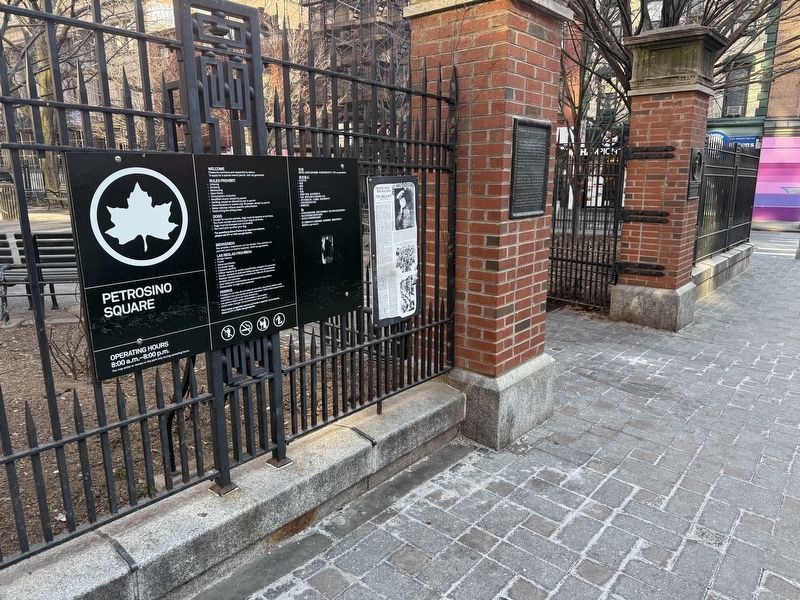
On the Way to the Church.. Punctually at 10:43 o'clock the coffin was carried out from the clubrooms of the Republican League of the Third Assembly District, 288 Lafayette Street, on the shoulders of six stalwart pall bearers selected from the traffic squad, and placed in the waiting hearse, while the Police Band played "Nearer, My God, to Thee." The wreaths of Lillie's and roses from the Police Commissioner and Deputy Commissioners rested on the coffin, which was draped with the Stars and Stripes at the head and the flag of the city at the foot. Every window and doorway in the vicinity, including those of the Bank of Italy and the Italian Consulate, was thronged with men and women as the pageant started. It was led by the Police Band, playing Verdi's Requiem March. The hearse was followed by the six honorary pall bearers, Lieuts. Funkstown, Coonay, Judge, Becker, Delaney, and Duggan from Police Headquarters; the six pall bearers from the traffic squad, and the guard of honor of twelve men from the traffic squad under Lieut. J. F. Shaw, who had kept watch over the body since its arrival on the Slavonia last Friday., Mrs. Petrosino and the other members of the family, dressed in deepest mourning, rode in the three coaches reserved for them. The widow appeared to be prostrated with grief, and had to be assisted into the carriage by her brother, Louis Sauline. Owing to the congestion in the streets, it was 11:30 o'clock when the cortθge reached the church in Mott Street, where two companies of mounted policemen stood in waiting and presented arms as the hearse stopped at the church door. Chief Inspector Schmittberger, mounted on a powerful bay horse, was in command of the pageant, and gave his orders to the senior officers in charge of the various detachments. As the coffin was carried into the church the band again played "Nearer, My God, to Thee," and the bells tolled, while men bared their heads and women stood in prayerful attitudes all along the lines in the street.,
Services in the Church.. The church was crowded with members of the Italian community who had entered earlier with tickets issued by Mgr. Kearney to his parishioners. Among the city officials who sat in the old-fashioned pews on the left of the centre aisle were Mayor McClellan, Gen. Bingham, Deputy Commissioners Baker, Bugher, Hanson, and Woods. Patrick McGowan, President of the Board of Aldermen; Daniel Slattery, Father Chidwick, the Police Chaplain; Fire Cheif Croker, and many others., The high requiem mass for the dead was celebrated by Mgr. Kearney, assisted by Deacon Domenico Epifania and the sub-Deacon Thomas B. Dougherty, and the choral service was sung b one hundred children from the parochial schools of St. Patrick., Mgr. Lavello of St. Patrick's Cathedral then delivered a brief eulogy of Lieut. Petrosino, after which he preached the sermon in English. He chose his text from St. Matthew: ,
A voice was heard in Ramah of lamentation and of great grief; of Rachel lamenting her children, and would not be comforted because they were not.
, Leaning over the pulpit and speaking in earnest tones, Father LaVelle said: ,
"The Catholic Church is like unto Rachel mourning for her children, and joins with the city and the whole civilized world in mourning him who lies before us. The Church, with all the tenderness of her maternal heart, deplores his untimely fate, and will always cherish the memory of his merits and deeds."
, After describing Petrosino's early struggles, from the time he began life as a wondering minstrel, through the Street Cleaning Department to the Police Department. Mgr. Lavelle spoke of the ciriticisms of the Police Department., "Many people, I fear," said the priest, "have a wrong idea of the police Force. It is criticized on every side, and, in a way, that is right, but if we stop to unreadable[ ],
Petrosino's Devotion to Duty.. Speaking of Petrosino's trip to Italy, Father Lavelle said that he went there to do his duty, with the full knowledge that his life might be forfeited. One of the priests of St. Patrick's Church who met him three days before he sailed said to him: "Do not go to Italy, because I am afraid that you will not return alive.", "The detective smiled," said Father Lavelle, "and replied: 'Probably not, but it is my duty to go and I am going.' He shook the hand of the priest, and that was their last good-bye.", Concluding, Father Lavelle said:
"May God grant that the sacrifice be productive of the greatest good, as the blood of the martyrs became the seed of the Christian Church. I hope and pray that the death of this faithful, true, large-hearted, devoted, and beloved man may be the means of inspiring self-respect among his countrymen, so that no mere small handful of criminals shall longer degrade their race. May it teach to the rest of the people the debt and the love that we owe to the strangers on our shores, so that we may not wrongly discriminate. Let us make every one as welcome in our hearts as they are under our flag."
, It was 12:40 o'clock when the coffin was carried from the church and again placed in the hearse for the drive to Calvary Cemetery. The delegations from the sixty Italian societies were ready, drawn up with bands at intervals. The order of the procession was, first, the mounted police, Chief Inspector, and flag of honor: police band, squadron mounted police, detachment from the Fire Department and street cleaners. Inspector McCafferty and adjutant, regiment of foot police. 1,000 strong: five open carriages filled with flowers; chaplain, hearse, pall bearers, guard of honor, honorary pallbearers, three carriages containing mourners. Police Commissioner and Deputy Commissioners, Inspectors of Police off duty, Lieutenants from the Detective Bureau, James E. March, and the Citizens Committee and honorary committee., The first division of the Italian societies was led by the Ninth Regiment Band, which in khaki uniforms, formed a striking contrast in the brilliant sunshine to the scarlet jackets and blue-gray trousers worn by the members of the Patriotic Garibaldi Guards, who followed immediately behind. The police colors and the National flags bourne by the standard bearers of the societies were all draped with crape. The bands played Chopin's funeral march and the Italian funeral march in turn as they marched along., An incident on Lafayette Street gave the firemen in the parade a start. It was an alarm of fire sent in to the station on the corner. Engine 20 was outside, and its bell was being rung in honor of Petrosino when the fire call came and the reserve men were at once called and sent out., At Broadway and Mercer Street and at Fourteenth, Twenty-third, Thirty-fourth, and Forty-second Streets and Fifth Avenue the crowds were so great that there were several delays to enable the police to clear the road. Passing the cathedral on Fiftieth Street the Catholics in the procession raised their caps. The clubs on the Avenue all had their flags at half mast as well as the Holland House, the Waldorf, St. Regis, and other hotels. It took nearly four hours for the pageant to go from Moot Street to Fifty-seventh Street and Second Avenue, which point was reached at 3:30 o'clock. At many points the lines of spectators were ten deep, and the side streets were blocked with vehicles., The regiment of 1,000 foot police fell out of the parade of Fifty-seventh Street and Second Avenue after presenting arms as the hearse passed to go over the bridge. The Italian societies followe and marched back along Fifth Avenue. The hearse proceeded over the bridge at a walk, but the pace was increased to a trot on the Long Island side. There large crowd had assembled. The hearse was escorted to the cemetery by the two companies of mounted police and the guard of honor who rode in carriages with the pallbearers., There were no services at the graveside, which was so covered with an awning. The mounted police formed up at the side of the grave, presenting arms. Their crape-draped colors waving in the bright sunlight made a picturesque spectacle in the bleak-looking cemetery.[unreadable] as he hurried away to return to duty.
Lieutenant Petrosino: Giuseppi Petrosino, an immigrant from Salerno who became the NYPD's first Italian-American detective, waged a valiant battle against the Black Hand, a loosely-knit criminal organization that extorted money from Italian immigrants. He founded the Bomb Squad, the first unit of its kind in the United States, to counter the Black Hand's use of explosives in carrying out its explosive threats. From 1905, Petrosino and the "Italian Branch," an elite corps of Italian-American undercover cops, arrested thousands of members of the Black Hand, deported 500 and reduced crime against Italian-Americans by half. Petrosino was murdered in 1909 in Palermo, Italy, where he had gone to gather intelligence about Black Hand members. His funeral was attended by 200,000 people, and the vast funeral procession lasted I've and a half hours. He is the only NYPD officer killed in line of duty outside the U.S.
Petrosino Buried with High Honors
200,000 Citizens Line Streets as the imposing Funeral Pageant Passes.
Widow Gives Way at Grave The New York Times
Published: April 13, 1909
The highest tribute ever paid to a New York policeman was paid yesterday at the funeral of Joseph Petrosino, who was paid yesterday at the funeral of Joseph
Click or scan to see this page online
Petrosino, who was murdered while in the discharge of his duties in Palermo, Italy, on March 12. Police officials who took part in the funeral pageant declared that it was a demonstration remarkable for its sincerity and spontaneous expressions of respect and grief. If Petrosino had died a President or an Emperor no deeper or truer show of feeling could have been manifested than was shown by the 200,000 citizens who lined the sidewalks and filled the balconies and windows of houses along the route of the procession from the old church of St. Patrick's in Mott Street to the grave in Calvary.
The roll of muffled drums and strains of martial music, tolling bells, and the rhythmic tread of hundreds of his comrades made Lieut. Petrosino's funeral pageant so imposing and solemn that it will never be forgotten by those who witnessed it. Flags were displayed at half mast from all public buildings and from hotels and clubs in all parts of the city, and as the hearse, drawn by six horses, draped with white nettings, passed by, the thousands of spectators bared their heads. From start to finish there was never a sign of trouble. In all 3,200 members of the Police Department took part in the pageant, the majority marching, while the others kept the route clear. Deputy Commissioner Bugher said that there had never been the there had never been the slightest basis for the reports
Photographed by Devry Becker Jones (CC0), January 17, 2025
2. Who Was Petrosino? Marker
that trouble was feared or that any threats had been made.
A feature of the procession was the appearance of 333 men from the Fire Department, led by Chief Croker, who walked immediately behind the first squadron of police.
The funeral service was held in the Old St. Patrick's Cathedral. It was conducted by Mgr. Kearney, and the Sherman was preached by Mgr. Lavellι, who drew a vivid picture of the life of Petrosino up to his tragic death in Palermo a month ago. The priest described Petrosino as a man "with the patent of nobility, not on parchment but in his heart.
An affecting scene took place at the grave, when Mrs. Petrosino gave way as the coffin was being lowered into the grave and while the bugles were sounding taps. The widow's grief was so consuming that it was with great difficulty that her relatives got her to leave the grave and return to her home.
On the Way to the Church.
Punctually at 10:43 o'clock the coffin was carried out from the clubrooms of the Republican League of the Third Assembly District, 288 Lafayette Street, on the shoulders of six stalwart pall bearers selected from the traffic squad, and placed in the waiting hearse, while the Police Band played "Nearer, My God, to Thee." The wreaths of Lillie's and roses from the Police Commissioner and Deputy Commissioners rested on the
coffin, which was draped with the Stars and Stripes at the head and the flag of the city at the foot. Every window and doorway in the vicinity, including those of the Bank of Italy and the Italian Consulate, was thronged with men and women as the pageant started. It was led by the Police Band, playing Verdi's Requiem March. The hearse was followed by the six honorary pall bearers, Lieuts. Funkstown, Coonay, Judge, Becker, Delaney, and Duggan from Police Headquarters; the six pall bearers from the traffic squad, and the guard of honor of twelve men from the traffic squad under Lieut. J. F. Shaw, who had kept watch over the body since its arrival on the Slavonia last Friday.
Mrs. Petrosino and the other members of the family, dressed in deepest mourning, rode in the three coaches reserved for them. The widow appeared to be prostrated with grief, and had to be assisted into the carriage by her brother, Louis Sauline. Owing to the congestion in the streets, it was 11:30 o'clock when the cortθge reached the church in Mott Street, where two companies of mounted policemen stood in waiting and presented arms as the hearse stopped at the church door. Chief Inspector Schmittberger, mounted on a powerful bay horse, was in command of the pageant, and gave his orders to the senior officers in charge of the various detachments. As the coffin was carried into the church the band again played "Nearer, My God, to Thee," and the bells tolled, while men bared their heads and women stood in prayerful attitudes all along the lines in the street.
Services in the Church.
The church was crowded with members of the Italian community who had entered earlier with tickets issued by Mgr. Kearney to his parishioners. Among the city officials who sat in the old-fashioned pews on the left of the centre aisle were Mayor McClellan, Gen. Bingham, Deputy Commissioners Baker, Bugher, Hanson, and Woods. Patrick McGowan, President of the Board of Aldermen; Daniel Slattery, Father Chidwick, the Police Chaplain; Fire Cheif Croker, and many others.
The high requiem mass for the dead was celebrated by Mgr. Kearney, assisted by Deacon Domenico Epifania and the sub-Deacon Thomas B. Dougherty, and the choral service was sung b one hundred children from the parochial schools of St. Patrick.
Mgr. Lavello of St. Patrick's Cathedral then delivered a brief eulogy of Lieut. Petrosino, after which he preached the sermon in English. He chose his text from St. Matthew:
A voice was heard in Ramah of lamentation and of great grief; of Rachel lamenting her children, and would not be comforted because they were not.
Leaning over the pulpit and speaking in earnest tones, Father LaVelle said:
"The Catholic Church is like unto Rachel mourning for her children, and joins with the city and the whole civilized world in mourning him who lies before us. The Church, with all the tenderness of her maternal heart, deplores his untimely fate, and will always cherish the memory of his merits and deeds."
After describing Petrosino's early struggles, from the time he began life as a wondering minstrel, through the Street Cleaning Department to the Police Department. Mgr. Lavelle spoke of the ciriticisms of the Police Department.
"Many people, I fear," said the priest, "have a wrong idea of the police Force. It is criticized on every side, and, in a way, that is right, but if we stop to unreadable[ ]
Petrosino's Devotion to Duty.
Speaking of Petrosino's trip to Italy, Father Lavelle said that he went there to do his duty, with the full knowledge that his life might be forfeited. One of the priests of St. Patrick's Church who met him three days before he sailed said to him: "Do not go to Italy, because I am afraid that you will not return alive."
"The detective smiled," said Father Lavelle, "and replied: 'Probably not, but it is my duty to go and I am going.' He shook the hand of the priest, and that was their last good-bye."
Concluding, Father Lavelle said:
"May God grant that the sacrifice be productive of the greatest good, as the blood of the martyrs became the seed of the Christian Church. I hope and pray that the death of this faithful, true, large-hearted, devoted, and beloved man may be the means of inspiring self-respect among his countrymen, so that no mere small handful of criminals shall longer degrade their race. May it teach to the rest of the people the debt and the love that we owe to the strangers on our shores, so that we may not wrongly discriminate. Let us make every one as welcome in our hearts as they are under our flag."
It was 12:40 o'clock when the coffin was carried from the church and again placed in the hearse for the drive to Calvary Cemetery. The delegations from the sixty Italian societies were ready, drawn up with bands at intervals. The order of the procession was, first, the mounted police, Chief Inspector, and flag of honor: police band, squadron mounted police, detachment from the Fire Department and street cleaners. Inspector McCafferty and adjutant, regiment of foot police. 1,000 strong: five open carriages filled with flowers; chaplain, hearse, pall bearers, guard of honor, honorary pallbearers, three carriages containing mourners. Police Commissioner and Deputy Commissioners, Inspectors of Police off duty, Lieutenants from the Detective Bureau, James E. March, and the Citizens Committee and honorary committee.
The first division of the Italian societies was led by the Ninth Regiment Band, which in khaki uniforms, formed a striking contrast in the brilliant sunshine to the scarlet jackets and blue-gray trousers worn by the members of the Patriotic Garibaldi Guards, who followed immediately behind. The police colors and the National flags bourne by the standard bearers of the societies were all draped with crape. The bands played Chopin's funeral march and the Italian funeral march in turn as they marched along.
An incident on Lafayette Street gave the firemen in the parade a start. It was an alarm of fire sent in to the station on the corner. Engine 20 was outside, and its bell was being rung in honor of Petrosino when the fire call came and the reserve men were at once called and sent out.
At Broadway and Mercer Street and at Fourteenth, Twenty-third, Thirty-fourth, and Forty-second Streets and Fifth Avenue the crowds were so great that there were several delays to enable the police to clear the road. Passing the cathedral on Fiftieth Street the Catholics in the procession raised their caps. The clubs on the Avenue all had their flags at half mast as well as the Holland House, the Waldorf, St. Regis, and other hotels. It took nearly four hours for the pageant to go from Moot Street to Fifty-seventh Street and Second Avenue, which point was reached at 3:30 o'clock. At many points the lines of spectators were ten deep, and the side streets were blocked with vehicles.
The regiment of 1,000 foot police fell out of the parade of Fifty-seventh Street and Second Avenue after presenting arms as the hearse passed to go over the bridge. The Italian societies followe and marched back along Fifth Avenue. The hearse proceeded over the bridge at a walk, but the pace was increased to a trot on the Long Island side. There large crowd had assembled. The hearse was escorted to the cemetery by the two companies of mounted police and the guard of honor who rode in carriages with the pallbearers.
There were no services at the graveside, which was so covered with an awning. The mounted police formed up at the side of the grave, presenting arms. Their crape-draped colors waving in the bright sunlight made a picturesque spectacle in the bleak-looking cemetery.
At the word of command "Taps" were pounded, and then the troopers rode away, leaving the widow at the grave shrieking in anguish.
"Joe, Joe, my Giuseppe, come back to me!" in accents that gave many a stalwart policeman a tightening of the [unreadable] as he hurried away to return to duty.
Location. 40° 43.299′ N, 73° 59.853′ W. Marker has been reported unreadable. Marker is in Manhattan, New York, in New York County. It is in Nolita. It is at the intersection of Kenmore Street and Lafayette Street, on the right when traveling west on Kenmore Street. Touch for map. Marker is at or near this postal address: 211 Lafayette St, New York NY 10012, United States of America. Touch for directions.

Regionally, this marker is in New York City. It is also in the American Northeast and in the Mid-Atlantic. Globally, it is in the North Atlantic Region, North America, the Western Hemisphere, the Western World, and the Anglosphere. Historically, it finds itself in what was once New Netherland and also one of the original Thirteen Colonies.
Another marker is no longer nearby. Lieutenant Joseph Petrosino Park (was here, next to this marker but has been permanently removed).
Related marker. Click here for another marker that is related to this marker. A maker with identical information hangs elsewhere along the fencing to the park.
Credits. This page was last revised on January 28, 2025. It was originally submitted on January 28, 2025, by Devry Becker Jones of Washington, District of Columbia. This page has been viewed 144 times since then and 17 times this year. Photos:1, 2. submitted on January 28, 2025, by Devry Becker Jones of Washington, District of Columbia.
