Union Station in Denver in Denver County, Colorado — The American Mountains (Southwest)
Cheyenne Dog Soldiers
Indian Wars on the Colorado Plains

Photographed by Conrad Ward, August 26, 2024
1. Cheyenne Dog Soldiers Panel
November 29, 1864. To the Cheyenne people, this day will forever be "Bo-No-ya-Hit": The Sand Creek Massacre. To the tribe's elite society of Dog Soldiers, it was their call to arms in a grasslands war with the United States.
Home on the Range
By 1800, as many as 3,000 Southern Cheyennes and their Arapaho allies controlled the Colorado plains. The Cheyennes lived in about ten bands that gathered every spring for a full tribal council. Bands often camped near the huge buffalo herds that regularly grazed around Denver's future site. But after gold was discovered near here in 1858, swarms of newcomers forced the buffalo herds to change their migration routes.
By then, many thousands of Indian horses had devoured the area's short grass prairie down to its roots. As the buffalo moved to quieter, greener pastures, the Cheyenne and Arapaho people around Denver began to starve.
Dogged Determination
According to Cheyenne custom, every young man joined one of several tribal warrior societies. With names such as the Bowstrings and the Fox Soldiers, these highly ritualized military organizations drew members from each band.
this page online
Of all the warrior societies, the Dog Soldiers, or Dog Men, were the most powerful. Highly skilled guerrilla fighters, the Dog Soldier Society led the Cheyennes - and eventually several other Plains tribes - in a full-scale war with the United States. After the Ft. Wise Treaty in 1861, the Dog Soldiers rode north to the Smoky Hills. Vowing never to live on a reservation, they operated with their own military and political authority.
War In The Air
In 1864, the sporadic clashes between Dog Soldiers and whites escalated to war. That spring, a string of bloody attacks and counter-attacks terrified whites across Colorado Territory. Governor John Evans ordered Col. John M. Chivington to raise the Third Colorado Calvary for 100 days.
In September, Black Kettle asked to meet with government officials to discuss peace. At Camp Weld, the Southern Cheyenne and Arapaho leaders agreed to move their people to Sand Creek under U.S. military protection.
By late November, Black Kettle, White Antelope and others were camped at Sand Creek. Meanwhile,
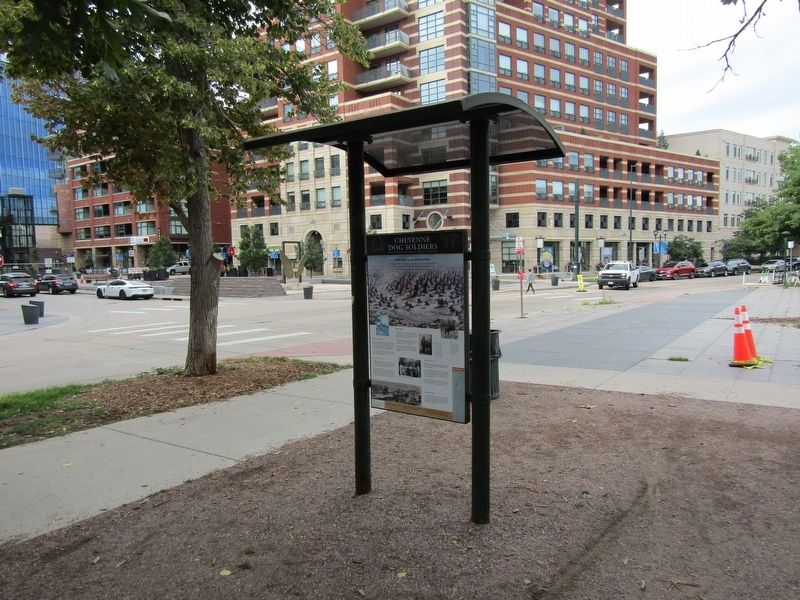
Photographed by Conrad Ward, August 26, 2024
2. Cheyenne Dog Soldiers Panel
Blood In The Valley
After the massacre, other military societies joined the Dog Soldiers in challenging the peace efforts of their chiefs. Military leaders, especially Dog Soldiers, stepped to the forefront of Cheyenne society.
By early 1865, the Dog Soldiers had assembled a force of 2,000 Cheyenne, Arapaho and Sioux warriors along the South Platte River. They launched a deadly attack on an army outpost and stage stop near Julesburg. That night began a reign of terror, as the Dog Soldiers captured wagon trains, destroyed telegraph lines and raided settlements up and down the Platte.
President Lincoln sent 8,000 troops to fight the Indian Wars. Within two years, war-weary Peace Chiefs signed the Medicine Lodge Treaty. The Cheyenne and Arapaho leaders who survived took their people to a bleak reservation in Oklahoma.
Honor In The End
The Dog Soldiers never regained their prominence as a separate political division of warriors. But they are still revered by the Cheyenne people today. Young Cheyenne men are still recruited into this respected soldier clan. During the 20th Century, Dog Soldiers served with honor in the United States military in two World Wars and in the conflicts in Korea, Vietnam and the Persian Gulf region.
Erected by Mayor's South Platte River Commission.
Topics. This historical marker is listed in these topic lists: Civil Rights • Indigenous Peoples and Communities • Wars, US Indian. A significant historical date for this entry is November 29, 1864.
Location. 39° 45.32′ N, 105° 0.293′ W. Marker is in Denver, Colorado, in Denver County. It is in Union Station. It is at the intersection of Little Raven Street and 16th Street, on the right when traveling south on Little Raven Street. The marker is located in Commons Park. Touch for map. Marker is in this post office area: Denver CO 80202, United States of America. Touch for directions.

Regionally, this marker is in the Front Range. It is also in the American Mountain West. Globally, it is in North America, the Rocky Mountains, the Western Hemisphere, the Western World, and the Anglosphere. Historically, it finds itself in what was once the Louisiana Purchase.
Other nearby markers. At least 8 other markers are within walking distance of this marker: Little Raven (here, next to this marker); Riverfront Park (within shouting distance of this marker); Union Station (within shouting distance of this marker); Commons Park (about 700 feet away, measured in a direct line); Confluence Park: Reclaiming Denver's Birthplace (approx. ¼ mile away); Trolley Town (approx. ¼ mile away); Denver Tramway Power Plant (approx. ¼ mile away); When the Depot Became a Station (approx. ¼ mile away). Touch for a list and map of all markers in Denver.
Also see . . . Sand Creek massacre (Wikipedia). (Submitted on February 15, 2025.)
Credits. This page was last revised on February 18, 2025. It was originally submitted on February 15, 2025, by Conrad Ward of Guilford, Connecticut. This page has been viewed 443 times since then and 135 times this year. Photos: 1, 2. submitted on February 15, 2025, by Conrad Ward of Guilford, Connecticut. • J. Makali Bruton was the editor who published this page.
