
Yorktown in York County, Virginia — The American South (Mid-Atlantic)
Admiral de Grasse, the French Navy and American Independence

Photographed by Brandon D Cross
1. Admiral de Grasse, the French Navy and American Independence Marker
The Global Context
"His Majesty, Sir, has entrusted me with the command of the naval forces which he has destined to protect his possessions in America and those of his allies in North America. The forces which I command, Sir, are sufficient to fulfill the offensive designs which it is in the interest of the Allied Powers to execute in order to bring about an honorable peace."
Admiral François Joseph Paul, Comte de Grasse' letter written from on board his flagship the 104-gun ship Ville-de-Paris, on March 29, 1781, reached General Jean-Baptiste Donatien de Vimeur, Comte de Rochambeau, in Providence, Rhode Island, on June 10, six weeks after de Grasse had reached Martinique on April 28. In the same letter he informed Washington that he could be in American waters by July 15 though would only stay until October 15. These lines bolstered General George Washington's hope that de Grasse offensive designs indicated an attack on New York City, the center of British political and military power in the United States. That was the decision Washington and Rochambeau had taken in the Conference at Wethersfield, Connecticut,
this page online
De Grasse sails to Virginia
In a letter of May 28, Rochambeau however hinted strongly that he would prefer the admiral to sail for Virginia rather than New York City. Knowing that his 74-gun ships could not cross the sand banks at the mouth of the Hudson River, de Grasse on July 28 decided to head for the Chesapeake. His letter reached allied headquarters in Westchester County, New York, on August 14. De Grasse had forced Washington's hand. Allied land forces would have to go wherever de Grasse took his fleet. On August 18, Washington and Rochambeau set out for Virginia.
De Grasse' fleet of 28 Ships of the Line and four frigates and two cutters set sail from Cap Français, today's Cap-Haïtien, in Haiti, on August 5. Their regular crews ranged from around 600 to almost 900 for a Ship of the Line. In addition, they carried 2,814 Line Infantry soldiers from 17 different regiments doing duty as marines. Rochambeau had requested additional troops and de Grasse had boarded the Câtinois, Agenois, and Touraine infantry regiments, a detachment from the Metz Artillery Regiment, and the Volontaires de St. Simon about 100

Photographed by Brandon D Cross
2. Admiral de Grasse, the French Navy and American Independence Marker
George Washington on board the Ville-de-Paris
Bienvenue, mon petit général - welcome, my little general!
This is how Admiral de Grasse, 6'4" tall, greeted General George Washington, at 6'2" also much taller than most of his contemporaries, as he boarded the Ville-de-Paris.
Though the greeting may be apocryphal, de Grasse heartily welcomed Washington in the morning of September 18, 1781. Washington, accompanied by the Comte de Rochambeau, the Chevalier de Chastellux and Generals Henry Knox and Presle Duportail had come to plead with de Grasse to stay beyond the deadline of October 15. Washington received the answer he had hoped for. De Grasse would stay until the end of October.
Battle of the Capes
Just as St. Simon's regiments were landing near Jamestown on September 5, the look-out on the frigate l'Aigrette spied Vice Admiral Thomas Graves'

Photographed by Evan Dwyer, August 7, 2025
3. Bust of Rear Admiral Francois Joseph Paul Comte de Grasse
Sculpted in 1981 by J. Kendetagi Orsolya, this bust is displayed in the Virginia Beach Surf & Rescue Museum.
As the French fleet struggled out of their anchorage, Graves wasted valuable time lining up his vessels. Thanks to Graves' maneuvering, de Grasse now had 24 ships and 1,794 cannons in his battle line versus 19 British ships with 1,410 guns when the battle commenced at 3:46 p.m. When Graves ordered fire to cease at 6:30 p.m., his 74-gun-ships Shrewsbury and Ajax were almost un-sailable, the Terrible had to be burned at sea. His fleet had suffered 336 casualties. The French side mourned around 230 casualties but the 74-gun-ships Diadème and Pluton and the 64-gun-ships Réfléchi and Caton needed extensive repairs.
For the next few days, de Grasse drifted to the southward pulling Graves with him. This opened the Chesapeake for Admiral jacques-Melchior Saint-Laurent, Comte de Barras' fleet from Newport with the siege artillery to enter. When de Grasse

Photographed by Evan Dwyer, April 4, 2024
4. Painting of The Battle of the Capes
This fantastic rendition of the battle that trapped Cornwallis hangs in the lobby of the Truist Bank Building in downtown Norfolk at 150 Water Street.
Departure
On October 19, British forces laid down their arms. De Grasse' chief administrative officer Lieutenant de Vaisseau Guillaume Jacques Constant de Liberge de Granchain represented the French Navy in the surrender negotiations. De Grasse never set foot on American soil. On November 4, his fleet sailed for the West Indies and anchored in Port Royal, today's Fort-de-France on Martinique, on November 25.
I consider myself infinitely happy to have been of some service to the United States... reserve me a place in your memory."
"Je me considère infiniment heureux d'avoir rendu service aux États-Unis ... réservez-moi une place dans votre mémoire."
- Admiral de Grasse to George Washington.
November 3, 1781
The Siege
The victory of September 5 established the siege ring on water. The landing of St. Simon's forces reenforced the lines
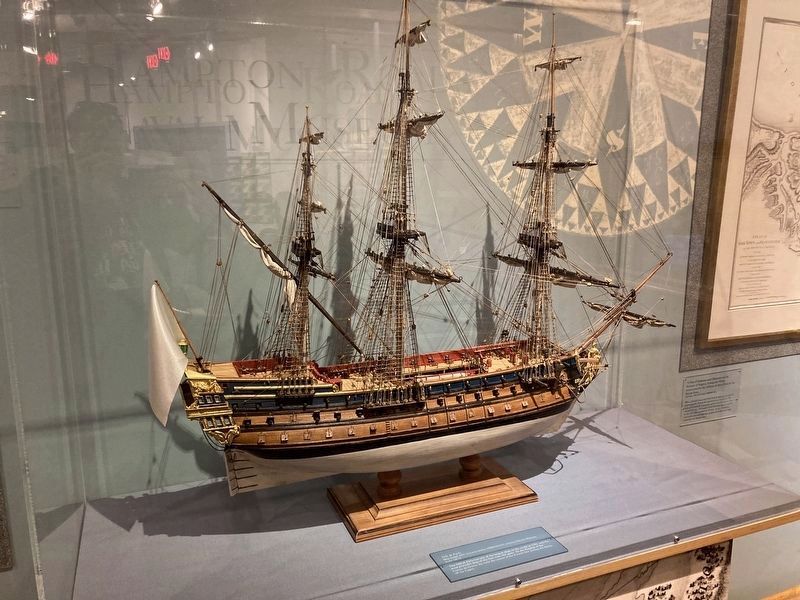
Photographed by Evan Dwyer, April 4, 2024
5. Admiral de Grasse's flagship, Ville de Paris
This model of de Grasse's flagship at the Battle of the Capes, mentioned in the marker as visited by George Washington, was built in 1957 by Leon Arnoux and is held in the collection of the Chrysler Museum in Norfolk. At the time this photo was taken, it was on loan for display at the Hampton Roads Naval Museum, also in Norfolk (within Nauticus).
The contributions of the French Navy made the victory at Yorktown possible.
1) It brought 3,000 troops under the Marquis de St. Simen to strengthen the siege lines in Yorktown
2) The victory on September 5 closed the siege ring on water and ended all hope of escape for Lord Cornwallis
3) It provided 800 men from its ship garrisons to Gloucester to strengthen the siege lines around Gloucester Point
4) It brought the majority of Rochambeau’s forces from Annapolis to Yorktown, allowing for an early start of the siege
5) It brought 1.2 million livres from Havana, allowing Washington to pay his Army before embarking at Elkton
(captions)
The Ville-de-Paris at its launch in De Grasse sails to Virginia January 1764
Americans were an immensely practical people as evidenced in the presents offered de Grasse upon his arrival in Virginia.
Recto of Robert Carter's and Richard H. Lee's proportion of present to De Grasse, circa 1775-6. Courtesy of Chicago History Museum, ICHi-176988-001
"Your Excellency will have observed that whatever efforts are made by the Land Armies, the Navy must have the casting vote in the present contest."
- George Washington to de Grasse, October 28, 1781
François Joseph Paul, Comte de Grasse (1723-1788) by Jean-Baptiste Mauzaisse, Château de Versailles
Admiral de Grasse (left) extends a handshake to General George Washington on board his flagship Ville-de-Paris, September 18, 1781, by Charles Cerny (1956)
Ville-de-Paris(front)
The victory in the Battle of the Capes provided Washington with the temporary naval superiority in a narrowly defined maritime area that he needed to force the surrender of Lord Cornwallis
Battle of the Capes, September 5, 1781 by Vladimir Zveg (1962). Hampton Roads Naval Museum, Norfolk, VA
De Grasse brought 1.2 million livres from Havana, allowing Washington to pay his army before embarking at Elkton
Carte 1781 - Carte imprimée, Paris, Esnauts et Rapilly Library of Congress Geography and Map Division Washington, D.C.
“I wish it was in my power to express to Congress, how much I feel myself indebted to the Count de Grasse and the Officers of the Fleet under his Command.”
— George Washington reporting the surrender of Lord Cornwallis to Congress, October 19, 1781
Erected 2022 by the American Society of Le Souvenir Français, Inc.
Topics. This memorial is listed in these topic lists: Colonial Era • War, US Revolutionary • Waterways & Vessels.
Location. 37° 14.341′ N, 76° 30.5′ W. Memorial is in Yorktown, Virginia, in York County. It can be reached from Water Street west of Buckner Street, on the right when traveling west. The marker is located along Yorktown’s Riverwalk. Touch for map. Memorial is at or near this postal address: 323 Water Street, Yorktown VA 23690, United States of America. Touch for directions.

Regionally, this memorial is on Virginia’s Peninsula, in Coastal Virginia, and in the Hampton Roads Metropolitan Area. It is also in the American South, specifically in the Upper South, in the Tidewater, and on the Eastern Seaboard. Globally, it is in the North Atlantic Region, North America, the Western Hemisphere, the Western World, and the Anglosphere. Historically, it finds itself in what was once the territory of the Mississippian Culture, one of the original Thirteen Colonies, one of the Confederate States of America, and the Antebellum South.
Other nearby markers. At least 8 other markers are within walking distance of this marker: The Olympic Flame (a few steps from this marker); Replica Cannon (a few steps from this marker); Converging on Yorktown (a few steps from this marker); Heavy Artillery at Yorktown (a few steps from this marker); Wars & Yorktown (a few steps from this marker); Lafayette’s Tour (within shouting distance of this marker); N.S. Savannah (within shouting distance of this marker); Nick's Seafood Pavilion (within shouting distance of this marker). Touch for a list and map of all markers in Yorktown.
Also see . . .
1. Comte de Grasse. (Submitted on February 16, 2025, by Brandon D Cross of Flagler Beach, Florida.)
2. François Joseph Paul de Grasse. Wikpedia (Submitted on January 15, 2026, by Luke Toussaint of Glenview, Illinois.)
Credits. This page was last revised on April 22, 2026. It was originally submitted on February 16, 2025, by Brandon D Cross of Flagler Beach, Florida. This page has been viewed 570 times since then and 131 times this year. Last updated on November 28, 2025, by Thierry Chaunu of New York, New York. Photos: 1, 2. submitted on February 16, 2025, by Brandon D Cross of Flagler Beach, Florida. 3, 4, 5. submitted on April 18, 2026, by Evan Dwyer of Richmond, Virginia. • Devry Becker Jones was the editor who published this page.
