North Shore in Duluth in Saint Louis County, Minnesota — The American Midwest (Upper Plains)
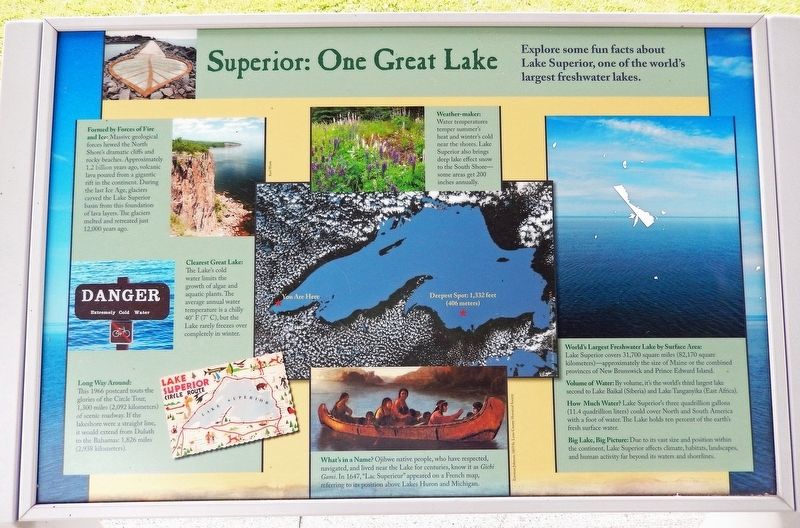
Superior: One Great Lake
Explore some fun facts about Lake Superior, one of the World's largest freshwater lakes.
Photographed by Cosmos Mariner, June 24, 2024
1. Superior: One Great Lake Marker
Formed by Forces of Fire and Ice:
Massive geological forces hewed the North Shore's dramatic cliffs and rocky beaches. Approximately 1.2 billion years ago, volcanic lava poured from a gigantic rift in the continent. During the last Ice Age, glaciers carved the Lake Superior basin from this foundation of lava layers. The glaciers melted and retreated just 12,000 years ago.
Clearest Great Lake:
The Lake's cold water limits the growth of algae and aquatic plants. The average annual water temperature is a chilly 40° F (7° C), but the Lake rarely freezes over completely in winter.
Long Way Around:
This 1966 postcard touts the glories of the Circle Tour, 1,300 miles (2,092 kilometers) of scenic roadway. If the lakeshore were a straight line, it would extend from Duluth to the Bahamas: 1,826 miles (2,938 kilometers).
Weather-maker:
Water temperatures temper summer’s heat and winter’s cold near the shores. Lake Superior also brings deep lake effect snow to the South Shore — some areas get 200 inches annually.
What's in a Name?
Ojibwe native people, who have respected, navigated, and lived near the Lake for centuries, know it as Gichi Gami.
this page online
World's Largest Freshwater Lake by Surface Area:
Lake Superior covers 31,700 square miles (82,170 square kilometers) — approximately the size of Maine or the combined provinces of New Brunswick and Prince Edward Island.
Volume of Water:
By volume, it's the world's third largest lake second to Lake Baikal (Siberia) and Lake Tanganyika (East Africa).
How Much Water?
Lake Superior's three quadrillion gallons (11.4 quadrillion liters) could cover North and South America with a foot of water. The Lake holds ten percent of the earth's fresh surface water.
Big Lake, Big Picture:
Due to its vast size and position within the continent, Lake Superior affects climate, habitats, landscapes, and human activity far beyond its waters and shorelines.
Topics. This historical marker is listed in these topic lists: Environment • Indigenous Peoples and Communities • Waterways & Vessels.
Location. 46° 52.875′ N, 91° 55.13′ W. Marker is in Duluth, Minnesota, in Saint Louis County. It is in North
Photographed by Cosmos Mariner, June 24, 2024
2. Superior: One Great Lake Marker
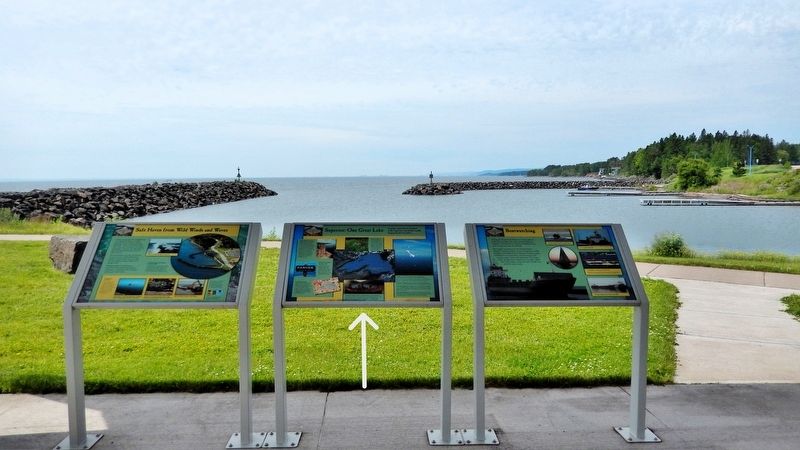
This is the center one of three panels on the north side of the McQuade Small Craft Harbor interpretive kiosk. The harbor is visible in the background.

Regionally, this marker is in the Arrowhead Region and in the Iron Range. It is also in the American Midwest and in the Corn Belt. Globally, it is in North America, in the Great North Woods, on the Great Lakes, in the Western Hemisphere, in the Western World, and in the Anglosphere. Historically, it finds itself in what was once the Viceroyalty of New France, Rupert’s Land, the territory of the Mississippian Culture, and the Northwest Territory.
Other nearby markers. At least 8 other markers are within 7 miles of this marker, measured as the crow flies: Boatwatching (here, next to this marker); Safe Haven from Wild Winds and Waves (here, next to this marker); Commercial Fishing (here, next to this marker); Highway 61: Road to Tourism
Photographed by Cosmos Mariner, June 24, 2024
3. McQuade Small Craft Harbor Interpretive Kiosk
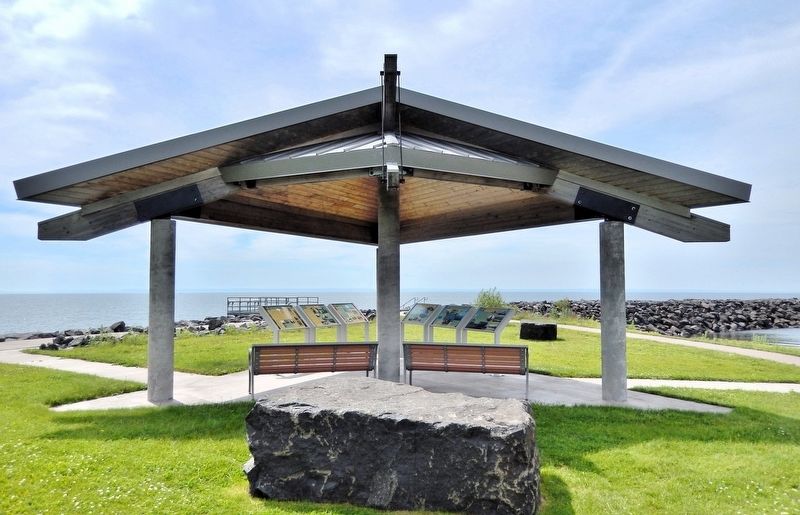
The interpretive kiosk is on the south side of North Shore Drive, overlooking Lake Superior. Access to the kiosk is from the parking lot on the north side of North Shore Drive. There is a pedestrian access tunnel under the highway. This is the 2nd from the right of six interpretive panels in the kiosk.
Also see . . . Lake Superior (Wikipedia).
Excerpt: The first people came to the Lake Superior region 10,000 years ago after the retreat of the glaciers in the Last Glacial Period. They are known as the Plano, and they used stone-tipped spears to hunt caribou on the northwestern side of Lake Minong. The Shield Archaic peoples arrived around 5000 BC; evidence of this culture can be found at the eastern and western ends of the Canadian shore. They used bows and arrows, paddled dugout canoes, fished, hunted, mined copper for tools and weapons, and established trading networks. They are believed to be the direct ancestors of the Ojibwe and Cree. The people of the Laurel complex (c. 500 BC to AD 500) developed seine net fishing, evidence being found at rivers around Superior such as the Pic and Michipicoten. The people of the Terminal Woodland period were evident in the area from AD 900 to 1650. They were Algonquian peoples who hunted, fished and gathered berries. They used snowshoes, birch bark canoes and conical or domed lodges. The Anishinaabe people (an ethnic grouping including the Ojibwe/Chippewa) have inhabited the Lake Superior region for over five hundred years and were preceded by the Dakota, Meskwaki (Fox), Menominee, Nipigon, Noquet and Gros Ventres. After the arrival of Europeans, the Anishinaabe made themselves middle-men between the French fur traders and other Native peoples. They soon became the dominant Native American nation in the region: they forced out the Sioux and Fox and won a victory against the Iroquois west of Sault Ste. Marie in 1662. By the mid-18th century, the Ojibwe occupied all of Lake Superior's shores.(Submitted on February 23, 2025, by Cosmos Mariner of Cape Canaveral, Florida.)
Credits. This page was last revised on February 23, 2025. It was originally submitted on February 23, 2025, by Cosmos Mariner of Cape Canaveral, Florida. This page has been viewed 170 times since then and 23 times this year. Photos: 1, 2, 3. submitted on February 23, 2025, by Cosmos Mariner of Cape Canaveral, Florida.
