Walker in Cass County, Minnesota — The American Midwest (Upper Plains)
The Battle of Sugar Point

Photographed by Cosmos Mariner, June 26, 2024
1. The Battle of Sugar Point Marker
Story adopted from "On This Day In History: The Battle of Sugar Point" by Kayla Duoos, Leech Lake News, Oct. 5, 2020
On the early Wednesday morning of October 5th, 1898, a handful of young Pillager Ojibwe men held off approximately 100 U.S. soldiers on the shores of Sugar Point. The firefight resulted in seven dead and ten wounded with no casualties reported on the Ojibwe side. The soldiers were eventually forced to retreat to Walker, MN. This event has come to be recognized as the last military conflict between the U.S. and American Indians.
The tensions that led to the Battle of Sugar Point were varied. Lumber companies routinely swindled the Ojibwe people out of large amounts of money through unscrupulous practices. Mistreatment and injustices at the hands of U.S. Marshals and other agents also played a large role. Kickback schemes abounded between these federal agents and local hotel and railroad men, who were paid by the U.S. Government each time a witness or defendant was brought before the court in Duluth. Ojibwe were routinely rounded up and brought to Duluth on false charges to line the pockets of those involved
this page online
Delayed timber payments and consistent arrests in weak, unsubstantiated bootlegging cases eventually led the leaders of the Pillager tribe to send a letter to the U.S. Government asking them to look into the on-going injustices the tribe was facing.
“We, the undersigned chiefs and headmen of the Pillager band of Chippewa Indians of Minnesota, respectfully represent that our people are carrying a heavy burden, and in order that they may not be crushed by it, we humbly petition you to send a commission, to investigate the existing troubles here.The letter went unacknowledged by the U.S. Government, furthering the poor relationship between the tribe and U.S. officials.
The Chippewa Indians of Minnesota have always been loyal to the United States and friendly to the whites, and they desire this friendship to be perpetual.
We now have only the pine lands of our reservations for our future subsistence and support, but the manner in which we are being defrauded out of these has alarmed us. We trust that you will protect us when the truth reaches you.”
Bug-O-Nay-Ge-Shig (Hole-In-The-Day) was an elder Pillager man and one of the
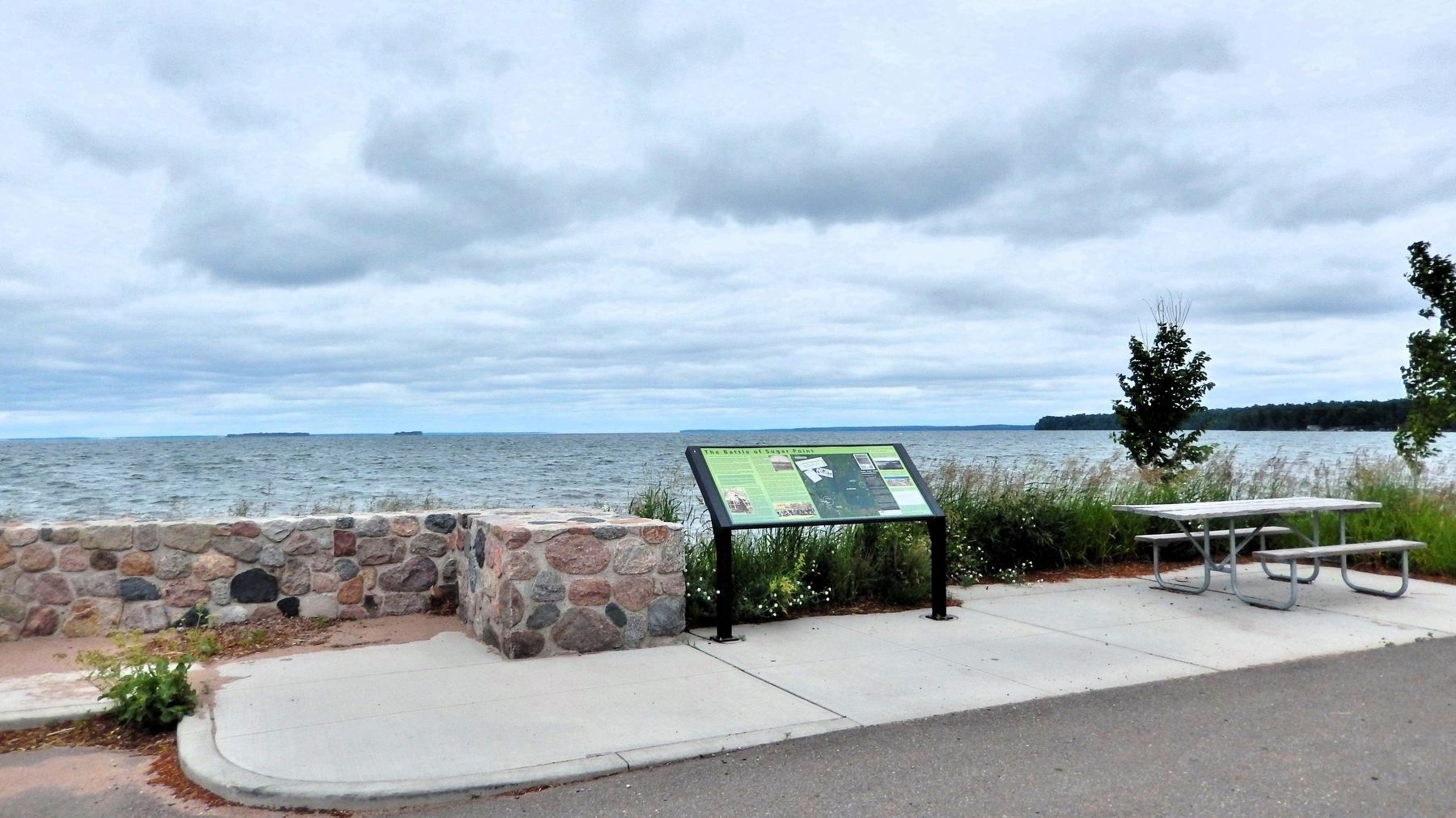
Photographed by Cosmos Mariner, June 26, 2024
2. The Battle of Sugar Point Marker
Looking northeast from the Whipholt Roadside Parking Area; Leach Lake is in the background.
Released due to insufficient evidence, Bug-O-Nay-Ge-Shig was left to make the 135-mile journey home on his own accord. After being thrown off multiple trains, he walked the last 40 miles home in his moccasins, wearing them down to his bare feet. He swore then he would never allow himself to be arrested ever again, lest he may perish on his next forced journey home.
When Bug-O-Nay-Ge-Shig was called as a witness for another bootlegging case a few months later, he ignored the U.S. Marshals warrant. He was then detained along with Sha-Boon-Day-Shkong, another Pillager man, when they went to collect their annuity payments in Onigum. Bug-O-Nay-Ge-Shig called out for help. The other Ojibwe, hearing his pleas, surrounded, and gently, yet forcefully, secured his release.
The army officials in charge told a tale of how they were surrounded by over 200 warriors and attacked, when in reality it was a small group of Pillager band members. Reportedly, less than 20 people, mostly
Photographed by Cosmos Mariner, June 26, 2024
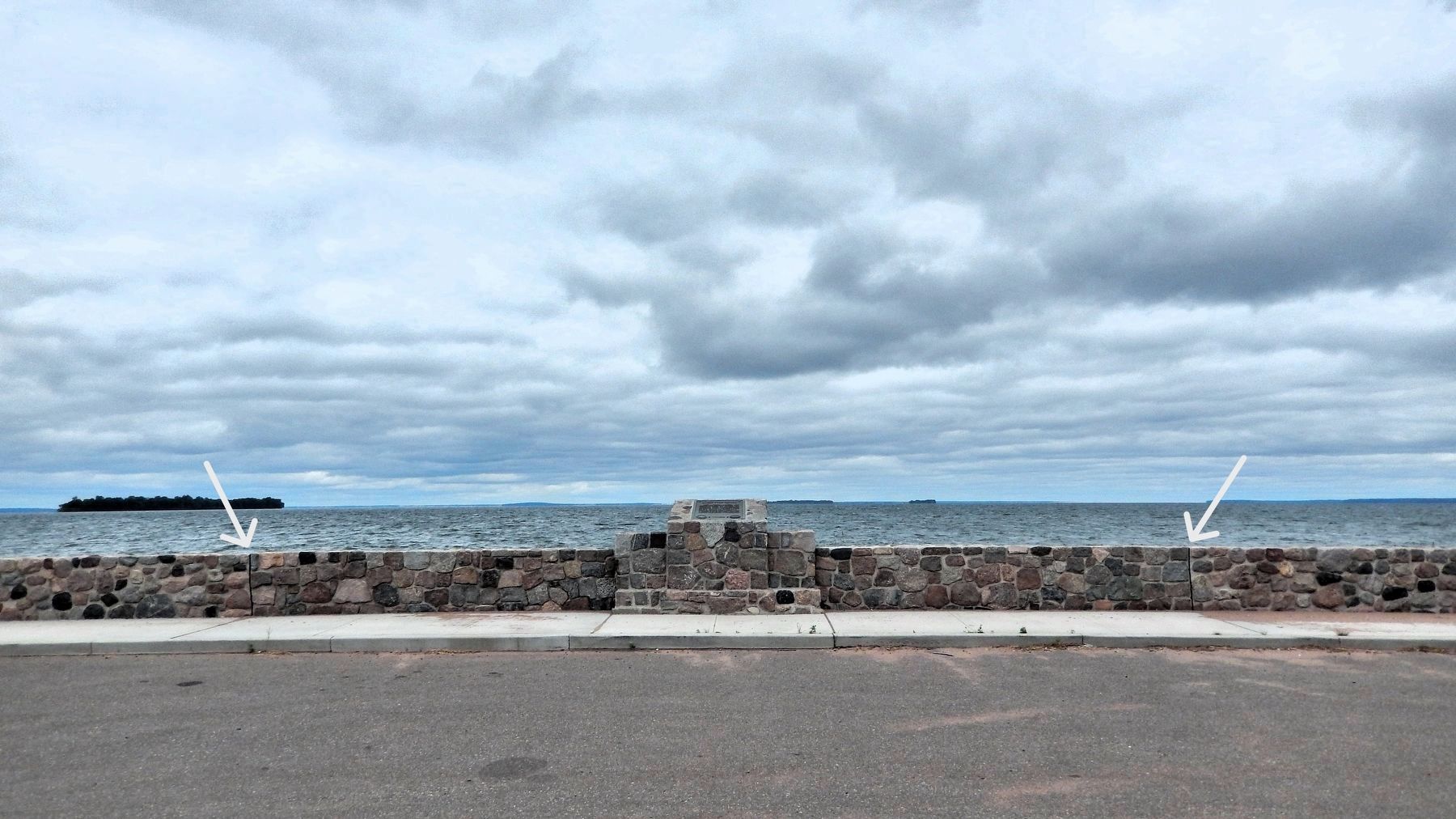
3. Whipholt Roadside Parking Area Rock Wall
Looking north; Leech Lake is in the background. The Sugar Point Battle historical marker is at the center. The white arrows mark the transition from 1941 Civilian Conservation Corps stonework to 1951 Minnesota Highway Department stonework on the west [left] and east [right] ends of the rock wall.
Once the U.S. Army received word of the escape, they put out wanted notices for those involved and requested an additional 77 soldiers from Fort Snelling.
On the morning of the battle the soldiers departed Walker by boat and arrived at Sugar Point that afternoon. After failing to find Bug-O-Nay-Ge-Shig, the army set up base camp.
How the battle began has often been disputed. The Pillager have held that the soldiers began firing on a canoe containing two women and a child as it rounded the corner of Sugar Point. The military claims that a rifle was accidentally discharged towards the Ojibwe side. Regardless, an intense firefight between the two sides erupted.
The battle continued into the night and no Ojibwe were injured outside of Indian Officer Gay-Gway-Day-Be-Tung (George Russell), who was allegedly shot by mistake by a soldier who assumed he was with the Pillagers. Six U.S. soldiers were killed and ten wounded that night.
On the morning of October 7, 1898, the soldiers retreated, battered, hungry and cold. Once back to safety in Walker, the commanding officer, General Bacon, was quoted
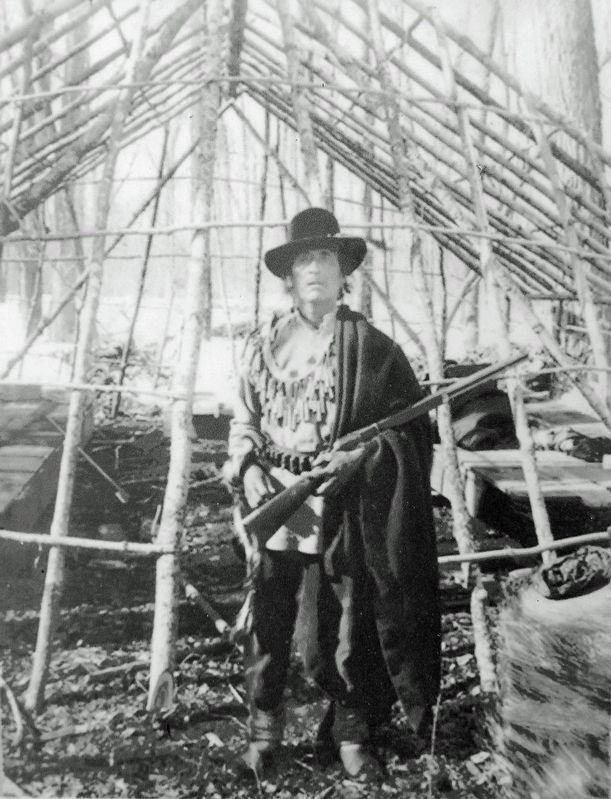
Minnesota Historical Society
4. Marker detail: Bug-O-Nay-Ge-Shig
Once word of the battle spread, hysteria ran rampant in the surrounding areas that an "Indian Uprising" was coming. Additional troops were sent, and outcries to the U.S. Government for assistance and protection were pouring in from the non-native people in Minnesota. Memories of Custer's defeat at Little Big Horn, just 22 years prior in 1876, led newspapers to run wild with unsubstantiated headlines. After several weeks the tensions in the region eased, but the relationship between the Ojibwe and their non-native neighbors was never the same.
With attention turned towards Leech Lake, the U.S. Government was forced to hear the grievances of the Ojibwe people. Ultimately, several Pillagers turned themselves in for warrants related to Bug-O-Nay-Ge-Shig's escape, although the man himself kept his pledge and was never tried or jailed again. Most served between two to six months, and everyone involved received a full pardon from President McKinley a short time after.
Further investigations revealed the damage that had been done to the
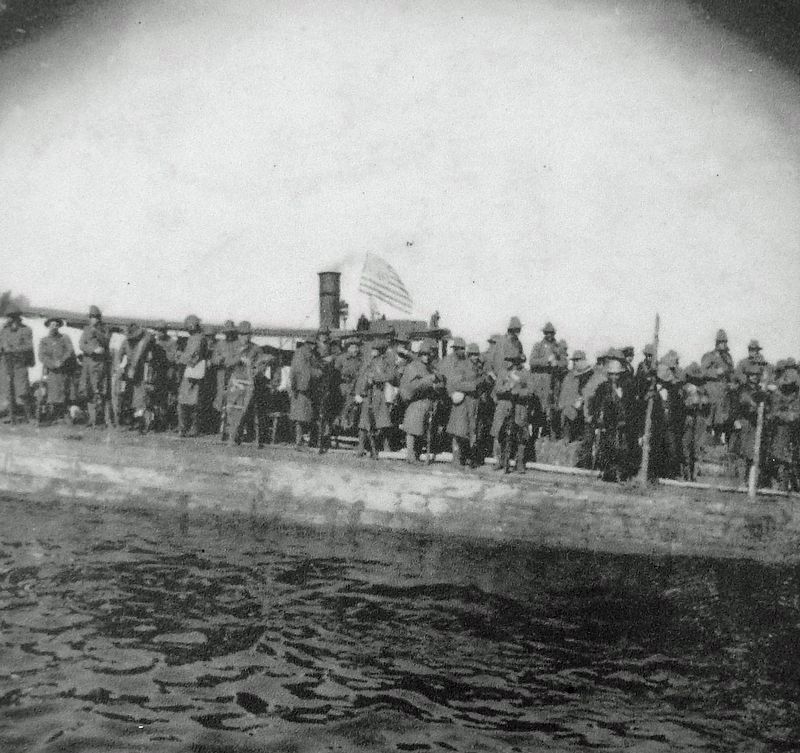
Minnesota Historical Society
5. Marker detail: Federal Troops Preparing for Launch near Walker
None of the Pillagers who engaged in battle at Sugar Point ever were tried or received punishment for their involvement. Bug-O-Nay-Ge-Shig went on to live another 18 years in the area before passing peacefully. The U.S. Army never returned to the shores of Sugar Point on Leech Lake, the site of their final battle and defeat in the period now known as the “Indian Wars.”
[group photo caption] Local students gather at Sugar Point to commemorate the anniversary of the battle.
[sidebar] Sugar Point Battle Historical Marker
The plaque at this site reads:
Why does the plaque here focus on the Battle at Sugar Point, which is across the lake?Sugar Point Battle When a Federal Marshal with about 100 troops of the 3rd Infantry tried to arrest the Chippewa chief Bugonaygeshig at Sugar Point opposite here on the northeast shore of the lake, a sharp fight occurred October 5, 1898. The whites lost 7 killed and 16 wounded and the arrest was never accomplished.
This battle was
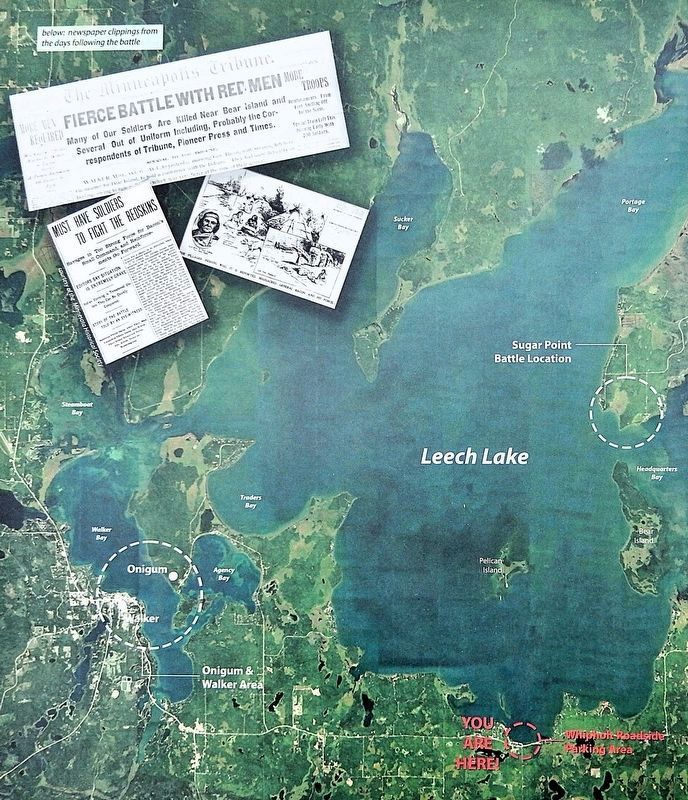
6. Marker detail: Leech Lake Map
It is not known if the site or the memorial idea came first. This roadside parking area was perhaps the closest memorial site available at the time the historians thought to mark it. Or, it could be that having selected this site, it was the most historically significant event that could be determined in the nearby vicinity.
Regardless of why the battle is marked at this location, as you look across the lake, you can see Bear Island, but Sugar Point is not actually visible from here!
[sidebar] Whipholt Roadside Parking Area
Construction of this rest area was begun in 1941 by the Leech Lake Civilian Conservation Corps (CCC) Camp, but was stopped when WWII began in 1942 and most men enlisted in the war. It was completed around 1951 by Minnesota Highway Department (now the Minnesota Department of Transportation) workers.
If you look closely, you can see a vertical joint running through the wall about 20 feet from either side of the plaque where the new workers took up the project. The shapes of the stones are quite different. The CCC masons' work appears more highly skilled as the stones in their portion of the wall are more carefully shaped and closely spaced.
The original plans for the site were much more complex. The plans included rounded stairs at each end of the wall leading down to the lakeshore, looking a bit like towers.
The site was designed by Arthur R. Nichols, a prominent landscape architect who designed many roadside areas, state parks, university campuses, and the Minnesota State Capitol Mall. It may be the last site built for the Minnesota Highway Department during the Depression Era using Federal Relief Programs to employ and train local workers for trades.
A rehabilitation of the site was completed in 2020.
For more information about this and other Historic Roadside Properties throughout Minnesota,
please visit: mndot.gov/roadsides/historic
Erected by Minnesota Department of Transportation.
Topics and series. This historical marker is listed in these topic lists: Charity & Public Work • Indigenous Peoples and Communities • Law Enforcement • Wars, US Indian. In addition, it is included in the Civilian Conservation Corps (CCC), and the Former U.S. Presidents: #25 William McKinley series lists. A significant historical date for this entry is October 5, 1898.
Location. 47° 3.007′ N, 94° 21.413′ W. Marker is in Walker, Minnesota, in Cass County. It is on Whipholt Beach Road (Maple Leaf Drive) (State Highway 200) 0.4 miles east of 16th Avenue (Pine Lake Road) (County Road 2108), on the left when traveling east. The marker is located in the Whipholt Roadside Parking Area, overlooking Leach Lake to the north. Touch for map. Marker is in this post office area: Walker MN 56484, United States of America. Touch for directions.

Regionally, this marker is in the Northland. It is also in the American Midwest, in the Corn Belt, and in the Great River Road Region. Globally, it is in North America, the Great North Woods, the Western Hemisphere, the Western World, and the Anglosphere. Historically, it finds itself in what was once Rupert’s Land, the territory of the Mississippian Culture, and the Northwest Territory.
Other nearby markers. At least 3 other markers are within 12 miles of this marker, measured as the crow flies: Sugar Point Battle (a few steps from this marker); Gaa-zagaskwaajimekaag (within shouting distance of this marker); Lucette Diana Kensack (approx. 11.4 miles away).
Related markers. Click here for a list of markers that are related to this marker. The Battle of Sugar Point
Credits. This page was last revised on July 13, 2025. It was originally submitted on February 23, 2025, by Cosmos Mariner of Cape Canaveral, Florida. This page has been viewed 636 times since then and 161 times this year. Photos: 1, 2. submitted on February 24, 2025, by Cosmos Mariner of Cape Canaveral, Florida. 3. submitted on February 25, 2025, by Cosmos Mariner of Cape Canaveral, Florida. 4, 5, 6. submitted on February 24, 2025, by Cosmos Mariner of Cape Canaveral, Florida.
