Fish House Replica
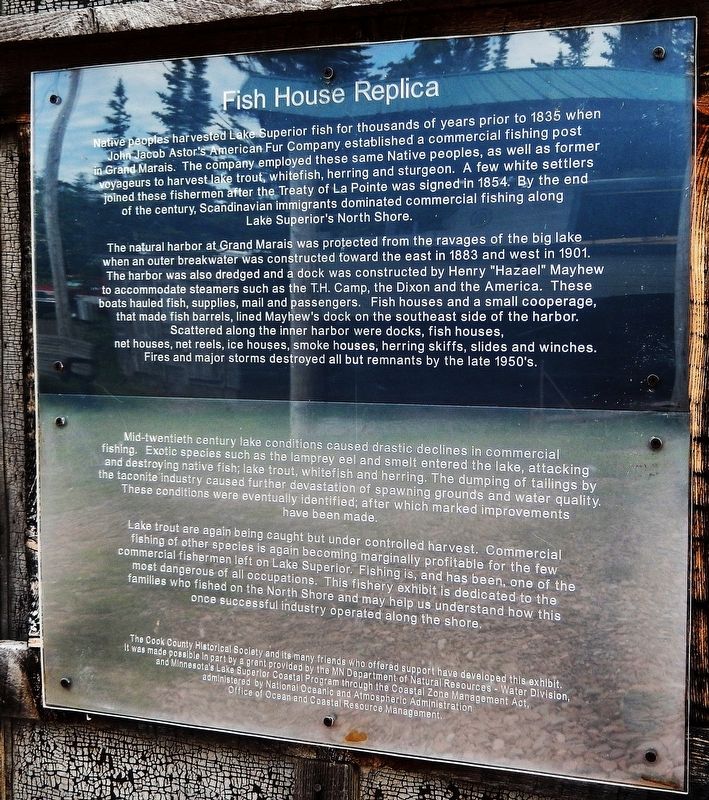
Native peoples harvested Lake Superior fish for thousands of years prior to 1835, when John Jacob Astor's American Fur Company established a commercial fishing post in Grand Marais. The company employed these same Native peoples, as well as former voyageurs to harvest lake trout, whitefish, herring and sturgeon. A few white settlers joined these fishermen after the Treaty of La Pointe was signed in 1854. By the end of the century, Scandinavian immigrants dominated commercial fishing along Lake Superior's North Shore.
The natural harbor at Grand Marais was protected from the ravages of the big lake when an outer breakwater was constructed toward the east in 1883 and-west in 1901. The harbor was also dredged and a dock was constructed by Henry "Hazael" Mayhew to accommodate steamers such as the T.H. Camp, the Dixon and the America. These boats hauled fish, supplies, mail and passengers. Fish houses and a small cooperage, that made fish barrels, lined Mayhew's dock on the southeast side of the harbor. Scattered along the inner harbor were docks, fish houses, net houses, net reels, ice houses, smoke houses, herring skiffs,
this page online
Mid-twentieth century lake conditions caused drastic declines in commercial fishing. Exotic species such as the lamprey eel and smelt entered the lake, attacking and destroying native fish: lake trout, whitefish and herring. The dumping of tailings by the taconite industry caused further devastation of spawning grounds and water quality. These conditions were eventually identified; after which marked improvements have been made.
Lake trout are again being caught but under controlled harvest. Commercial fishing of other species is again becoming marginally profitable for the few commercial fishermen left on Lake Superior. Fishing is, and has been, one of the most dangerous of all occupations. This fishery exhibit is dedicated to the families who fished on the North Shore and may help us understand how this once successful industry operated along the shore.
The Cook County Historical Society and its many friends who offered support have developed this exhibit. It was made possible in part by a grant provided by the MN Department of Natural Resources - Water Division, and Minnesota's Lake Superior Coastal Program through the Coastal Zone Management Act, administered by National Oceanic and Atmospheric Administration Office of Ocean and Coastal Resource Management.
Topics.
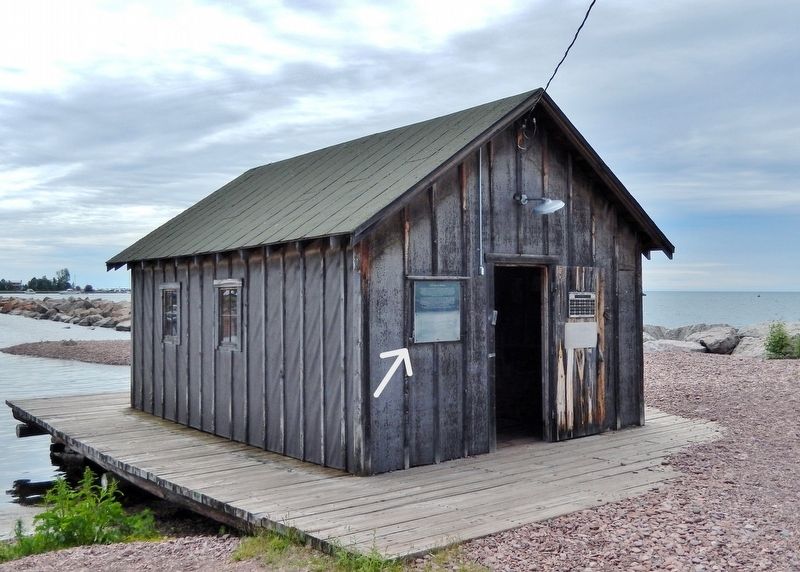
Location. 47° 44.868′ N, 90° 20.55′ W. Marker is in Grand Marais, Minnesota, in Cook County. It can be reached from South 8th Avenue West 0.2 miles south of Voyageur Highway (State Highway 61), on the left when traveling south. The marker is mounted at eye-level on the front/west side of the Fish House Replica located on the beach at the Grand Marais Campground & Marina. Touch for map. Marker is at or near this postal address: 114 South 8th Avenue West, Grand Marais MN 55604, United States of America. Touch for directions.

Regionally, this marker is on the Boundary Waters Canoe Area Wilderness, in the Arrowhead Region, in the Iron Range, and in the North Shore. It is also in the American Midwest and in the Corn Belt. Globally, it is in North America, in the Great North Woods, on the Great Lakes, on Lake Superior’s North Shore, in the Western Hemisphere, in the Western World, and in the Anglosphere. Historically,
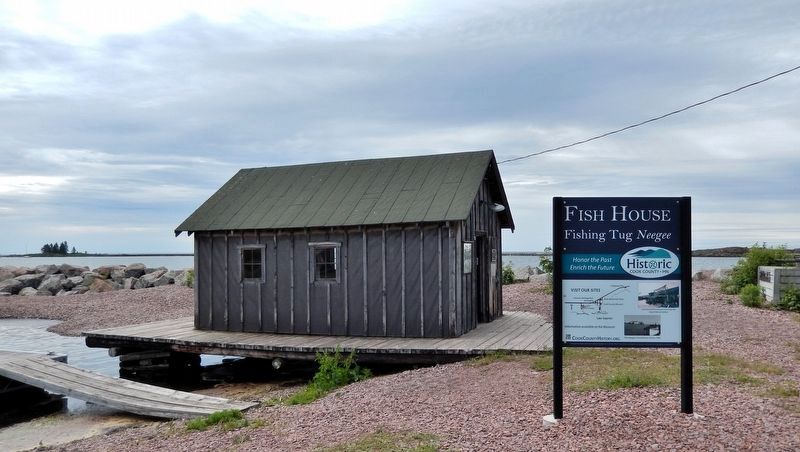
Other nearby markers. At least 8 other markers are within walking distance of this marker: The NEEGEE (here, next to this marker); The Fishing Tug NeeGee (a few steps from this marker); Smokehouse (a few steps from this marker); George Morrison (about 600 feet away, measured in a direct line); Geology of Minnesota (approx. ¼ mile away); The Grand Marais Harbor (approx. ¼ mile away); Pulpwood Rafting (approx. 0.4 miles away); a different marker also named Grand Marais Harbor (approx. 0.4 miles away). Touch for a list and map of all markers in Grand Marais.
Also see . . . American Fur Company Fishing on Lake Superior, 1835–1841. MNopedia website entry:
(Creator: Thomas K. Backerud) Excerpt: In 1834, the American Fur Company established a commercial fishing operation on Lake Superior to supplement the company's profits. The financial panic of 1837 doomed the operation and the company declared bankruptcy in 1842. Commercial fishermen did not have a significant presence(Submitted on March 3, 2025, by Cosmos Mariner of Cape Canaveral, Florida.)on Lake Superior again until the Duluth fishing boom in the 1870s.Photographed by Cosmos Mariner, June 22, 20244. Fish House ReplicaA typical fisherman for the American Fur Company earned approximately 150-300 dollars per year. The fishermen spent the year in small log cabins in various camps around the lake. Fish such as lake trout and whitefish were caught in nets near shore. One of the most productive sites was along the west coast of Lake Superior between Grand Marais and the Pigeon River. Trout came near the shore in late August to spawn. Whitefish showed up in autumn and stayed through November. This was the peak of the fishing season. The men spent much of the winter packing and salting their catch.
The American Fur Company's Lake Superior fisheries reached the peak of production in 1839. The interests of the company were hit hard after the financial panic of 1837. The panic caused a prolonged economic recession. The market for Lake Superior fish had evaporated by 1841.
Credits. This page was last revised on March 5, 2025. It was originally submitted on March 3, 2025, by Cosmos Mariner of Cape Canaveral, Florida. This page has been viewed 158 times since then and 25 times this year. Photos: 1, 2, 3, 4. submitted on March 3, 2025, by Cosmos Mariner of Cape Canaveral, Florida.
