Clear Springs in Citrus County, Florida — The American South (South Atlantic)
Remembering the Dead
Crystal River Archaeological State Park
Photographed by Brandon D Cross
1. Remembering the Dead Marker
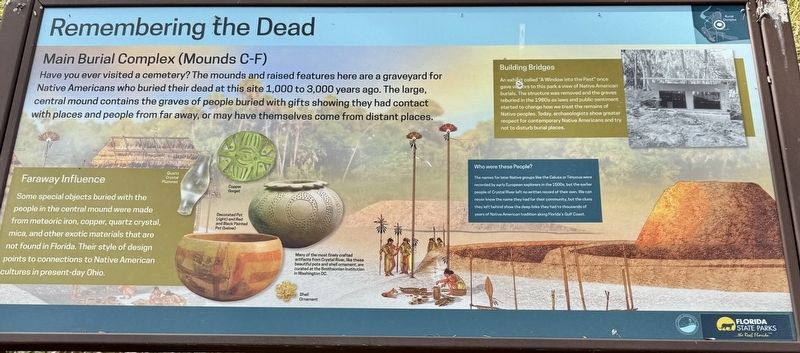
Main Burial Complex (Mounds C-F)
Have you ever visited a cemetery? The mounds and raised features here are a graveyard for Native Americans who buried their dead at this site 1,000 to 3,000 years ago. The large, central mound contains the graves of people buried with gifts showing they had contact with places and people from far away, or may have themselves come from distant places.
Faraway Influence
Some special objects buried with the people in the central mound were made from meteoric iron, copper, quartz crystal, mica, and other exotic materials that are not found in Florida. Their style of design points to connections to Native American cultures in present-day Ohio.
Building Bridges
An exhibit called "A Window into the Past" once gave visitors to this park a view of Native American burials. The structure was removed and the graves reburied in the 1980s as laws and public sentiment started to change how we treat the remains of Native peoples. Today, archaeologists show greater respect for contemporary Native Americans and try not to disturb burial places.
Who were these People?
The names
this page online
(captions)
Quartz Crystal Plummet
Copper Gorget
Decorated Pot (right) and Red and Black Painted Pot (below)
Many of the mact finely crafted artifacts from Crystal River like these beautiful pots and shell ornament are curated at the Smithsonian Institution in Washington DC
Shell Ornament
Erected by Florida Humanities Council and the National Endowment for the Humanities.
Topics. This historical marker is listed in these topic lists: Anthropology & Archaeology • Cemeteries & Burial Sites • Indigenous Peoples and Communities.
Location. 28° 54.525′ N, 82° 37.637′ W. Marker is in Clear Springs, Florida, in Citrus County. It can be reached from North Museum Point 0.1 miles
Photographed by Brandon D Cross
2. Remembering the Dead Marker

Regionally, this marker is on the Gulf Coast. It is also in the American South and on the Gulf Coast. Globally, it is in the North Atlantic Region, North America, a Gulf of Mexico state, the Western Hemisphere, the Western World, and the Anglosphere. Historically, it finds itself in what was once New Spain, the territory of the Mississippian Culture, one of the Confederate States of America, and the Antebellum South.
Other nearby markers. At least 8 other markers are within 3 miles of this marker, measured as the crow flies: Mystery in Stone (within shouting distance of this marker); A Separate Resting Place (about 400 feet away, measured in a direct line); Watery World (about 500 feet away); Temple or Stage? (about 500 feet away); A Place to Call Home (about 500 feet away); A View from the Top (about 500 feet away); Crystal River: An Enduring Legacy (about 500 feet away); Kings Bay Park (approx. 2.1 miles away).
Also see . . .
1. Crystal River Archaeological State Park. (Submitted on March 6, 2025, by Brandon D Cross of Flagler Beach, Florida.)
2. Crystal River Archaeological State Park. (Submitted on March 6, 2025, by Brandon D Cross of Flagler Beach, Florida.)
Credits. This page was last revised on March 8, 2025. It was originally submitted on March 6, 2025, by Brandon D Cross of Flagler Beach, Florida. This page has been viewed 190 times since then and 41 times this year. Photos: 1, 2. submitted on March 6, 2025, by Brandon D Cross of Flagler Beach, Florida. • Andrew Ruppenstein was the editor who published this page.
