Norwich in Southeastern Region, Connecticut — The American Northeast (New England)
Yantic Cemetery
Photographed by Conrad Ward, October 20, 2024
1. Yantic Cemetery Marker
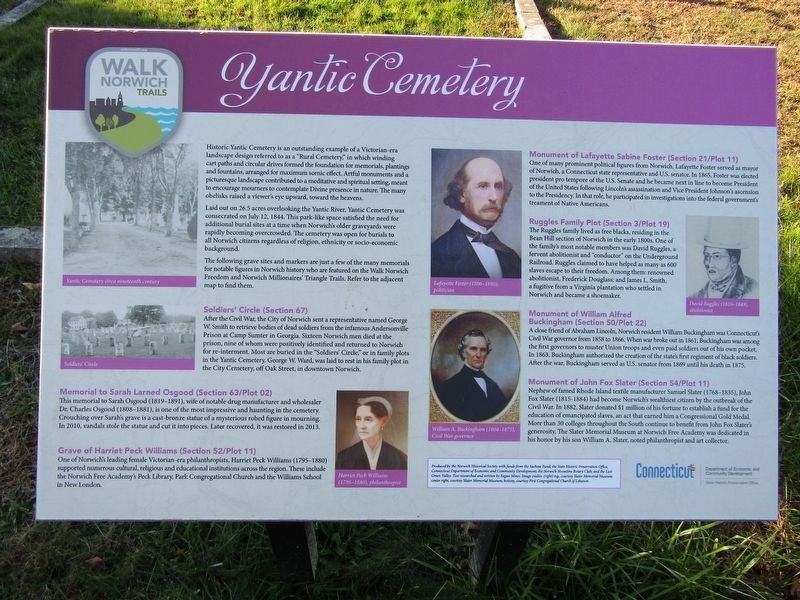
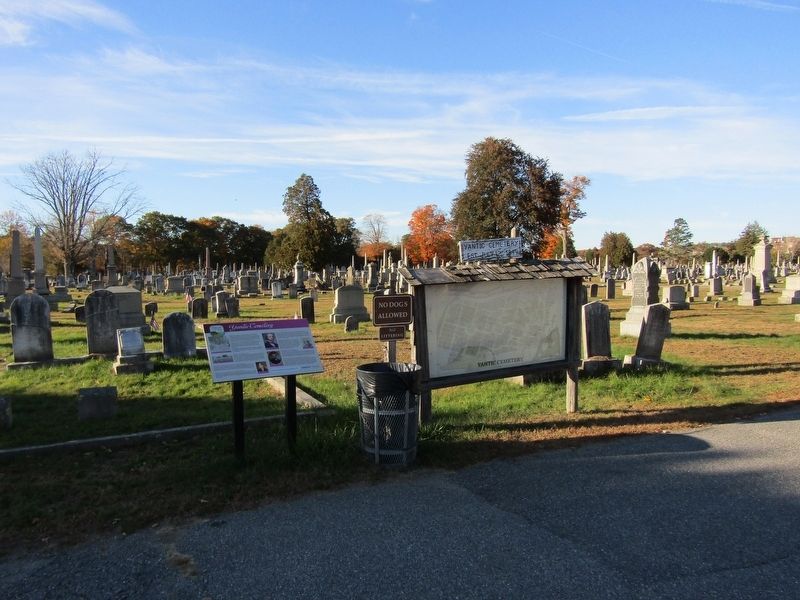
Historic Yantic Cemetery is an outstanding example of a Victorian-era landscape design referred to as a "Rural Cemetery," in which winding cart paths and circular drives formed the foundation for memorials, plantings and fountains, arranged for maximum scenic effect. Artful monuments and a picturesque landscape contributed to a meditative and spiritual setting, meant to encourage mourners to contemplate Divine presence in nature. The many obelisks raised a viewer's eye upward, toward the heavens.
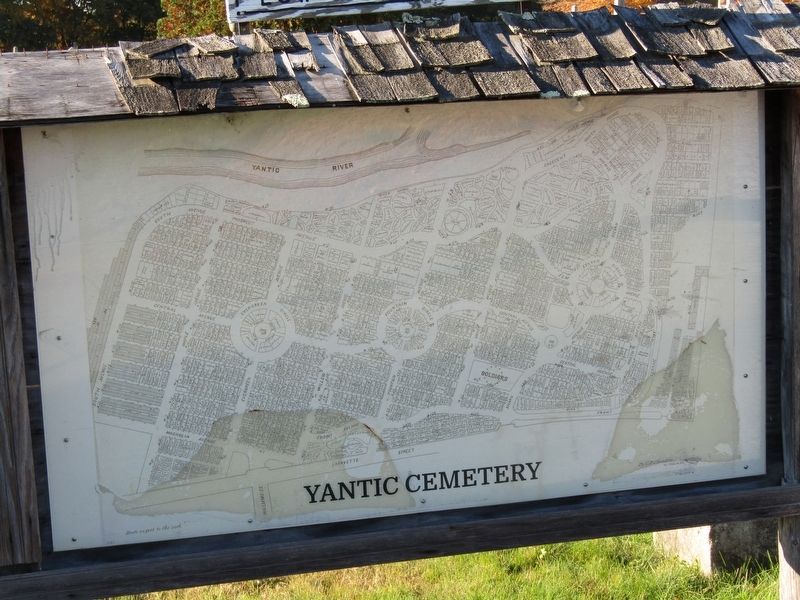
Laid out on 26.5 acres overlooking the Yantic River, Yantic Cemetery was consecrated on July 12, 1844. This park-like space satisfied the need for additional burial sites at a time when Norwich's older graveyards were rapidly becoming overcrowded. The cemetery was open for burials to all Norwich citizens regardless of religion, ethnicity or socio-economic background.
The following grave sites and markers are just a few of the many memorials for notable figures in Norwich history who are featured on the Walk Norwich Freedom and Norwich Millionaires' Triangle Trails. Refer to the adjacent map to find them.
Soldiers' Circle (Section 67)
After
this page online
Memorial to Sarah Larned Osgood (Section 63/Plot 02)
This memorial to Sarah Osgood (1819-1891), wife of notable drug manufacturer and wholesaler Dr. Charles Osgood (1808-1881), is one of the most impressive and haunting in the cemetery. Crouching over Sarah's grave is a cast-bronze statue of a mysterious robed figure in mourning. In 2010, vandals stole the statue and cut it into pieces. Later recovered, it was restored in 2013.
Grave of Harriet Peck Williams (Section 52/Plot 11)
One of Norwich's leading female Victorian-era philanthropists, Harriet Peck Williams (1795-1880) supported numerous cultural, religious and educational institutions
Photographed by Conrad Ward, October 20, 2024
2. Yantic Cemetery Marker
Monument of Lafayette Sabine Foster (Section 21/Plot 11)
One of many prominent political figures from Norwich, Lafayette Foster served as mayor of Norwich, a Connecticut state representative and U.S. senator. In 1865, Foster was elected president pro tempore of the U.S. Senate and he became next in line to become President of the United States following Lincoln's assassination and Vice President Johnson's ascension to the Presidency. In that role, he participated in investigations into the federal government's treatment of Native Americans.
Ruggles Family Plot (Section 3/Plot 19)
The Ruggles family lived as free blacks, residing in the Bean Hill section of Norwich in the early 1800s. One of the family's most notable members was David Ruggles a fervent abolitionist and "conductor" on the Underground Railroad. Ruggles claimed to have helped as many as 600 slaves escape to their freedom. Among them renowned abolitionist, Frederick Douglass; and James L. Smith, a fugitive from a Virginia plantation
Photographed by Conrad Ward, October 20, 2024
3. Yantic Cemetery Map
Monument of William Alfred Buckingham (Section 50/Plot 22]
A close friend of Abraham Lincoln, Norwich resident William Buckingham was Connecticut's Civil War governor from 1858 to 1866. When war broke out in 1861, Buckingham was among the first governors to muster Union troops and even paid soldiers out of his own pocket. In 1863, Buckingham authorized the creation of the state's first regiment of black soldiers. After the war, Buckingham served as U.S. senator from 1809 until his death in 1875.
Monument of John Fox Slater (Section 54/Plot 11)
Nephew of famed Rhode Island textile manufacturer Samuel Slater (1768-1835), John Fox Slater (1815-1884) had become Norwich's wealthiest citizen by the outbreak of the Civil War. In 1882, Slater donated $1 million of his fortune to establish a fund for the education of emancipated slaves, an act that earned him a Congressional Gold Medal. More than 30 colleges throughout the South continue to benefit from John Fox Slater's generosity. The Slater Memorial Museum at Norwich Free Academy was dedicated in his honor by his son William A. Slater, noted philanthropist and art collector.
Produced by the Norwich Historical Society with funds from the Sachem Fund; the State Historic Preservation Office, Connecticut Department of Economic and Community Development; the Norwich Noontime Rotary Club; and the Last Green Valley. Text researched and written by Regan Miner. Image credits: (right) top, courtesy Slater Memorial Museum; center right, courtesy Slater Memorial Museum; bottom, courtesy First Congregational Church of Lebanon.
Erected 2020 by Norwich Historical Society.
Topics. This historical marker is listed in these topic lists: African Americans • Cemeteries & Burial Sites • War, US Civil • Women. A significant historical date for this entry is July 12, 1844.
Location. 41° 32.291′ N, 72° 5.405′ W. Marker is in Norwich in Southeastern Region, Connecticut. It is at the intersection of Lafayette Street and Williams Street, on the right when traveling south on Lafayette Street. Touch for map. Marker is at or near this postal address: 68 Lafayette St, Norwich CT 06360, United States of America. Touch for directions.

Regionally, this marker is on the Connecticut Shoreline, in Greater New London and in the Thames River Valley. It is also in the American Northeast, in New England, and on the Eastern Seaboard. Globally, it is in the North Atlantic Region, North America, the Western Hemisphere, the Western World, and the Anglosphere. Historically, it finds itself in what was once New London County and also one of the original Thirteen Colonies.
Other nearby markers. At least 8 other markers are within walking distance of this marker: Andersonville Prison Camp Victims (about 700 feet away, measured in a direct line); Benedict Arnold (approx. 0.3 miles away); Veterans Dedication Stone (approx. 0.3 miles away); Everlasting Vigilance (approx. 0.3 miles away); The Freedom Tree (approx. 0.3 miles away); Norwich Vietnam War Memorial (approx. 0.3 miles away); Norwich POW MIA Monument (approx. 0.3 miles away); Norwich World War II & Korean War Monument (approx. 0.3 miles away). Touch for a list and map of all markers in Norwich.
More about this marker. The marker was likely installed in Fall of 2020, but also could have been installed in Spring of 2021 if there was a delay.
Also see . . .
1. Lafayette S. Foster (Wikipedia). (Submitted on March 31, 2025.)
2. David Ruggles (Wikipedia). (Submitted on March 31, 2025.)
3. William A. Buckingham (Wikipedia). (Submitted on March 31, 2025.)
4. John Fox Slater (Wikipedia). (Submitted on March 31, 2025.)
Credits. This page was last revised on May 19, 2026. It was originally submitted on March 31, 2025, by Conrad Ward of Guilford, Connecticut. This page has been viewed 415 times since then and 70 times this year. Photos: 1, 2, 3. submitted on March 31, 2025, by Conrad Ward of Guilford, Connecticut. • Bernard Fisher was the editor who published this page.
