Buckhannon in Upshur County, West Virginia — The American South (Appalachia)
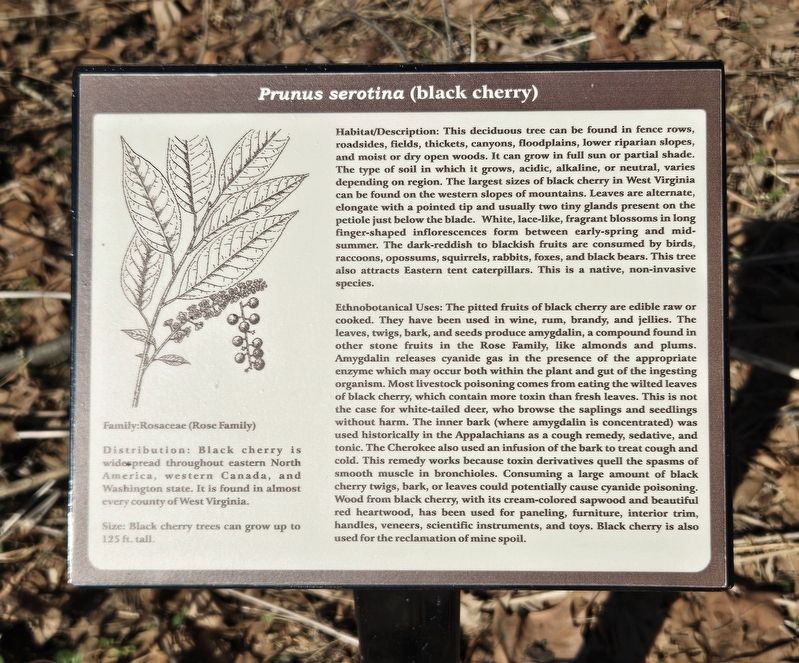
Prunus serotina (black cherry)
Photographed by Bradley Owen, March 10, 2025
1. Prunus serotina (black cherry) Marker
Family:Rosaceae (Rose Family)
Distribution: Black cherry is widespread throughout eastern North America, western Canada, and Washington state. It is found in almost every county of West Virginia.
Size: Black cherry trees can grow up to 125 ft. tall.
Habitat/Description: This deciduous tree can be found in fence rows, roadsides, fields, thickets, canyons, floodplains, lower riparian slopes, and moist or dry open woods. It can grow in full sun or partial shade. The type of soil in which it grows, acidic, alkaline, or neutral, varies depending on region. The largest sizes of black cherry in West Virginia can be found on the western slopes of mountains. Leaves are alternate, elongate with a pointed tip and usually two tiny glands present on the petiole just below the blade. White, lace-like, fragrant blossoms in long finger-shaped inflorescences form between early-spring and mid-summer. The dark-reddish to blackish fruits are consumed by birds, raccoons, opossums, squirrels, rabbits, foxes, and black bears. This tree also attracts Eastern tent caterpillars. This is a native, non-invasive species.
Ethnobotanical
this page online
Photographed by Bradley Owen, March 10, 2025
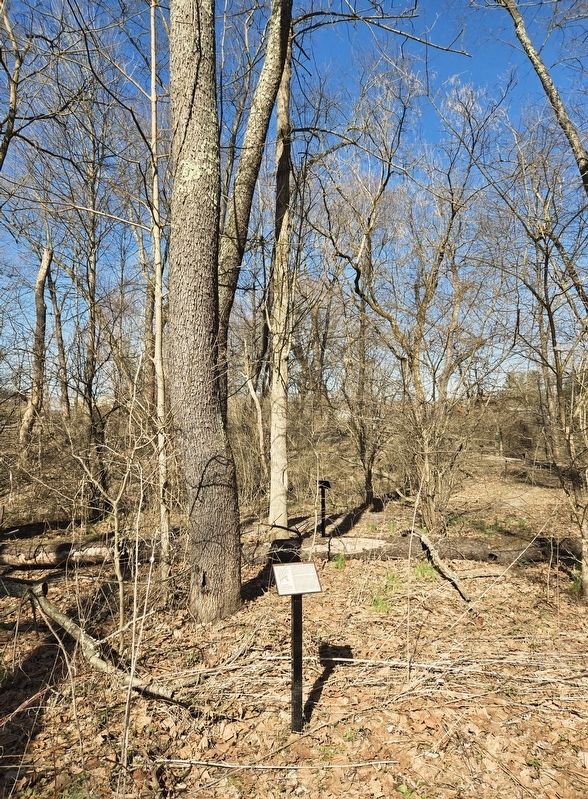
2. Prunus serotina (black cherry) Marker
Erected 2017 by West Virginia Wesleyan College Department of Biology.
Topics. This historical marker is listed in these topic lists: Environment • Indigenous Peoples and Communities • Industry & Commerce • Science & Medicine.
Location. 38° 59.595′ N, 80° 13.009′ W. Marker is in Buckhannon, West Virginia, in Upshur County. It can be reached from Camden Avenue north of Walktrail Lane, on the left when traveling north. Marker is located on the Buckhannon Nature Park and Learning Trail west of the Camden Avenue parking area. Touch for map. Marker is at or near this postal address: 8 Camden Avenue, Buckhannon WV 26201, United States of America. Touch for directions.

Regionally, this marker is in North Central West Virginia. It is also in the American South, specifically in the Upper South, in Appalachia, and specifically in Northern Appalachia. Globally, it is in North America, the Western Hemisphere, the Western World, and the Anglosphere. Historically, it finds itself in what was once the territory of the Mississippian Culture.
Other nearby markers. At least 8 other markers are within walking distance of this marker: Fraxinus americana (white ash) (here, next to this marker); Hydrangea arborescens (wild hydrangea) (a few steps from this marker); Euonymus fortunei (winter creeper or Fortune's spindle) (a few steps from this marker); Baptisia australis (blue false indigo) (a few steps from this marker); Lindera benzoin (spicebush) (a few steps from this marker); Ulmus americana (American elm) (a few steps from this marker); Acer saccharinum (silver maple) (a few steps from this marker); Microstegium vimineum (Japanese stiltgrass) (within shouting distance of this marker). Touch for a list and map of all markers in Buckhannon.
Credits. This page was last revised on April 2, 2025. It was originally submitted on April 2, 2025, by Bradley Owen of Morgantown, West Virginia. This page has been viewed 112 times since then and 18 times this year. Photos: 1, 2. submitted on April 2, 2025, by Bradley Owen of Morgantown, West Virginia.
