
Montgomery in Montgomery County, Alabama — The American South (East South Central)
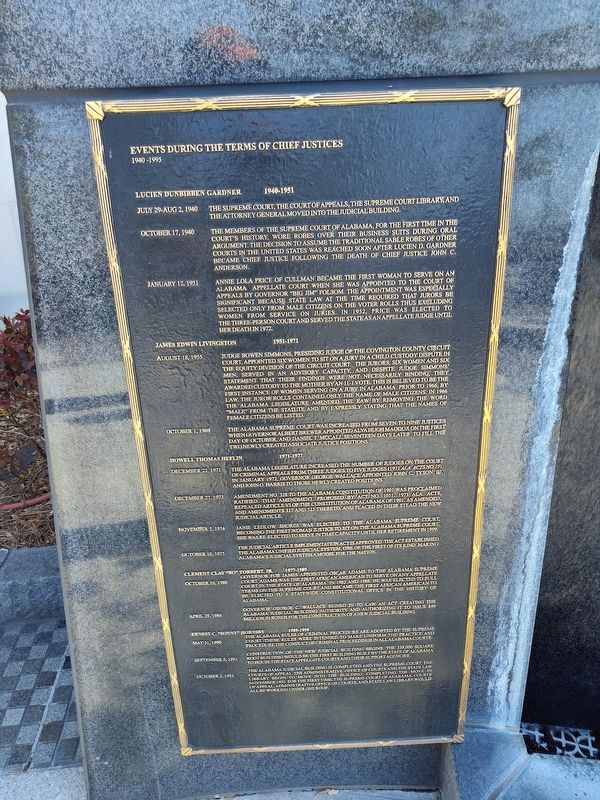
Events During the Terms of Chief Justices
1940-1995
Photographed by Craig Doda, March 1, 2025
1. Events During the Terms of Chief Justices 1940-1995 Marker
July 29-Aug 2, 1940 The Supreme Court, the Court of Appeals, the Supreme Court Library, and the Attorney General moved into the Judicial Building.
October 17, 1940 The members of the Supreme Court of Alabama, for the first time in the court's history, wore robes over their business suits during oral argument. The decision to assume the traditional sable robes of other courts in the United States was reached soon after Lucien D. Gardner became Chief Justice following the death of Chief Justice John C. Anderson.
January 12, 1951 Annie Lola Price of Cullman became the first woman to serve on an Alabama appellate court when she was appointed to the Court of Appeals by Governor "Big Jim" Folsom. The appointment was especially significant because state law at the time required that jurors be selected only from male citizens on the voter rolls thus excluding women from service on juries. In 1952, Price was elected to the three-person court and served the state as an Appellate Judge until her death in 1972.
James Edwin Livingston 1951-1971
August 18, 1955 Judge Bowen Simmons, presiding
this page online
October 1, 1969 The Alabama Supreme Court was increased from seven to nine justices when Governor Albert Brewer appointed Alvahugh Maddox on the first day of October, and Daniel T. McCall seventeen days later, to fill the two newly created associate justice positions.
Howell Thomas Heflin 1971-1977
December 22, 1971 The Alabama Legislature increased the number of judges on the Court of Criminal Appeals from three judges to five judges (1971 Ala. Acts No 75).
Photographed by Craig Doda, March 1, 2025
2. Events During the Terms of Chief Justices 1940-1995 Marker
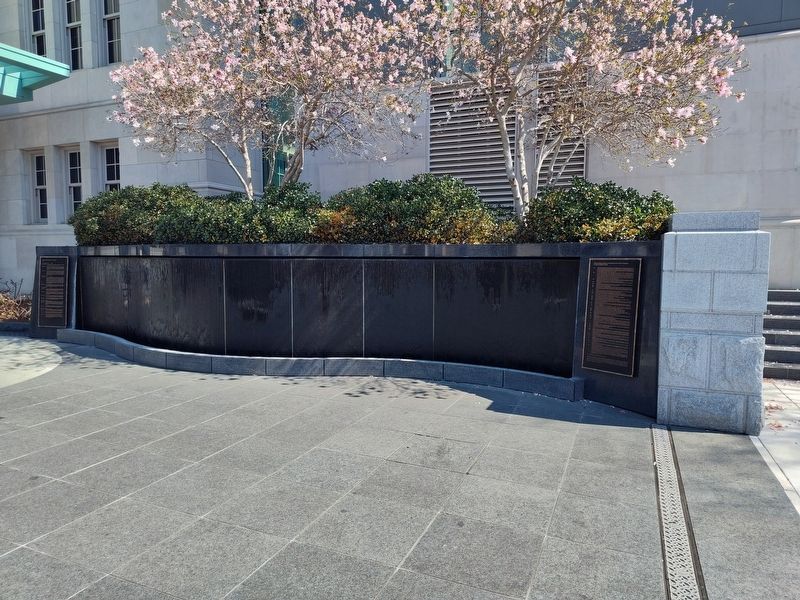
December 27, 1973 Amendment No. 328 to the Alabama Constitution of 1901 was proclaimed ratified. That amendment, proposed by Act No. 1051, 1973 Ala. Acts, repealed Article VI of the Constitution of Alabama of 1901, as amended, and amendments 317 and 323 thereto, and placed in their stead the new judicial article.
November 5, 1974 Janie Ledlow Shores was elected to the Alabama Supreme Court, becoming the first woman justice to sit on the Alabama Supreme Court. She was re-elected to serve in that capacity until her retirement in 1999.
October 10, 1975 The Judicialarticle Implementation Act is approved. The Act established the Alabama Unified Judicial System, one of the first of its kind, making Alabama's judicial system a model for the nation.
Clement Clay "Bo" Torbert, Jr. 1977-1989
October 10, 1980 Governor Fob James appointed Oscar Adams to the Alabama Supreme Court. Adams was the first African American to serve on any Appellate Court in the state of Alabama. In 1982 and 1988, he was elected to full terms on the Supreme Court and became the first African American to be elected to a statewide constitutional office in the history of Alabama.
April 29, 1986 Governor George C. Wallace signed in to law an act creating the Alabama Judicial Building Authority and authorizing it to issue $40 million in bonds for the construction of a new judicial building.
Ernest C. "Sonny" Hornsby 1989-1995
May 31, 1990 The Alabama Rules of Criminal Procedure are adopted by the Supreme Court. These rules were intended to make uniform the practice and procedure the conduct of criminal proceedings in all Alabama courts.
September 9, 1991 Construction of the new judicial building begins. The 338,000 square foot building would be the first building built by the State of Alabama to house the State Appellate Courts and their support agencies.
October 5, 1993 The Alabama Judicial Building is completed and the Supreme Court, the Courts of Appeal, the Administrative Office of Courts and the State Law library begin to move into the building, completing the move in November 1993. For the first time, the Supreme Court of Alabama, Courts of Appeal, Administrative Office of Courts, and State Law Library would all be working under one roof.
Topics. This historical marker is listed in these topic lists: African Americans • Civil Rights • Women. A significant historical date for this entry is January 12, 1951.
Location. 32° 22.675′ N, 86° 18.188′ W. Marker is in Montgomery, Alabama, in Montgomery County. It is on Dexter Avenue 0.3 miles east of South Decauter Street, on the right when traveling west. Touch for map. Marker is at or near this postal address: 445 Dexter Ave, Montgomery AL 36130, United States of America. Touch for directions.

Regionally, this marker is in Alabama’s Tri-Counties River Region. It is also in the American South, specifically in the Deep South, and in the Black Belt. Globally, it is in North America, a Gulf of Mexico state, the Western Hemisphere, the Western World, and the Anglosphere. Historically, it finds itself in what was once the territory of the Mississippian Culture, one of the Confederate States of America, and the Antebellum South.
Other nearby markers. At least 8 other markers are within walking distance of this marker: The Alabama Judicial System and the Chief Justices of the Supreme Court. (here, next to this marker); Clement Clay "Bo" Torbert, Jr. (a few steps from this marker); Lucien Dunbibben Gardner (a few steps from this marker); The Alabama Appellate Courts (a few steps from this marker); James Edwin Livingston (a few steps from this marker); Howell Thomas Heflin (a few steps from this marker); Associate Justices (a few steps from this marker); Ernest C. “Sonny” Hornsby (a few steps from this marker). Touch for a list and map of all markers in Montgomery.
Credits. This page was last revised on April 7, 2025. It was originally submitted on April 4, 2025, by Craig Doda of Napoleon, Ohio. This page has been viewed 178 times since then and 24 times this year. Photos: 1, 2. submitted on April 4, 2025, by Craig Doda of Napoleon, Ohio. • James Hulse was the editor who published this page.
