Los Alamos in Los Alamos County, New Mexico — The American Mountains (Southwest)
Five Eras of History
Los Alamos Historical Walking Tour
Photographed by James Hulse, March 25, 2025
1. Five Eras of History Marker
this page online
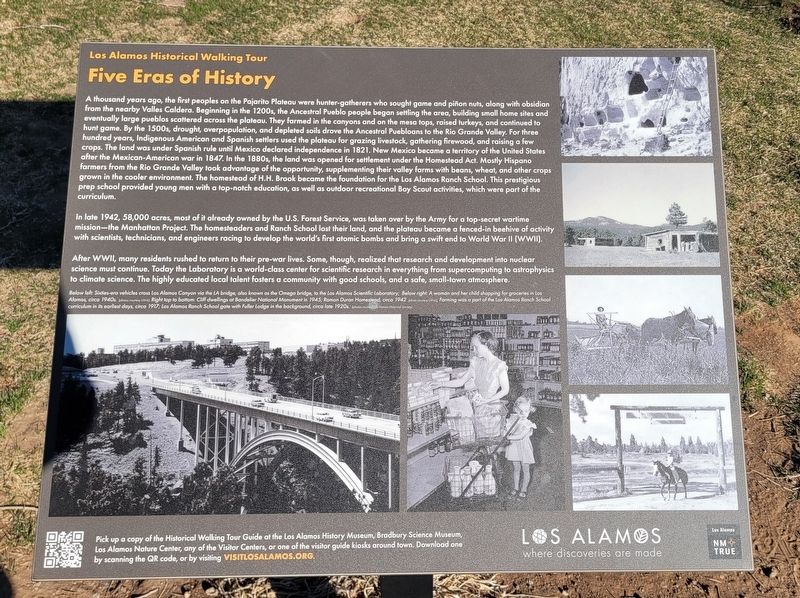
In late 1942, 58,000 acres, most of it already owned by the U.S. Forest Service, was taken over by the Army for a top-secret wartime mission-the Manhattan Project. The homesteaders and Ranch School lost their land, and the plateau became a fenced-in beehive of activity with scientists, technicians, and engineers racing to develop the world's first atomic bombs and bring a swift end to World War II (WWII).
After WWII, many residents rushed to return to their pre-war lives. Some, though, realized that research and development into nuclear science must continue. Today the Laboratory is a world-class center for scientific research in everything from supercomputing to astrophysics to climate science. The highly educated local talent fosters a community with good schools, and a safe, small-town atmosphere.
Below left: Sixties-era vehicles cross Los Alamos Canyon via the LA bridge, also known as the Omega bridge, to the Los Alamos Scientific Laboratory; Below right: A woman and her child shopping for groceries in Los Alamos, circa 1940s, photos coutery LAN), Right top to bottom: Cliff dwellings at Bandelier National Monument in 1945; Raman Duran Homestead, circa 1942 (photo courtesy LANI); Farming was a part of the Los Alamos Ranch School curriculum in its earliest days, circa 1917; Los Alamos Ranch School gate with Fuller Lodge in the background, circa late 1920s. (photos courtesy Los Alamos Historical Society)
Pick up a copy of the Historical Walking Tour Guide at the Los Alamos History Museum, Bradbury Science Museum, Los Alamos Nature Center, any of the Visitor Centers, or one of the visitor guide kiosks around town. Download one by scanning the QR code, or go to visitlosalamos.org.
Erected by Los
Photographed by James Hulse, March 25, 2025
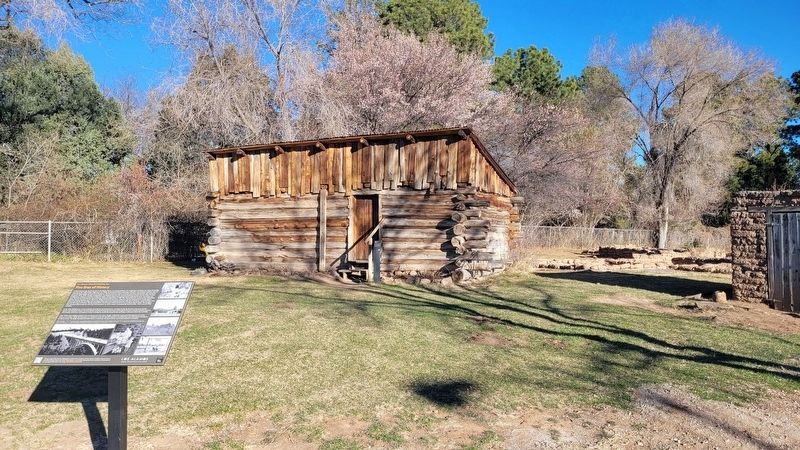
2. The Five Eras of History Marker in front of the Romero Cabin
Topics. This historical marker is listed in these topic lists: Immigration • Indigenous Peoples and Communities • Science & Medicine • Settlements & Settlers. A significant historical year for this entry is 1821.
Location. 35° 52.962′ N, 106° 18.089′ W. Marker is in Los Alamos, New Mexico, in Los Alamos County. It is at the intersection of Juniper Street and 19th Street on Juniper Street. The marker is located at the front of the Romero Cabin. Touch for map. Marker is at or near this postal address: 1954 Juniper St, Los Alamos NM 87544, United States of America. Touch for directions.

Regionally, this marker is in Northern New Mexico. It is also in the American Southwest. Globally, it is in North America, the Rocky Mountains, the Western Hemisphere, the Western World, and the Anglosphere. Historically, it finds itself in what was once New Spain and also the territory of the Ancestral Puebloans.
Other nearby markers. At least 8 other markers are within walking distance of this marker: A different marker also named Romero Cabin (here, next to this marker); Fire Cache (here, next to this marker); Ancestral Pueblo Site (within shouting distance of this marker); The Big House (within shouting distance of this marker); Memorial Rose Garden (within shouting distance of this marker); Los Alamos Ranch School Dormitory (within shouting distance of this marker); Bathtub Row (within shouting distance of this marker); Hitching Rail (within shouting distance of this marker). Touch for a list and map of all markers in Los Alamos.
Other markers no longer nearby. Homesteading on the Pajarito Plateau, 1887-1942 (was here, next to this marker but has been permanently removed); The Romero Cabin (was here, next to this marker but has been permanently removed); Harold H. Brook (was a few steps from this marker but has been permanently removed); Albert J. Connell (was a few steps from this marker but has been permanently removed); William Mackwood Hopper (was a few steps from this marker but has been permanently removed); Martha Brook (was a few steps from this marker but has been permanently removed).
Also see . . .
1. Los Alamos where discoveries are made. Los Alamos County (Submitted on April 7, 2025, by James Hulse of Medina, Texas.)
2. Historical Walking Tour Map. Los Alamos Historical Museum
Walk from the Stone Age to the atomic age. Your walking tour spans eight centuries of Los Alamos history, from ancestral Pueblos, through homesteading on the Pajarito Plateau, to the future of science and technology. We hope that it will be just the beginning of your acquaintance with Los Alamos.(Submitted on April 8, 2025, by James Hulse of Medina, Texas.)
Credits. This page was last revised on April 8, 2025. It was originally submitted on April 7, 2025, by James Hulse of Medina, Texas. This page has been viewed 175 times since then and 21 times this year. Photos: 1, 2. submitted on April 8, 2025, by James Hulse of Medina, Texas.
