Blanding in San Juan County, Utah — The American Mountains (Southwest)
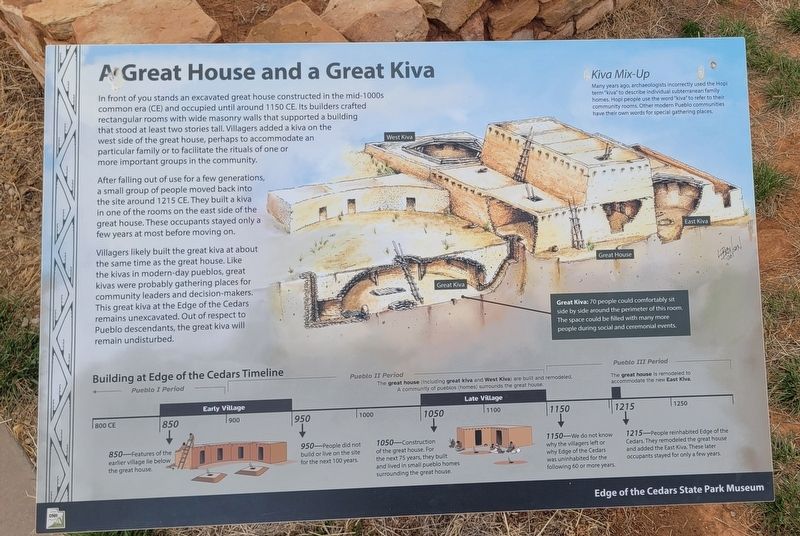
A Great House and a Great Kiva
Photographed by James Hulse, March 28, 2025
1. A Great House and a Great Kiva Marker
After falling out of use for a few generations, a small group of people moved back into the site around 1215 CE. They built a kiva in one of the rooms on the east side of the great house. These occupants stayed only a few years at most before moving on.
Villagers likely built the great kiva at about the same time as the great house. Like the kivas in modern-day pueblos, great kivas were probably gathering places for community leaders and decision-makers. This great kiva at the Edge of the Cedars remains unexcavated. Out of respect to Pueblo descendants, the great kiva will remain undisturbed.
Kiva Mix-Up
Many years ago, archaeologists incorrectly used the Hopi term "kiva" to describe
this page online
Great Kiva: 70 people could comfortably sit side by side around the perimeter of this room. The space could be filled with many more people during social and ceremonial events.
Building at Edge of the Cedars Timeline
Pueblo I Period
Early Village
850 - Features of the earlier village lie below the great house.
950 - People did not build or live on the site for the next 100 years.
Pueblo II Period
The great house (including great kiva and West Kiva) are built and remodeled. A community of pueblos (homes) surrounds the great house.
Late Village
1050 - Construction of the great house. For the next 75 years, they built and lived in small pueblo homes surrounding the great house.
1150 - We do not know why the villagers left or why Edge of the Cedars was uninhabited for the following 60 or more years.
Pueblo III Period
The great house is remodeled to accommodate the new East Kiva.
1215 - People reinhabited Edge of the Cedars. They remodeled the great house and added the East Kiva. These later occupants stayed for only a few years.
Erected by Edge

Photographed by James Hulse, March 28, 2025
2. The Great House and the Marker
Topics. This historical marker is listed in these topic lists: Anthropology & Archaeology • Indigenous Peoples and Communities • Parks & Recreational Areas • Settlements & Settlers.
Location. 37° 37.874′ N, 109° 29.432′ W. Marker is in Blanding, Utah, in San Juan County. It is at the intersection of West 400 North and 600 W on West 400 North. The marker is located on the grounds of the Edge of the Cedars State Park Museum. Touch for map. Marker is at or near this postal address: 660 W 400 N, Blanding UT 84511, United States of America. Touch for directions.

Regionally, this marker is in Canyon Country. It is also in the American Mountain West, on the Colorado Plateau, and at the Four Corners. Globally, it is in North America, the Western Hemisphere, the Western World, and the Anglosphere. Historically, it finds itself in what was once New Spain, the territory of the Ancestral Puebloans, and Mexico’s Alta California.

Other nearby markers. At least 8 other markers are within walking distance of this marker: Living in the Earth: A Look Inside a Kiva
Photographed by James Hulse, March 28, 2025
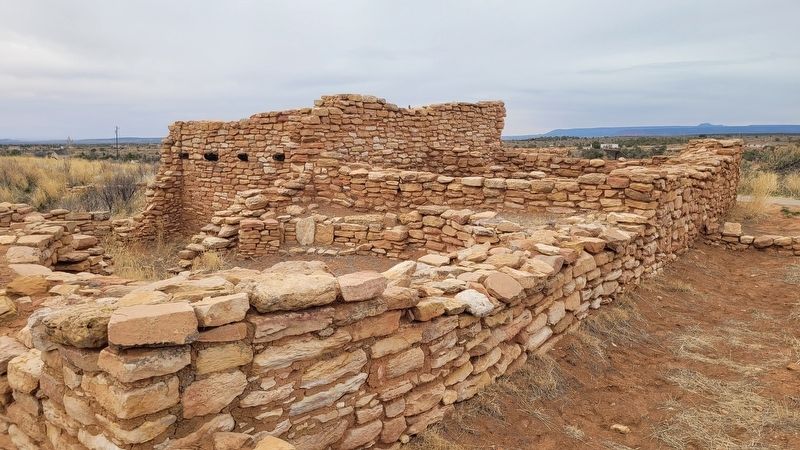
3. The Great House
Credits. This page was last revised on April 18, 2025. It was originally submitted on April 16, 2025, by James Hulse of Medina, Texas. This page has been viewed 193 times since then and 43 times this year. Photos: 1, 2, 3. submitted on April 18, 2025, by James Hulse of Medina, Texas.
