Port Royal in Caroline County, Virginia — The American South (Mid-Atlantic)
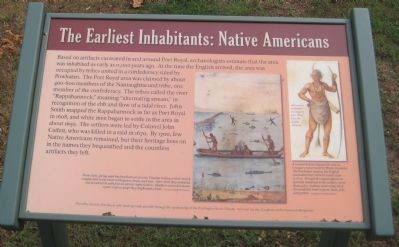
The Earliest Inhabitants: Native Americans
Photographed by Kevin W., July 11, 2012
1. The Earliest Inhabitants: Native Americans Marker
Erected by Historic Port Royal with funding made possible through the sponsorship of the Washington-Lewis Chapter, National Society Daughters of the American Revolution.
Topics and series. This historical marker is listed in these topic lists: Colonial Era • Indigenous Peoples and Communities
this page online
Location. 38° 10.236′ N, 77° 11.324′ W. Marker is in Port Royal, Virginia, in Caroline County. It is on Water Street, on the left when traveling east. Touch for map. Marker is at or near this postal address: 826 Water St, Port Royal VA 22535, United States of America. Touch for directions.

Regionally, this marker is in the Piedmont and in Central Virginia. It is also in the American South, specifically in the Upper South, and on the Eastern Seaboard. Globally, it is in the North Atlantic Region, North America, the Western Hemisphere, the Western World, and the Anglosphere. Historically, it finds itself in what was once the territory of the Mississippian Culture, one of the original Thirteen Colonies, one of the Confederate States of America, and the Antebellum South.
Other nearby markers. At least 8 other markers are within walking distance of this marker: St. Peter's Church (within shouting distance of this marker); The Fox Tavern: A Colonial Landmark (about
Photographed by Kevin W., July 11, 2012
2. The Earliest Inhabitants: Native Americans Marker
More about this marker. The caption on the picture reads, "From early spring until the first harvest of corn, Virginia Indians relied on fish caught close to the shore with spears, traps, and nets. After dark they ventured out in canoes lit with fires to attract night feeders. Paddlers steered between oyster reefs so large they might sink a boat. [Photo Courtesy of the British Museum.]
Credits. This page was last revised on May 6, 2025. It was originally submitted on July 15, 2012, by Kevin W. of Stafford, Virginia. This page has been viewed 2,234 times since then and 80 times this year. Last updated on May 5, 2025, by Carl Gordon Moore Jr. of North East, Maryland. Photos: 1, 2. submitted on July 15, 2012, by Kevin W. of Stafford, Virginia. • Devry Becker Jones was the editor who published this page.
