
Barrie in Simcoe County, Ontario — Central Canada (North America)
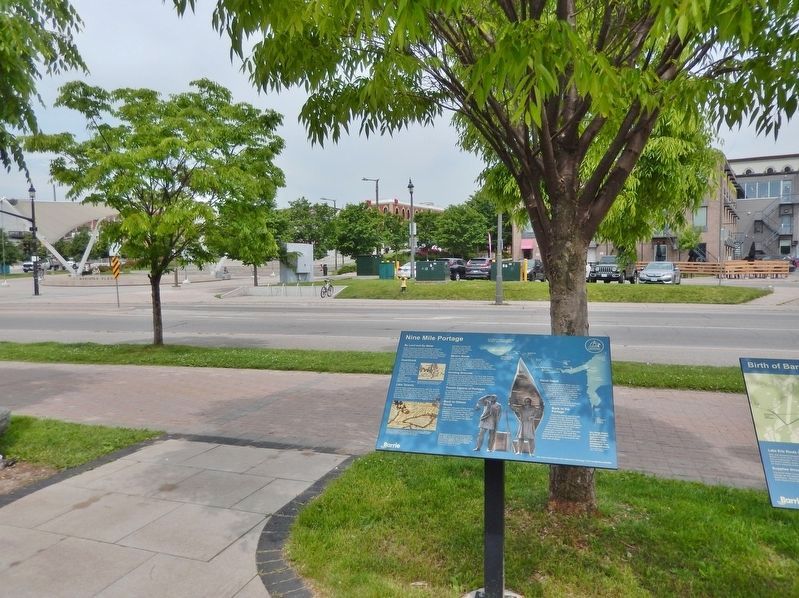
Nine Mile Portage
| — | Waterfront Heritage Trail | — |
Photographed by Cosmos Mariner, June 5, 2024
1. Nine Mile Portage Marker
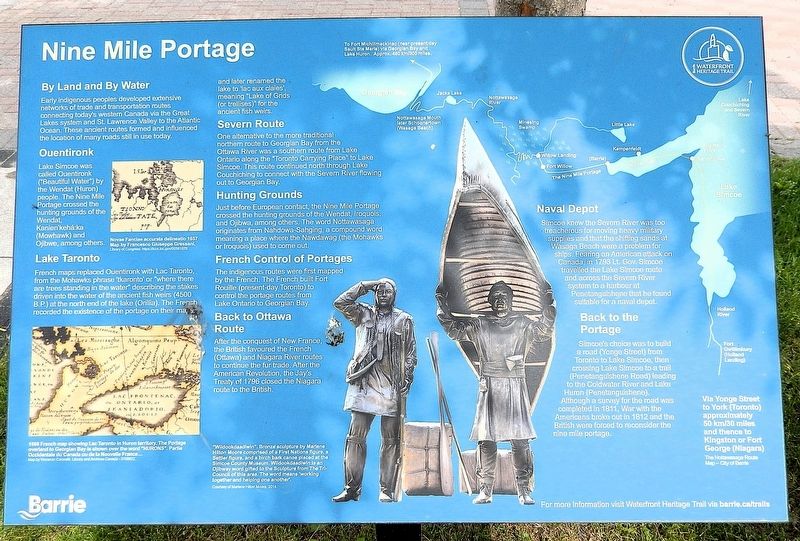
By Land and By Water
Early indigenous peoples developed extensive networks of trade and transportation routes connecting today's western Canada via the Great Lakes system and St. Lawrence Valley to the Atlantic Ocean. These ancient routes formed and influenced the location of many roads still in use today.
Ouentironk
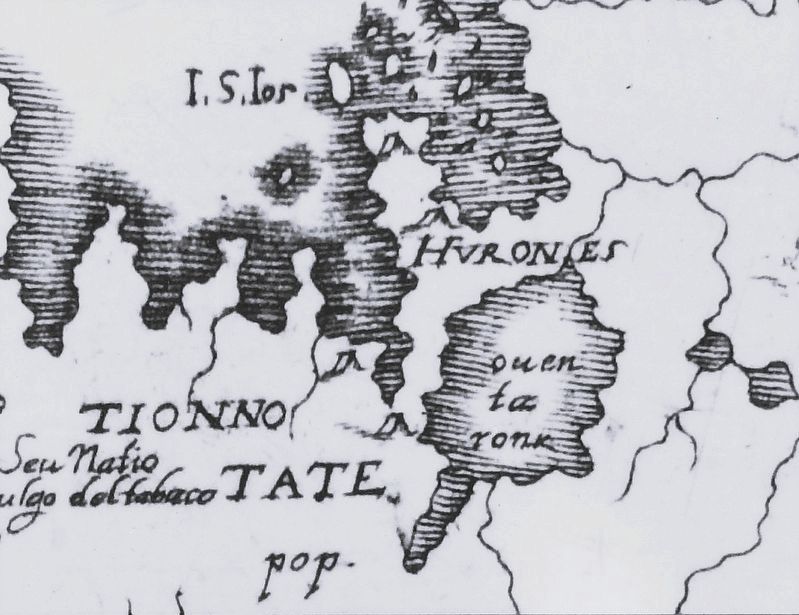
Lake Simcoe was called Ouentironk ("Beautiful Water") by the Wendat (Huron) people. The Nine Mile Portage crossed the hunting grounds of the Wendat, Kanien'kehá:ka (Mowhawk) and Ojibwe, among others.
Lake Taronto
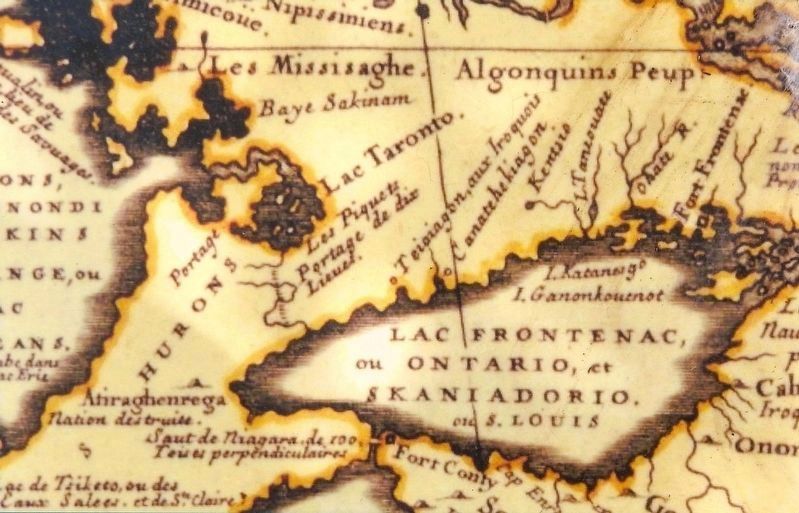
French maps replaced Ouentironk with Lac Taronto, from the Mohawks phrase 'tkaronto' or "where there are trees standing in the water" describing the stakes driven into the water of the ancient fish weirs (4500 B.P.) at the north end of the lake (Orillia). The French recorded the existence of the portage on their maps and later renamed the lake to 'lac aux claies', meaning "Lake of Grids (or trellises)" for the ancient fish weirs.
Severn Route
One alternative to the more traditional northern route to Georgian Bay from the Ottawa River was a southern route from Lake Ontario along the "Toronto Carrying Place"
this page online
Hunting Grounds
Just before European contact, the Nine Mile Portage crossed the hunting grounds of the Wendat, Iroquois, and Ojibwa, among others. The word Nottawasaga originates from Nandowa-Sahging, a compound word meaning a place where the Nawdawag (the Mohawks or Iroquois) used to come out.
French Control of Portages
The indigenous routes were first mapped by the French. The French built Fort Rouille (present-day Toronto) to control the portage routes from Lake Ontario to Georgian Bay.
Back to Ottawa Route
After the conquest of New France, the British favoured the French (Ottawa) and Niagara River routes to continue the fur trade. After the American Revolution, the Jay's Treaty of 1796 closed the Niagara route to the British.
Naval Depot
Simcoe knew the Severn River was too treacherous for moving heavy military supplies and that the shifting sands at Wasaga Beach were a problem for ships. Fearing an American attack on Canada, in 1793 Lt. Gov. Simcoe travelled the Lake Simcoe route and across the Severn River
Library of Congress
2. Marker detail: Map by Francesco Guiseppe Gressani, 1657
Back to the Portage
Simcoe's choice was to build a road (Yonge Street) from Toronto to Lake Simcoe, then crossing Lake Simcoe to a trail (Penetanguishene Road) leading to the Coldwater River and Lake Huron (Penetanguishene). Although a survey for the road was completed in 1811, War with the Americans broke out in 1812 and the British were forced to reconsider the nine mile portage.
[photo & image captions]
• “Wiidookdaadiwin” — Bronze sculpture by Marlene Hilton Moore comprised of a First Nations figure, a Settler figure, and a birch bark canoe placed at the Simcoe County Museum. Wiidookdaadiwin is an Ojibway word gifted to the Sculpture from The Tri-Council of this area. The word means “working together and helping one another.”
• To Fort Michilimackinac (near present day Sault Ste Marie) via Georgian Bay and Lake Huron. Approximately 480 km/300 miles. [from Nottawasaga Mouth, later Schoonertown (Wasaga Beach)]
• Via Yonge Street to York (Toronto) approximately 50 km/30 miles and thence to Kingston or Fort George (Niagara) [from Fort Gwillimbury (Holland Landing) at south end of Lake Simcoe]
Erected by Barrie
Library and Archives Canada
3. Marker detail: 1688 French map showing Lac Taronto in Huron territory
The Portage overland to Georgian Bay is shown over the word "HURONS". Partie Occidentale du Canada ou de la Nouvelle France. Map by Vincenzo Coronelli.
Topics. This historical marker is listed in these topic lists: Colonial Era • Indigenous Peoples and Communities • Industry & Commerce • Waterways & Vessels. A significant historical year for this entry is 1796.
Location. 44° 23.304′ N, 79° 41.217′ W. Marker is in Barrie, Ontario, in Simcoe County. It is at the intersection of Simcoe Street and Lakeshore Mews, on the right when traveling east on Simcoe Street. The marker is at Waterfront Heritage Trail Station #9 ("Downtown"), on the west side of the Heritage Park parking lot. Touch for map. Marker is at or near this postal address: 5 Simcoe Street, Barrie ON L4M 1L6, Canada. Touch for directions.

Regionally, this marker is in Central Ontario Cottage Country and specifically in Georgian Bay Country. It is also in Central Canada. Globally, it is in North America, on the Great Lakes, in the Western Hemisphere, in the Western World, and in the Anglosphere. Historically, it finds itself in what was once a British colony, the Viceroyalty of New France, the Haudenosaunee (Iroquois) Confederacy, and Rupert’s Land.
Other nearby markers. At
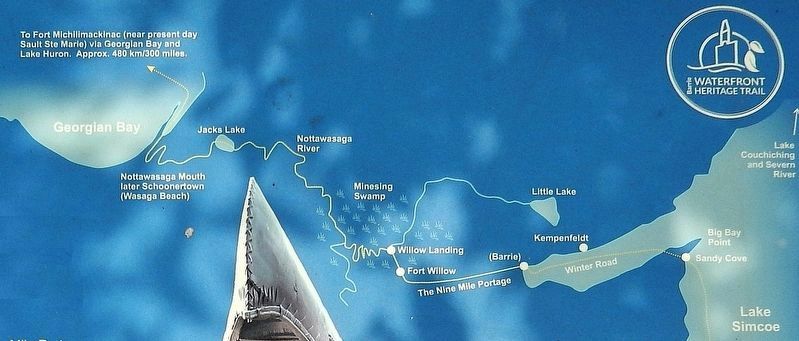
4. Marker detail: The Nine Mile Portage
Also see . . . Nine Mile Portage (Wikipedia).
Excerpt: The Nine Mile Portage connected Kempenfelt Bay of Lake Simcoe, Ontario, to Willow Creek, a tributary of the Nottawasaga River that flows to Wasaga Beach on Georgian Bay. In the early centuries of the colonial period, the Nine Mile Portage was a minor fur trade route. Following the War of 1812, the portage was used by the Royal Navy and British Army until as late as the 1850s to transport supplies to the Penetanguishene Naval Yard.(Submitted on May 22, 2025, by Cosmos Mariner of Cape Canaveral, Florida.)The Barrie Chamber of Commerce in the nineteen fifties restored what was still traceable of the Nine Mile Portage. The city of Barrie plans to make it possible to walk the original
route of the trail. Very small portions of the original portage are incorporated into the Nine Mile Portage Heritage Trail which is a multi-use recreational trail running between Meridian Place in downtown Barrie and Fort Willow in Springwater Township. Most of the original portage route is on private property and not accessible to the public.Photographed by Cosmos Mariner, June 5, 20245. Nine Mile Portage MarkerLooking north across Simcoe Street from Heritage Park.
Credits. This page was last revised on May 22, 2025. It was originally submitted on May 19, 2025, by Cosmos Mariner of Cape Canaveral, Florida. This page has been viewed 213 times since then and 100 times this year. Photos: 1, 2, 3, 4, 5. submitted on May 22, 2025, by Cosmos Mariner of Cape Canaveral, Florida.
