Logan Square in Chicago in Cook County, Illinois — The American Midwest (Great Lakes)
Logan Square • Palmer Square
Photographed by Sean P. Flynn, May 22, 2025
1. Logan Square • Palmer Square Marker
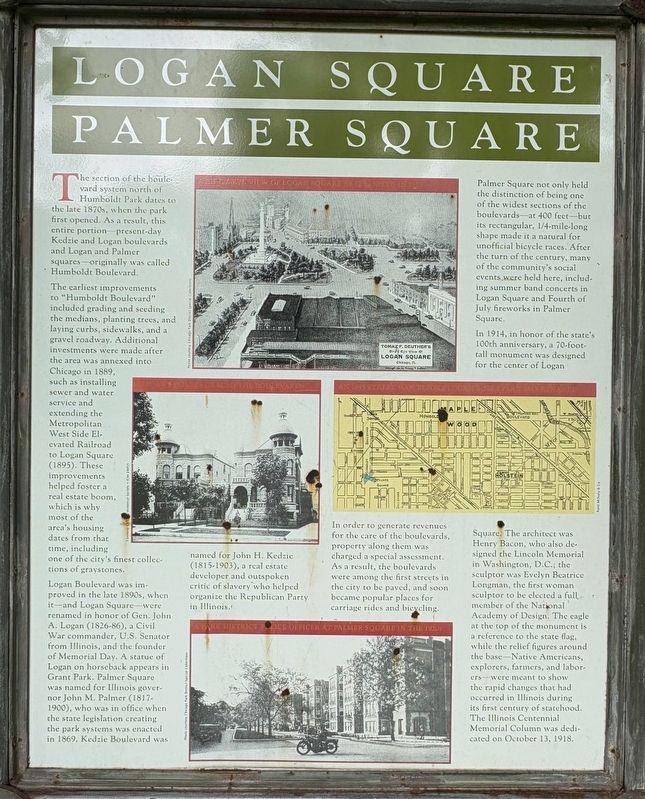
The section of the boulevard system north of Humboldt Park dates to the late 1870s, when the park first opened. As a result, this entire portion—present-day Kedzie and Logan boulevards and Logan and Palmer squares—originally was called Humboldt Boulevard.
The earliest improvements to "Humboldt Boulevard" included grading and seeding the medians, planting trees, and laying curbs, sidewalks, and a gravel roadway. Additional investments were made after the area was annexed into Chicago in 1889, such as installing sewer and water service and extending the Metropolitan West Side Elevated Railroad to Logan Square (1895). These improvements helped foster a real estate boom, which is why most of the area's housing dates from that time, including one of the city's finest collections of graystones.
Logan Boulevard was improved in the late 1890s, when it—and Logan Square—were renamed in honor of Gen. John A. Logan (1826-86), a Civil War commander, U.S. Senator from Illinois, and the founder of Memorial Day. A statue of Logan on horseback appears in Grant Park. Palmer Square was named for Illinois governor John M. Palmer (1817-1900),
this page online
In order to generate revenues for the care of the boulevards, property along them was charged a special assessment. As a result, the boulevards were among the first streets in the city to be paved, and soon became popular places for carriage rides and bicycling.
Palmer Square not only held the distinction of being one of the widest sections of the boulevards—at 400 feet—but its rectangular, ¼-mile-long shape made it a natural for unofficial bicycle races. After the turn of the century, many of the community’s social events were held here, including summer band concerts in Logan Square and Fourth of July fireworks in Palmer Square.
In 1914, in honor of the state's 100th anniversary, a 70-foot-tall monument was designed for the center of Logan Square. The architect was Henry Bacon, who also designed the Lincoln Memorial in Washington, D.C.; the sculptor was Evelyn
Photographed by Sean P. Flynn, May 22, 2025
2. Logan Square • Palmer Square Marker
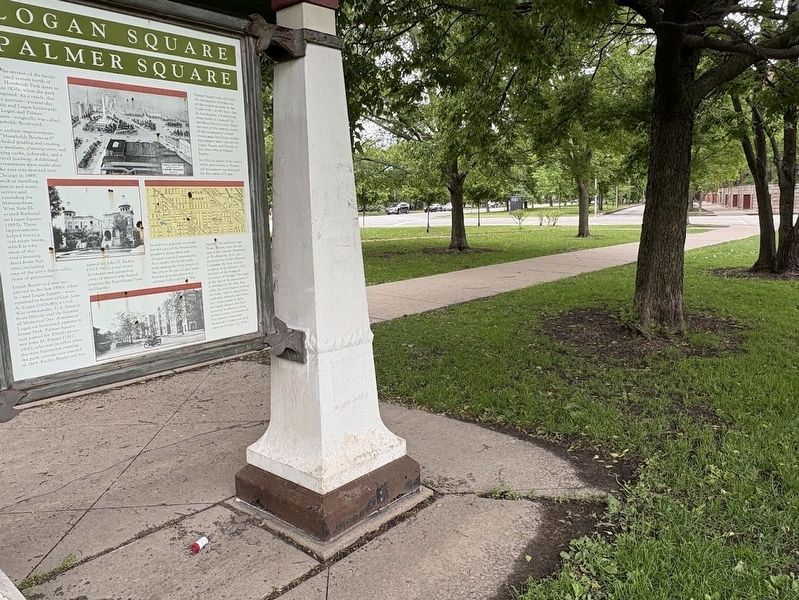
Kedzie Boulevard can be seen running north from this location.
Erected 1995 by City of Chicago.
Topics and series. This historical marker is listed in these topic lists: Parks & Recreational Areas • Railroads & Streetcars • Roads & Vehicles • War, US Civil. In addition, it is included in the Former U.S. Presidents: #16 Abraham Lincoln, and the Former U.S. Presidents: #18 Ulysses S. Grant series lists. A significant historical year for this entry is 1877.
Location. 41° 55.266′ N, 87° 42.411′ W. Marker is in Chicago, Illinois, in Cook County. It is in Logan Square. It is at the intersection of North Kedzie Boulevard and West Palmer Square, on the right when traveling north on North Kedzie Boulevard. The marker is on the western edge of Palmer

Photographed by Sean P. Flynn, May 22, 2025
3. Chicago's Boulevard System marker
The opposite side has a marker about Chicago's boulevard system. Palmer Square can be seen in the rear.

Regionally, this marker is on Chicago’s North Side. It is also in the American Midwest. Globally, it is in North America, on the Great Lakes, in the Western Hemisphere, in the Western World, and in the Anglosphere. Historically, it finds itself in what was once the Viceroyalty of New France, the territory of the Mississippian Culture, and the Northwest Territory.
Other nearby markers. At least 8 other markers are within walking distance of this marker: The Boulevard System (here, next to this marker); Logan Square Boulevards (within shouting distance of this marker); a different marker also named Logan Square Boulevards (approx. 0.2 miles away); a different marker also named Logan Square Boulevards (approx. ¼ mile away); a different marker also named Logan Square Boulevards (approx. ¼ mile away); a different marker also named Logan Square Boulevards (approx. ¼ mile away); a different marker also named Logan Square Boulevards (approx. 0.3 miles away); a different marker also named Logan Square Boulevards

Photographed by Sean P. Flynn, May 22, 2025
4. Logan Square
The Illinois Centennial Column, which is referenced on this marker, can be seen amid construction in this May 2025 photo.
More about this marker. The marker shares a steel kiosk-type structure with another marker on the opposite side, which is about Chicago's boulevard system. An identical set of markers with the same text on both sides can be found near the Illinois Centennial Column at Logan Square.
At least a dozen of this style marker can be found around Chicago near its boulevards and parks, with a description of a local feature on one side and the story of Chicago's boulevard system on the other. While quite faded on this marker (and completely faded on many other variations around the city), an inscription on the kiosk says that it was erected in 1995.
Also see . . . Chicago Park District: Palmer (John McAuley) Square Park.
Excerpt: "As elegant residences began developing along Palmer Square and Humboldt Boulevard between the 1880s and early 1900s, Chicagoans often used the thoroughfares for strolling, carriage rides, and cycling. At the time, a bicycle craze swept through Chicago, largely spurred by the recent invention of the safety bike. Palmer Square became a popular spot for 'wheelmen,' local clubs, and even national biking organizations. Biking enthusiasts used the ovular paved road surrounding the parkland as a track, sometimes even sharing it with pedestrians who occasionally objected to these 'scorchers' taking over the roads. Because of its boulevard connection with Humboldt Park, Palmer Square was also used in city-wide bike routes, races, and parades. These events, ranging from two to 25 miles, were extremely popular with clubs across the city. In one particularly descriptive Chicago Tribune article, dated May 25, 1896, the writer calls the Associated Cycling Clubs Annual Run – where clubs chose specific colors and patterns as riding emblems - a 'kaleidoscope of color.' This trend is especially interesting considering that Ignaz Schwinn (1860 - 1948), founder of Schwinn Bicycles, lived at the corner of W. Palmer St. and N. Humboldt Blvd. during the 1910s."(Submitted on May 23, 2025, by Sean P. Flynn of Oak Park, Illinois.)
Credits. This page was last revised on May 23, 2025. It was originally submitted on May 23, 2025, by Sean P. Flynn of Oak Park, Illinois. This page has been viewed 140 times since then and 29 times this year. Photos: 1, 2, 3, 4. submitted on May 23, 2025, by Sean P. Flynn of Oak Park, Illinois.
