Granville South in Licking County, Ohio — The American Midwest (Great Lakes)
A Glimpse Into Ohio's Prairie Past
Ohio Prairies Have Ebbed and Flowed Through Time

Photographed by Craig Doda, May 3, 2025
1. A Glimps Into Ohio's Prairie Past Marker
This small prairie gives you an opportunity to see and enjoy native prairie plants that once covered the western portions of Ohio. After being covered in ice by the Wisconsinan glacier, Ohio experienced a period of hot, dry weather about 6,000 to 4,000 years ago. The warming allowed prairie grasslands to expand into Ohio from the west, forming an area known as the Prairie Peninsula. Perhaps as much as half of Ohio was covered with prairie at that time.
Over time cooler and wetter conditions returned that favored hardwood forests. Through the natural process of succession, prairies gave way to shrubs and trees. When the first European settlers arrived, Ohio was only two to four percent prairie.
So how did those portions of prairie survive? The answer is Native Americans, who found that hunting was easier on prairie land. By periodically burning the prairies, they kept the forest at bay and maintained their hunting strategies.
Today many of these remnant prairies are presently owned and managed as preserves by both state and local agencies and conservation organizations. In addition, large and small prairies are
this page online
[Captions:]
Native Plants: Adapted For Prairie Life
This prairie was planted in late spring of 2018 by Park Board Commissioner Richard Moseley. It was seeded with over 40 species of prairie plants native to Ohio, including flowers like prairie coneflower, purple coneflower, prairie dock, compass plant, and grasses like big bluestem and Indian grass.
Native plants are those plants which occur naturally in a region. Plants adapted for prairie habitats have roots that extend downward to more than 10 feet. This allows them to absorb moisture during dry periods and survive periodic fires. Native plants also support pollinators and local wildlife, including bees, butterflies, amphibians, reptiles and mammals.
Burn, Prairie, Burn Managing The Land With Fire
Prescribed burns are a useful tool in land management and are commonly used to improve ecosystem health. A number of prairie plant species are adapted to fire and benefit from periodic burns. Once established, prairies need to be burned every two to three years to reduce shrub and tree growth, as well as invading exotic species. For small prairies, mowing can be used when burning is not an option.
Erected by Licking
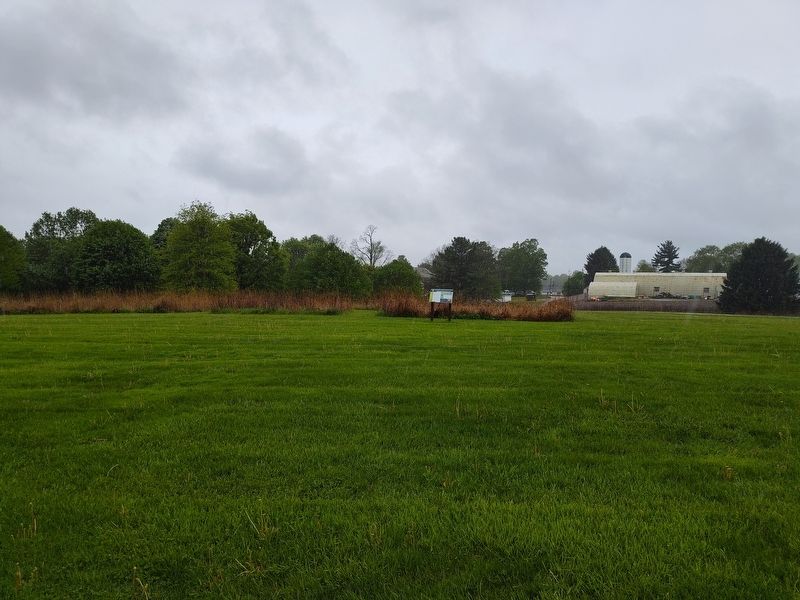
Photographed by Craig Doda, May 3, 2025
2. A Glimps Into Ohio's Prairie Past Marker
Topics. This historical marker is listed in these topic lists: Environment • Horticulture & Forestry • Indigenous Peoples and Communities • Natural Features. A significant historical year for this entry is 2018.
Location. 40° 1.626′ N, 82° 31.258′ W. Marker is in Granville South, Ohio, in Licking County. It can be reached from the intersection of Lancaster Road and Union Station Road, on the right when traveling north. On the grounds of the Infirmary Mound Park. Touch for map. Marker is at or near this postal address: 4309 Lancaster Rd, Granville OH 43023, United States of America. Touch for directions.

Regionally, this marker is in the Columbus Metropolitan Area. It is also in the American Midwest, in the Corn Belt, in Appalachia, and specifically in Northern Appalachia. Globally, it is in North America, the Western Hemisphere, the Western World, and the Anglosphere. Historically, it finds itself in what was once the Haudenosaunee (Iroquois) Confederacy, the territory of the Mississippian Culture, and the Northwest Territory.
Other nearby markers. At least 8 other markers are within 3 miles of this marker, measured as the crow flies: Vietnam Memorial (about 400 feet away, measured in a direct line); What is a Chimney Swift Tower? (about 500 feet away); Infirmary Mound: A Stry Lost In Time (approx. 0.4 miles away); Granville (approx. 2½ miles away); The Toledo and Ohio Central Railroad (approx. 2½ miles away); Old Colony Burying Ground (approx. 2.7 miles away); Old Colony Burying Ground, 1805 (approx. 2.7 miles away); Evans-Miley House (approx. 2.7 miles away).
Credits. This page was last revised on May 27, 2025. It was originally submitted on May 25, 2025, by Craig Doda of Napoleon, Ohio. This page has been viewed 316 times since then and 89 times this year. Photos: 1, 2. submitted on May 25, 2025, by Craig Doda of Napoleon, Ohio. • Devry Becker Jones was the editor who published this page.
