
Devonport in Plymouth, England, United Kingdom — Northwestern Europe (the British Isles)
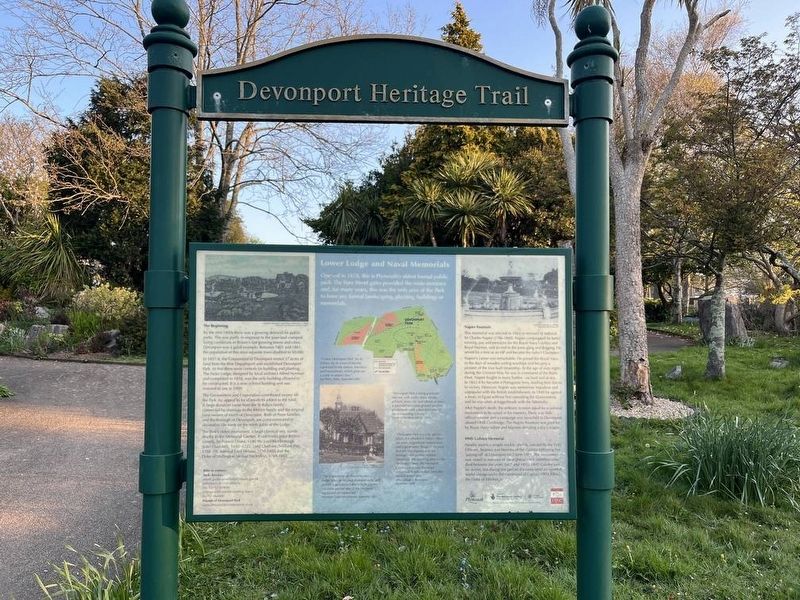
Lower Lodge and Navy Memorials
| — | Devonport Heritage Trail | — |
Photographed by Ray Gurganus, April 9, 2025
1. Lower Lodge and Navy Memorials Marker
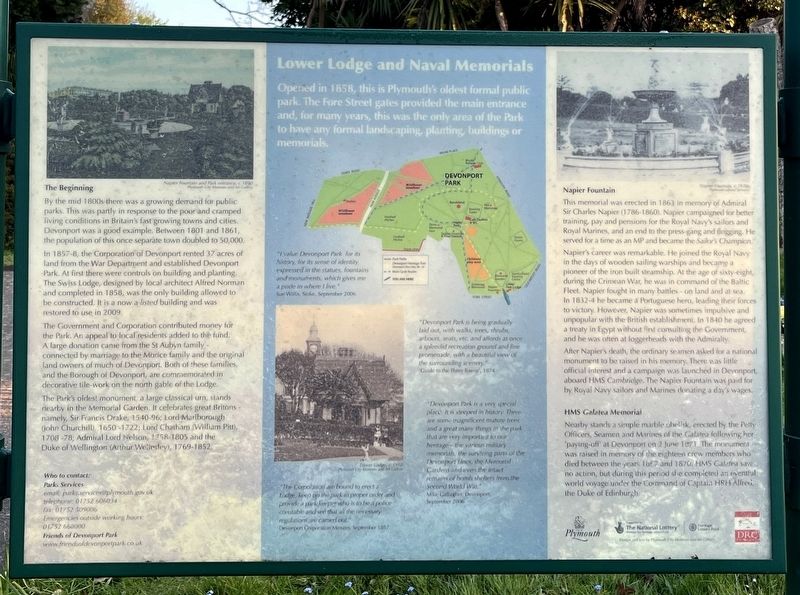
"I value Devonport Park for its history, for its sense of identity expressed in the statues, fountains, and monuments, which gives me a pride in where I live."
-- Sue Willis, Stoke, September 2006
"Devonport Park is being gradually laid out, with walks, trees, shrubs, arbours, seats, etc, and affords at once a splendid promenade with a breauticul view of the surrounding scenery."
-- Guide to the Three Towns, 1874
"Devonport Park is a very special place. It is steeped in history. There are some magnificent mature trees and a great many things in the park that are very important to heritage - the various military memorials, the surviving part of the Devonport Lines, the Memorial Gardens and even the intact remains of bomb shelters from the Second World War."
-- Mike Gallagher, Devenport, September 2006
"The Corporation are bound to erect a lodge, keep up the park in proper order
this page online
-- Devonport Corporation Minutes, September 1857
The Beginning
By the mid 1800s there was a growing demand for public parks. This was partly in response to the poor and cramped living conditions in Britain's fast growing towns and cities. Devonport was a good example. Between 1801 and 1861, the population of this once separate town doubled to 50,000.
In 1857-8, the Corporation of Devonport rented 37 acres of land from the War Department and established Devonport Park. At first there were controls on building and planting. The Swiss Lodge, designed by local architect Alfred Norman and completed in 1858, was the only building allowed to be constructed. It is a now a listed building and was restored to use in 2009.
The Government and Corporation contributed money for the Park. An appeal to local residents added to the fund A large donation came from the St Aubyn family connected by marriage to the Morice family and the original land owners of much of Devonport. Both of these families, and the Borough of Devonport,
Photographed by Ray Gurganus, April 9, 2025
2. Napier Fountain
The Park's oldest monument, a large classical urn, stands nearby in the Memorial Garden. It celebrates great Britons namely, Sir Francis Drake, 1540-96; Lord Marlborough (John Churchill), 1650-1222; Lord Chatham (William Pitt), 1708-78; Admiral Lord Nelson, 1758-1805 and the Duke of Wellington (Arthur Wellesley), 1769-1852.
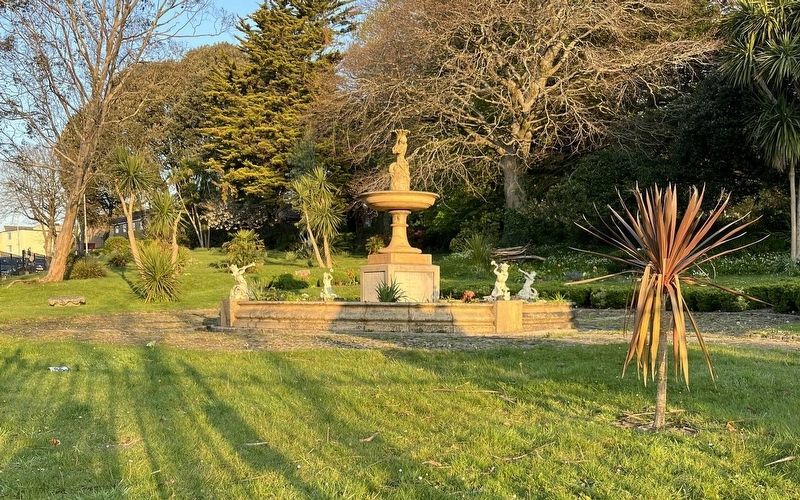
Napier Fountain
This memorial was erected in 1863 in memory of Admiral Sir Charles Napier (1786-1860). Napier campaigned for better training, pay and pension for the Royal Navy's sailors and Royal Marines, and an end to the press gang and frigging. He served for a time as an MP and became the Sailor's Champion.
Napier's career was remarkable. He joined the Royal Navy in the days of wooden sailing warships and became a pioneer of the iron built steamship. At the age of sixty-eight during the Crimean War, he was in command of the Baltic Fleet. Napier fought in many battles on land and at sea. In 1832-4 he became a Portuguese hero, leading their forces to victory. However, Napier was sometimes impulsive and unpopular with the British
Photographed by Ray Gurganus, April 9, 2025
3. Marker
After Napiers death, the ordinary seamen asked for a national monument to be raised in his memory. There was little official interest and a campaign was launched in Devonport, aboard HMS Cambridge. The Napier Fountain was paid for by Royal Navy sailors and Marines donating a day's wages.
HMS Galatea Memorial
Nearby stands a simple marble obelisk, erected by the Petty Officers, Seamen and Marines of the Galatea following her 'paying-off' at Devonport on 2 June 1871. The monument was raised in memory of the eighteen crew members who died between the years 1867 and 1870. HMS Galatea saw no action, but during this period she completed an eventful world voyage under the Command of Captain HRH Alfred, the Duke of Edinburgh.
Topics. This historical marker is listed in these topic lists: Parks & Recreational Areas • Wars, Non-US • Waterways & Vessels. A significant historical year for this entry is 1858.
Location. 50° 22.439′ N, 4° 10.269′ W. Marker is in Plymouth, England. It is in Devonport.

1905
4. Devonport Park

Regionally, this marker is in South West England. Globally, it is on the Atlantic Ocean, in the North Atlantic Region, in Europe, in Atlantic Europe, on one of the British Isles, in the Western World, and in the Anglosphere. Historically, it finds itself in what was once the Roman Empire.
Other nearby markers. At least 8 other markers are within 3 kilometers of this marker, measured as the crow flies: Richard Dunning 1761-1851 (approx. 0.3 kilometers away); Those that Fell -- DHS in World War One (approx. 0.6 kilometers away); Stoke Damerel Parish Church (approx. 0.6 kilometers away); Sir Arthur Conan Doyle (approx. 2 kilometers away); Plymouth Hoe (approx. 2 kilometers away); Beatle Bums (approx. 2.1 kilometers away); Invicta Hotel (approx. 2.1 kilometers away); Frank Bickerton (approx. 2.1 kilometers away). Touch for a list and map of all markers in Plymouth.
Credits. This page was last revised on June 3, 2025. It was originally submitted on May 27, 2025, by Ray Gurganus of Washington, District of Columbia. This page has been viewed 132 times since then and 46 times this year. Photos: 1, 2, 3. submitted on May 27, 2025, by Ray Gurganus of Washington, District of Columbia. 4. submitted on June 3, 2025. • Andrew Ruppenstein was the editor who published this page.
