
Barrie in Simcoe County, Ontario — Central Canada (North America)
Warming Up the Land
| — | Barrie Waterfront Heritage Trail | — |

Photographed by Cosmos Mariner, June 5, 2024
1. Warming Up the Land Marker
Ancient Shoreline
The process of glacial ice advancing, halting and retreating deposited a series of ridges or beach lines across Ontario. In Barrie, the last terrace of ancient Lake Algonquin rises to about 40 feet high on the north shore at the Nelson Lookout.
How Deep Was the Ice?
The maximum ice extent of the Laurentide Ice Sheet occurred approximately 25,000-21,000 years ago, when the ice sheet was up to two kilometres thick over Barrie. That's 2.65 CN towers or 95 Spirit Catchers stacked on top of each other.
Barrie Under Ice
During the most recent Ice Age, four thick sheets of glacial ice covered almost all of Canada. Barrie was covered by the Laurentide Ice Sheet. When the gradually warming climate triggered the beginning of glacial retreat around 20,000 years ago, a long succession of environmental changes signaled the end of one geological epoch, the Pleistocene and the beginning of another, the Holocene.
Extinction
About 12,800 years ago, more than three-fourths of the large Ice Age animals, including woolly mammoths, mastodons, saber-tooth tigers and giant bears, died out. One theory attributes the mass extinction
this page online
Glacial Lakes
Massive glacial ice sheets depressed the earth below relative to surrounding land. When the glaciers started to melt in southern Ontario, an enormous amount of water was released. Glacial lakes formed against the depressed land of the retreating glacier.
Lake Algonquin
Lake Algonquin formed over Barrie about 12,000 years ago, the largest proglacial lake to occupy the three upper Great Lakes. The glacial ice bordering the north edge of the lake contained silt from ground-up rock, called ‘rock flower’. It would have been a very cold and dirty lake, choked with icebergs.
Shifting Land
As the weight of the glaciers was removed, the land began to slowly spring back up, a process known as isostatic rebound. The land would be constantly changing drainage patterns and elevation; shrinking into Lake Stanley, then expanding into ancient Lake Nipissing. Finally, Lake Simcoe emerged with Kempenfelt Bay in its modern form about two thousand years ago.
First Plants
Where

2. Marker detail: 25,000 Years Ago
Southern Ontario would have been arctic tundra for the first thousand years, supporting nomadic indigenous people who hunted caribou, hare and arctic fox.
The ecosystem then changed to open spruce parkland as the glaciers continued to recede and the climate warmed.
At first dense forest of spruce replaced the open spruce parkland tundra and the pine replaced the spruce as the climate changed. White-tailed deer colonized the emerging hardwood forests followed by moose.
Climate Peak
The warming trend peaked between 8,000 and 4,000 years ago, an interval called the Altithermal or Hypsithermal. Around you, various species such as hemlock, oak, elm, maple and beech competed for dominance.
Reversal
Sometime after 4,000 years ago the general warming trend reversed, and the climate underwent a long period of deterioration, shifting between short warming and cooling trends down to our present time.
Erected by Barrie Waterfront Heritage Trail.
Topics.

3. Marker detail: 14,000 Years Ago
Location. 44° 22.444′ N, 79° 40.515′ W. Marker is in Barrie, Ontario, in Simcoe County. It can be reached from Lakeshore Drive one kilometer west of Minet's Point Road, on the right when traveling west. The marker is on the Barrie Waterfront Heritage Trail at Station #1 (Natural Heritage), ¼ km east of Military Heritage Park. Touch for map. Marker is at or near this postal address: 225 Lakeshore Drive, Barrie ON L4N 7Y9, Canada. Touch for directions.

Regionally, this marker is in Central Ontario Cottage Country and specifically in Georgian Bay Country. It is also in Central Canada. Globally, it is in North America, on the Great Lakes, in the Western Hemisphere, in the Western World, and in the Anglosphere. Historically, it finds itself in what was once a British colony, the Viceroyalty of New France, the Haudenosaunee (Iroquois) Confederacy, and Rupert’s Land.
Other nearby markers. At least 8 other markers are within

4. Marker detail: 13,000 Years Ago

5. Marker detail: 11,000 Years Ago
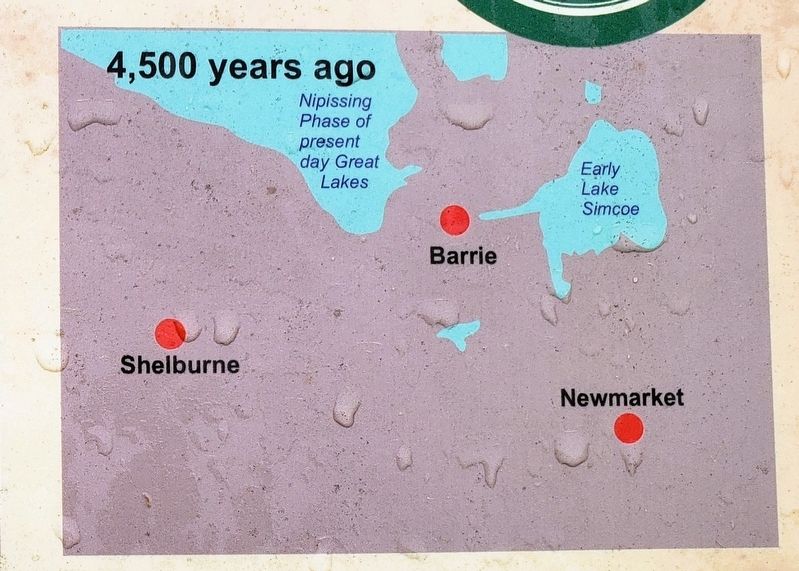
6. Marker detail: 4,500 Years Ago

Photographed by Cosmos Mariner, June 5, 2024
7. Warming Up the Land Marker
Looking east along the Barrie Waterfront Heritage Trail.
Credits. This page was last revised on May 31, 2025. It was originally submitted on May 28, 2025, by Cosmos Mariner of Cape Canaveral, Florida. This page has been viewed 100 times since then and 18 times this year. Photos: 1. submitted on May 30, 2025, by Cosmos Mariner of Cape Canaveral, Florida. 2, 3, 4, 5, 6, 7. submitted on May 31, 2025, by Cosmos Mariner of Cape Canaveral, Florida.
