
Worth Township on Blue Island in Cook County, Illinois — The American Midwest (Great Lakes)
Henry Heimbach's Store
Built c. 1915 Painted 1974-75
Photographed by Henry Flynn, May 31, 2025
1. Henry Heimbach's Store Marker
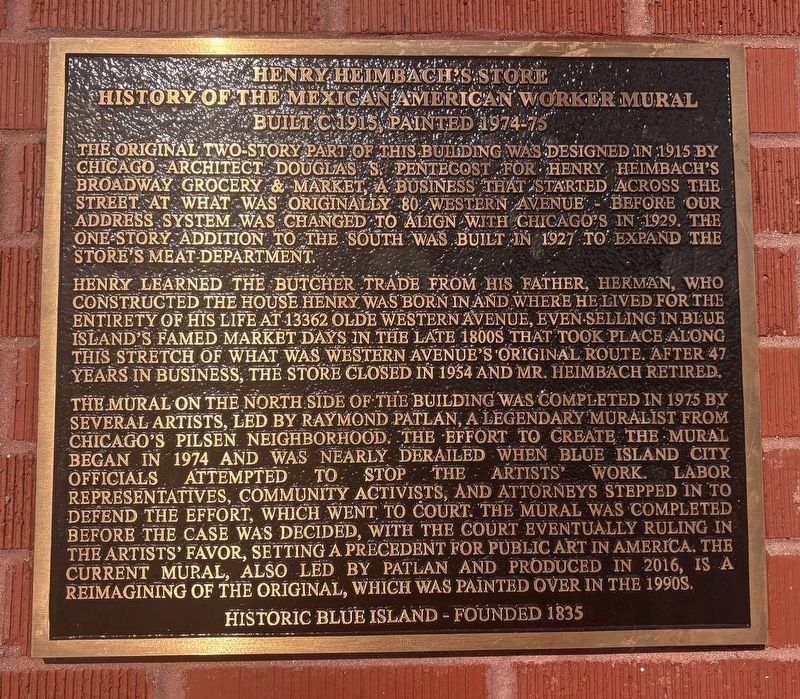
Henry learned the butcher trade from his father, Herman, who constructed the house Henry was born in and where he lived for the entirety of his life at 13362 Olde Western Avenue, even-selling in Blue Island's famed Market Days in the late 1800s that took place along this stretch of what was Western Avenue's original route. After 47 years in business, the store closed in 1954 and Mr. Heimbach retired.
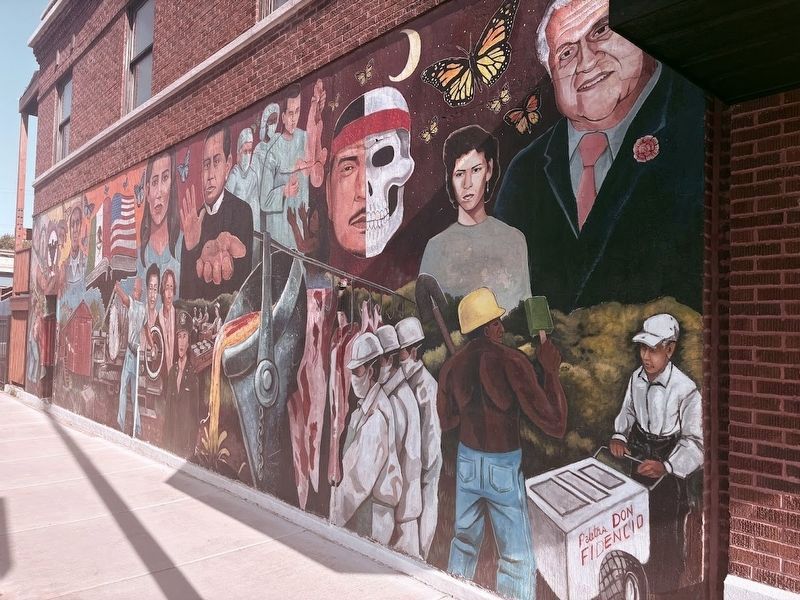
The mural on the north side of the building was completed in 1975 by several artists, led by Raymond Patlan, a legendary muralist from Chicago's Pilsen neighborhood. The effort to create the mural began in 1974 and was nearly derailed when Blue Island city officials attempted to stop the artists' work. Labor representatives,
this page online
Erected by Village of Blue Island.
Topics. This historical marker is listed in these topic lists: Hispanic Americans • Industry & Commerce • Labor Unions • Roads & Vehicles. A significant historical year for this entry is 1915.
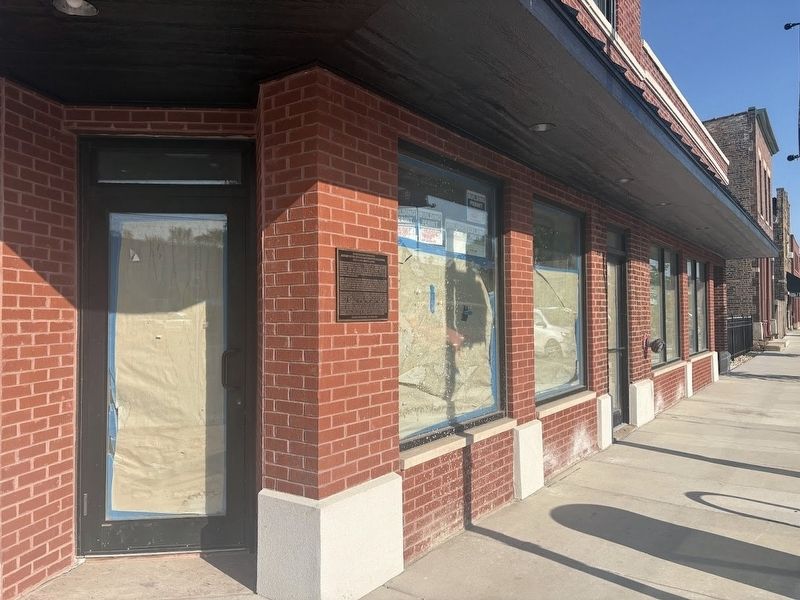
Location. 41° 39.023′ N, 87° 40.854′ W. Marker is on Blue Island, Illinois, in Cook County. It is in Worth Township. It is at the intersection of Old Western Avenue and Broadway Street on Old Western Avenue. Touch for map. Marker is at or near this postal address: 13337 Old Western Avenue, Blue Island IL 60406, United States of America. Touch for directions.

Regionally, this marker is in Greater Chicago and in the Calumet Region. It is also in the American Midwest. Globally, it is
Photographed by Henry Flynn, May 31, 2025
2. The Mexican-American mural
It faces Broadway Street. The historical marker is off-camera to the right.
Other nearby markers. At least 8 other markers are within walking distance of this marker: The "Groskopf Corner" (within shouting distance of this marker); The Klein Residence, Tavern, & Boarding House (within shouting distance of this marker); Jebens Hardware Store (within shouting distance of this marker); Herman & Sophia Heimbach House (about 300 feet away, measured in a direct line); Fiedler-Mohr Motors (about 300 feet away); Stephan & Martha Jones House (about 300 feet away); Henry & Catherine Doehler House (about 500 feet away); Blue Island's Sister Cities (about 600 feet away). Touch for a list and map of all markers in Blue Island.
More about this marker. The marker is one of several within the Olde Western Avenue historic district. While the district adds the e to "old," the official street signs do not.
Also see . . .
1. ABC 7 Chicago: Blue Island residents repaint controversial Mexican-American mural.
Photographed by Henry Flynn, May 31, 2025
3. Henry Heimbach's Store Marker
Excerpt: "'Shortly after they began to paint, city officials said you have to stop. If you continue to paint, everyone here, including the building owner, could be fined or arrested,' De Los Santos said.(Submitted on June 2, 2025, by Sean P. Flynn of Oak Park, Illinois.)
"The symbol for the United Farm Workers, the city claimed, was an ad, not art. Racial tensions boiled over."
"'People were threatening to bomb the building if the mural was completed, the windows were broken,' De Los Santos said.
Ray Patlan, the lead muralist then and now, remembers his lawyers' advice in the 70s.
"'Just keep painting and so we did. Before the court case was over, we had finished the mural. Of course, it won,' Patlan said."
2. Ray Patlán, Pioneering Chicano Artist And Pilsen Legend, Dies At 77. Patlán died in April 2024.
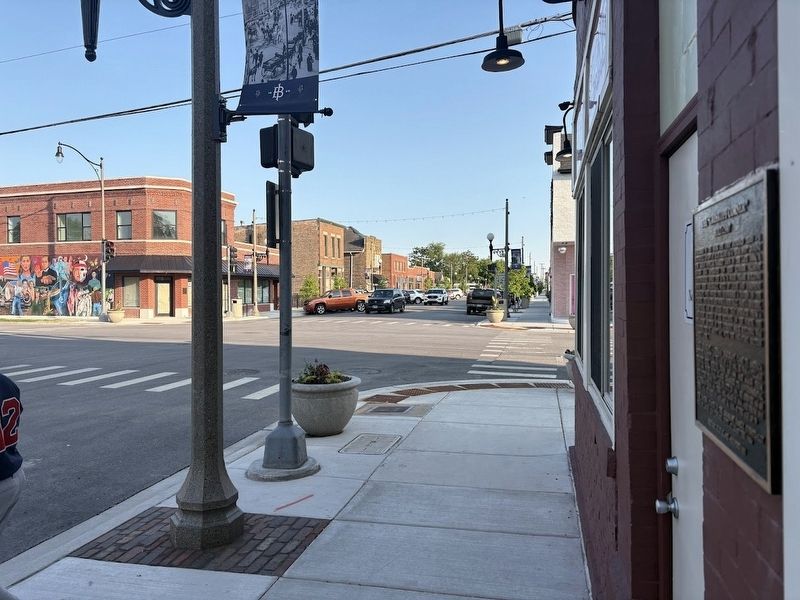
Excerpt: "Patlán started painting murals after serving in the Vietnam War. He worked on his first public art installation in the 1970s at the former Casa Aztlán community center, 1831 S. Racine Ave., which he called his 'second(Submitted on June 2, 2025, by Sean P. Flynn of Oak Park, Illinois.)home.' He had been going there since he was 10, he said. The Casa Aztlán mural — like much of Patlán’s work — was a tribute to his Mexican heritage, Chicano figures and his neighborhood. It became a Pilsen landmark and was heralded a masterpiece within the Chicano art movement, neighbors said."Photographed by Sean P. Flynn, May 31, 20254. Henry Heimbach's Store MarkerThe marker is seen on the left from across the Broadway-Old Western intersection.
3. Encyclopedia of Chicago: Blue Island, IL. The Chicago Historical Society looks at the history of Blue Island, a south suburb of Chicago.
Excerpt: "In 1901 Blue Island incorporated as a city to avoid annexation by Chicago. In 1915 residents rejected annexation while nearby Morgan Park joined Chicago. Italians, Poles, and Slovaks settled in Blue Island between 1900 and 1920, but African Americans who were excluded from the town incorporated Robbins in 1917. Population plateaued at 16,000 to 21,000 between 1930 and 1990. Despite chain stores and Western Avenue's designation as the Dixie Highway in the 1920s, the central business district declined. Political and fiscal conservatism blocked annexation of the future Alsip industrial district. Landlocked industries left the city. During the 1990s, however, the city appeared to revive slowly. Old industries such as Modern Drop Forge and Clark Oil Refineries thrived, while antique stores, theaters, and Mexican restaurants lined Western Avenue."(Submitted on June 2, 2025, by Sean P. Flynn of Oak Park, Illinois.)
Credits. This page was last revised on September 7, 2025. It was originally submitted on June 2, 2025, by Sean P. Flynn of Oak Park, Illinois. This page has been viewed 146 times since then and 28 times this year. Photos: 1, 2, 3, 4. submitted on June 2, 2025, by Sean P. Flynn of Oak Park, Illinois.
