Wasaga Beach in Simcoe County, Ontario — Central Canada (North America)
Nottawasaga River Brings First Inhabitants
Photographed by Cosmos Mariner, June 6, 2024
1. Nottawasaga River Brings First Inhabitants Marker
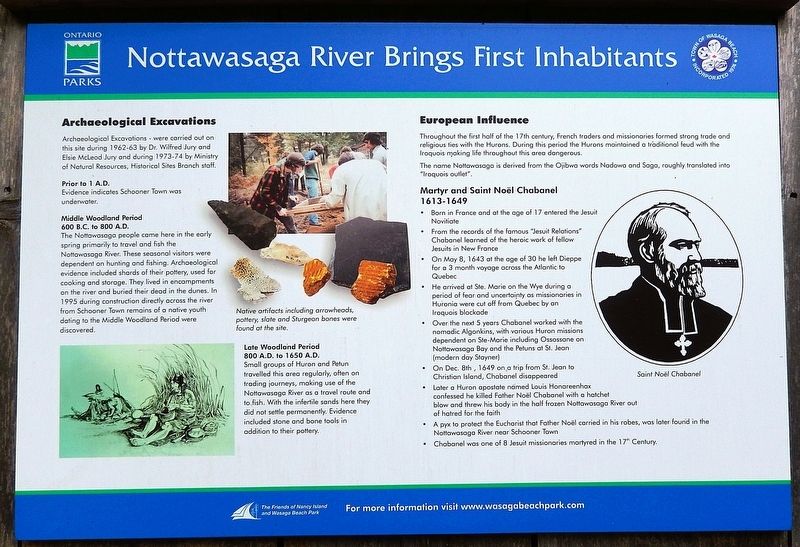
Archaeological Excavations
Archaeological Excavations were carried out on this site during 1962-63 by Dr. Wilfred Jury and Elsie McLeod Jury and during 1973-74 by Ministry of Natural Resources, Historical Sites Branch staff.
Prior to 1 A.D.
Evidence indicates Schooner Town was underwater.
Middle Woodland Period
600 B.C. to 800 A.D.
The Nottawasaga people came here in the early spring primarily to travel and fish the Nottawasaga River. These seasonal visitors were dependent on hunting and fishing. Archaeological evidence included shards of their pottery, used for cooking and storage. They lived in encampments on the river and buried their dead in the dunes. In 1995 during construction directly across the river from Schooner Town remains of a native youth dating to the Middle Woodland Period were discovered.
Late Woodland Period
800 A.D. to 1650 A.D.
Small groups of Huron and Petun travelled this area regularly, often on trading journeys, making use of the Nottawasaga River as a travel route and to fish. With the infertile sands here they did not settle permanently. Evidence included stone and bone tools in addition to their pottery.
this page online
European Influence
Throughout the first half of the 17th century, French traders and missionaries formed strong trade and religious ties with the Hurons. During this period the Hurons maintained a traditional feud with the Iroquois making life throughout this area dangerous. The name Nottawasaga is derived from the Ojibwa words Nadowa and Saga, roughly translated into “Iroquois outlet”.
Martyr and Saint Noël Chabanel
1613-1649
• Born in France and at the age of 17 entered the Jesuit Novitiate
• From the records of the famous “Jesuit Relations” Chabanel learned of the heroic work of fellow Jesuits in New France
• On May 8, 1643 at the age of 30 he left Dieppe for a 3 month voyage across the Atlantic to Quebec
• He arrived at Ste. Marie on the Wye during a period of fear and uncertainty as missionaries in Huronia were cut off from Quebec by an Iroquois blockade
• Over the next 5 years Chabanel worked with the nomadic Algonkins, with various Huron missions dependent on Ste-Marie including Ossossane on Nottawasaga Bay and the Petuns at St. Jean (modern day Stayner)
• On Dec. 8th, 1649 on a trip from St. Jean to Christian Island, Chabanel disappeared
•
Photographed by Cosmos Mariner, June 6, 2024
2. Nottawasaga River Brings First Inhabitants Marker
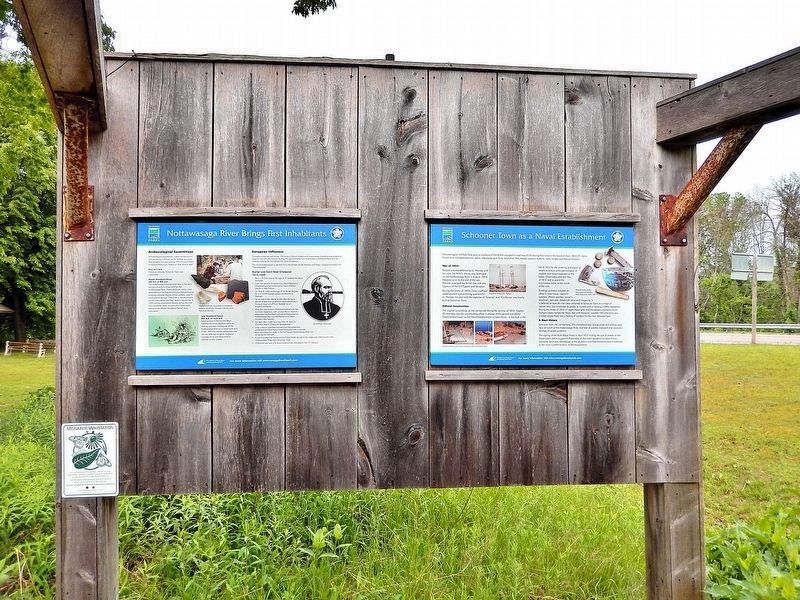
This is the leftmost of two markers mounted on the back side of a large wooden Wasaga Beach sign. River Road West can be seen in the right background.
• A pyx to protect the Eucharist that Father Noël carried in his robes, was later found in the Nottawasaga River near Schooner Town
• Chabanel was one of 8 Jesuit missionaries martyred in the 17th Century.
[photo caption] Native artifacts including arrowheads, pottery, slate and Sturgeon bones were found at the site.
Erected by The Friends of Nancy Island and Wasaga Beach Park.
Topics. This historical marker is listed in these topic lists: Anthropology & Archaeology • Indigenous Peoples and Communities • Settlements & Settlers • Waterways & Vessels.
Location. 44° 29.421′ N, 80° 2.856′ W. Marker is in Wasaga Beach, Ontario, in Simcoe County. It can be reached from Oxbow Park Drive just south of River Road West (County Road 92), on the right when traveling south. The marker is located at the north end of the Sunset Court cul-de-sac in Schoonertown Parkette. Touch for map. Marker
Photographed by Cosmos Mariner, June 6, 2024
3. Wasaga Beach Sign
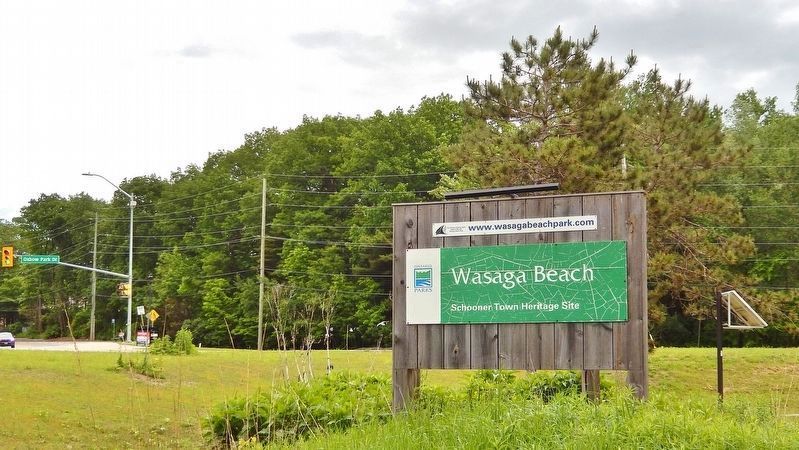
Looking east; River Road West is in the left background. The marker is mounted on the back side of this sign at the Schooner Town Heritage Site.

Regionally, this marker is in Central Ontario Cottage Country and specifically in Georgian Bay Country. It is also in Central Canada. Globally, it is in North America, on the Great Lakes, in the Western Hemisphere, in the Western World, and in the Anglosphere. Historically, it finds itself in what was once a British colony, the Viceroyalty of New France, the Haudenosaunee (Iroquois) Confederacy, and Rupert’s Land.
Other nearby markers. At least 8 other markers are within 13 kilometers of this marker, measured as the crow flies: Schooner Town as a Naval Establishment (here, next to this marker); Schooner Town (here, next to this marker); The Muirhead Cabin (approx. 4.2 kilometers away); Stayner (formerly Nottawasaga Station) (approx. 8.4 kilometers away); The Founding of Stayner (approx. 8.7 kilometers away); Shannon's Bridge (approx. 12.2 kilometers away); Edenvale Park (approx. 12.4 kilometers away); Glengarry Landing / Le débarquement du « Glengarry » (approx. 12.4 kilometers away). Touch for a list and map of all markers in Wasaga Beach.
Also see . . . Noël Chabanel (Wikipedia).
Excerpt: In 1643, he was sent to New France along with Leonard Garreau and Gabriel Druillettes. Chabanel was sent to assist Jean de Brébeuf at the mission of Saint Louis (near the present day hamlet of Victoria Harbour), but was replaced in February 1649 by Gabriel Lalemant. Chabanel was sent to help Charles Garnier among the Petun. One month later, Brébeuf and Lalemant were captured in an Iroquois raid on the St. Louis mission and taken to the nearby mission off St. Ignace where they were killed. In early December 1649, Chabanel was directed to go to St. Joseph Island. Chabanel was martyred on December 8, 1649, by what is described as a "renegade" Huron. There was a strong presumption that he was killed by the man who offered to carry him across. Paul Ragueneau, Provincial Superior, noted that Louis Honarreennha was known to have believed and spread a false rumor that the French had betrayed the Huron and made a secret treaty with the Iroquois; and later admitted that he killed Chabanel. Noël Chabanel was canonized by Pope Pius XI on 29 June 1930.(Submitted on June 8, 2025, by Cosmos Mariner of Cape Canaveral, Florida.)
Credits. This page was last revised on June 9, 2025. It was originally submitted on June 8, 2025, by Cosmos Mariner of Cape Canaveral, Florida. This page has been viewed 219 times since then and 81 times this year. Photos: 1, 2, 3. submitted on June 8, 2025, by Cosmos Mariner of Cape Canaveral, Florida.
