Bay City in Bay County, Michigan — The American Midwest (Great Lakes)
Medicine Wheel Garden
Photographed by Craig Doda, August 25, 2024
1. Medicine Wheel Garden Marker
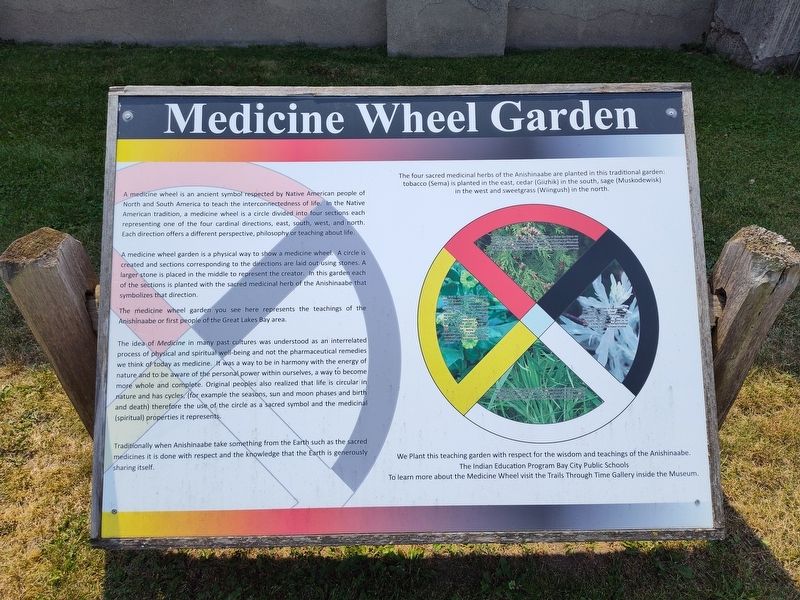
A medicine wheel is an ancient symbol respected by Native American people of North and South America to teach the interconnectedness of life. In the Native American tradition, a medicine wheel is a circle divided into four sections, each representing one of the four cardinal directions, east, south, west, and north. Each direction offers a different perspective, philosophy, or teaching about life.
A medicine wheel garden is a physical way to show a medicine wheel. A circle is created and sections corresponding to the directions are laid out using stones. A larger stone is placed in the middle to represent the creator. In this garden each of the sections is planted with the sacred medicinal herb of the Anishinaabe that symbolizes that direction.
The medicine wheel garden you see here represents the teachings of the Anishinaabe or first people of the Great Lakes Bay area.
The idea of Medicine in many past cultures was understood as an interrelated process of physical and spiritual well-being and not the pharmaceutical remedies we think of today as medicine. It was a way to be in harmony with the energy of nature and
this page online
Traditionally when Anishinaabe take something from the Earth such as the sacred medicines it is done with respect and the knowledge that the Earth is generously sharing itself.
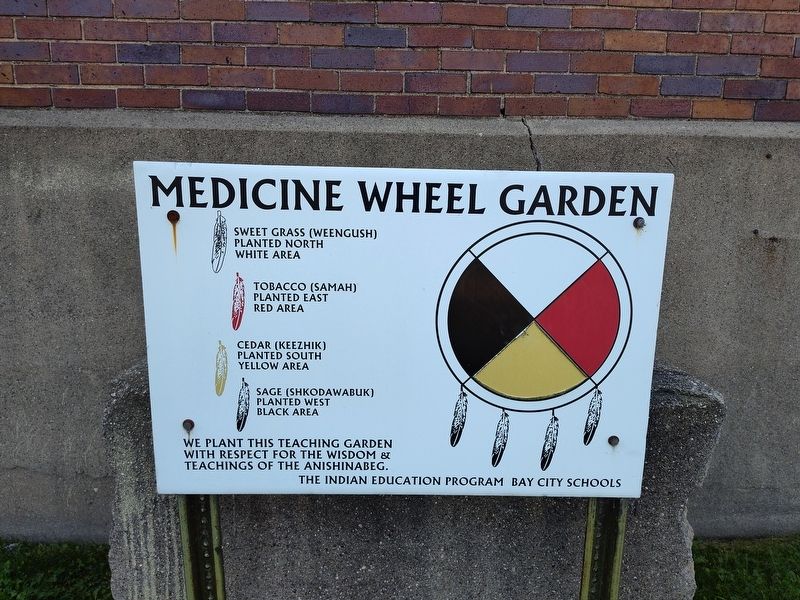
The four sacred medicinal herbs of the Anishinaabe are planted in this traditional garden: tobacco (Sema) is planted in the east, cedar (Giizhik) in the south, sage (Muskodewisk) in the west and sweetgrass (Wiingush) in the north.
The South is represented by the sacred herb Giizhik, or Cedar. The leaves are cleaned from the stems and separated into small pieces that are used in many ways. Giizhik is used in prayer and burned for smudging. When burned, Giizhik acts as a purifier, cleansing the area in which it is burned and emitting a pleasant scent. Traditionally, many Anishinaabe carry cedar with them to help keep the
Photographed by Craig Doda, August 25, 2024
2. Medicine Wheel Garden Marker
The East is represented by the sacred plant Sema, or tobacco. Sema is used by the Anishinaabe in thanks and for offering prayer to the creator and acts as a medium for communication. It is either offered to the fire so the smoke can lift the prayers to the Creator, or it is set on the ground in a clean place. Traditionally this is done on a daily basis as each new day is greeted with prayers of thankfulness. The Elders say to hold it in your left hand during prayers of thankfulness. Also, it is always respectful to offer Sema when seeking knowledge or advice from an Elder or when a Pipe is present.
The Western direction is represented by Muskodewisk, or Sage. Sage is used in much the same way the Giizhik is used. Traditionally it is used as a smudge to spiritually cleanse an area prior to an event; it helps to remove the bad feelings and to increase a positive frame of mind.
The Northern direction is represented by Wiingush or Sweetgrass. It is known for its beautifully sweet, aromatic scent which is enhanced when it rains or is burned. Sweetgrass is a purifier and is used to smudge our head and bring positive thoughts
Photographed by Craig Doda, August 25, 2024
3. Medicine Wheel Garden Marker
We plant this teaching garden with respect for the wisdom and teachings of the Anishinaabe. The Indian Education Program Bay City Public Schools. To learn more about the Medicine Wheel visit the Trails Through Time Gallery inside the Museum.
Topics. This historical marker is listed in these topic lists: Anthropology & Archaeology • Horticulture & Forestry • Indigenous Peoples and Communities • Science & Medicine.
Location. 43° 35.642′ N, 83° 53.349′ W. Marker is in Bay City, Michigan, in Bay County. It is at the intersection of 9th Street and Saginaw Street, on the right when traveling east on 9th Street. Touch for map. Marker is at or near this postal address: 321 Washington Ave, Bay City MI 48708, United States of America. Touch for directions.

Regionally, this marker is in Mid-Michigan and in one of the Lake Huron Shore counties. It is also in the American Midwest. Globally, it is in North America, on the Great Lakes, in the Western Hemisphere, in the Western World, and in the Anglosphere. Historically, it finds itself in what was once the Northwest Territory.
Other nearby markers. At least 8 other markers are within walking distance of this marker: Barbara Walworth (within shouting distance of this marker); Aaliyah (within shouting distance of this marker); Madonna (within shouting distance of this marker); Roll of Honor (within shouting distance of this marker); Steven Parkhurst (within shouting distance of this marker); Abraham Lincoln (within shouting distance of this marker); Sara Brooks Clark (about 300 feet away, measured in a direct line); Keit's Florist (approx. 0.2 miles away). Touch for a list and map of all markers in Bay City.
Credits. This page was last revised on June 16, 2025. It was originally submitted on August 29, 2024, by Craig Doda of Napoleon, Ohio. This page has been viewed 518 times since then and 119 times this year. Last updated on June 16, 2025, by John D Grabenstein of Easton, Maryland. Photos: 1, 2, 3. submitted on August 29, 2024, by Craig Doda of Napoleon, Ohio. • Devry Becker Jones was the editor who published this page.
