Plymouth in Washington County, North Carolina — The American South (South Atlantic)
Why Plymouth?
Willing Citizens, Opportunity, Transportation
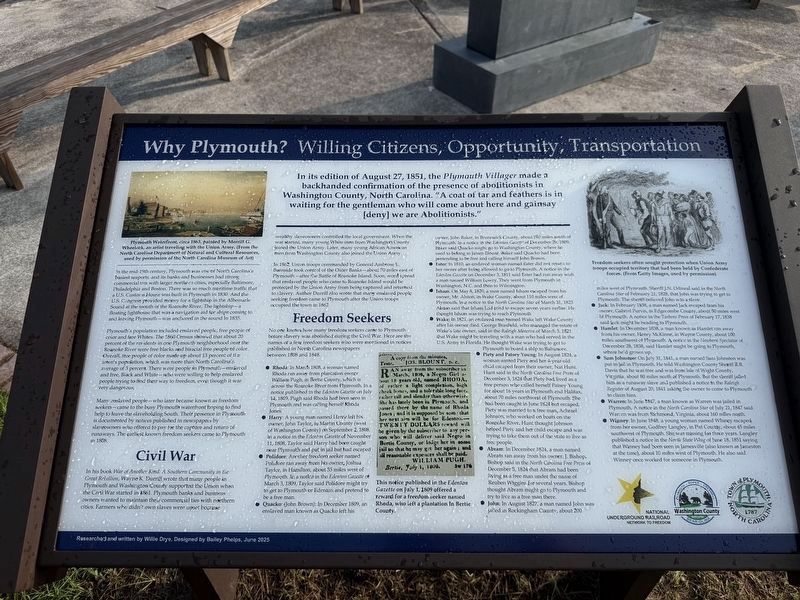
In the mid-19th century, Plymouth was one of North Carolina's busiest seaports, and its banks and businesses had strong commercial tires with larger northern cities, especially Baltimore, Philadelphia and Boston. There was so much maritime traffic that a U.S. Customs House was built in Plymouth in 1830. And the U.S. Congress provided money for a lightship in the Albemarle Sound at the mouth of the Roanoke River. The lightship — a floating lighthouse that was a navigation aid for ships coming to and leaving Plymouth — was anchored in the sound in 1835.
Plymouth's population included enslaved people, free people of color and free Whites. The 1860 Census showed that about 20 percent of the residents in one Plymouth neighborhood near the Roanoke River were free blacks and biracial free people of color. Overall, free people of color made
this page online
Many enslaved people — who later became known as freedom seekers — came to the busy Plymouth waterfront hoping to find help to leave the slaveholding South. Their presence in Plymouth is documented by notices published in newspapers by slaveowners who offered to pay for the capture and return of runaways. The earliest known freedom seekers came to Plymouth in 1808.
In 1862, Union troops commanded by General Ambrose E. Burnside, took control of the Outer Banks — about 70 miles east of Plymouth — after the Battle of Roanoke Island. Soon, word spread that enslaved people who came to Roanoke Island, would be protected by the Union Army from being captured and returned to slavery. Author Durrill also wrote that many enslaved people seeking freedom came to Plymouth after the Union troops occupied the town in 1862.
• Rhoda: In March 1808, a woman named Rhoda ran away from plantation owner William Pugh, in Bertie County, which is across the Roanoke River from Plymouth. In a notice published in the Edenton Gazette on July 14, 1809, Pugh said Rhoda had been seen in Plymouth and was calling herself Rhoda Jones.
• Harry: A young man named Harry left his owner, John Taylor, in Martin County (west of Washington County) on September 2, 1808. In a notice in the Edenton Gazette of November 11, 1808, Taylor said Harry had been caught near Plymouth and put in jail but had escaped.
• Polidor: Another freedom seeker named Polidore ran away from his owner, Joshua Taylor, in Hamilton, about 35 miles west of Plymouth. In a notice in the Edenton Gazette of March 3, 1809, Taylor said Polidore might try to get to Plymouth or Edenton and pretend to be a free man.
• Quacko: (John Brown): In December 1809, an enslaved man known as Quacko left his owner, John Baker, in Brunswick County, about 180 miles south of Plymouth. In a notice in the Edenton Gazette of December 29, 1809, Baker said Quacko might go to Washington County, where he used to belong to James Blount. Baker said Quacko had been pretending to be free and calling himself John Brown.
• Ester: In 1810, an enslaved woman named Ester did not return to her owner after being allowed to go to Plymouth. A notice in the Edenton Gazette on December 3, 1811 said Ester had run away with a man named William Lowry. They went from Plymouth to Washington, N.C. and then to Wilmington.
• Isham: On May 8, 1820, a man named Isham escaped from his owner, Mr. Alston, in Wake County, about 110 miles west of Plymouth. In a notice in the North Carolina Star of March 31, 1823 Alston said that Isham was trying to reach Plymouth.
• Wake: In 1821, an enslaved man named Wake left Wake County after his owner died. George Brasfield, who managed the estate of Wake's late owner, said in the Raleigh Minerva of March 3, 1821 that Wake might be traveling with a man who had served in the U.S. Army in Florida. He thought Wake was trying to get to Plymouth to board a ship to Baltimore.
• Piety and Patsey Young: In August 1824, a woman named Piety and her 4-year-old child escaped from their owner, Nat Hunt. Hunt said that in the North Carolina Free Press of December 3, 1824 that Piety had lived as a free person who called herself Patsey Young for about 16 years in Plymouth and Halifax, about 70 miles northwest of Plymouth. She had been caught in June 1824 but escaped. Piety was married to a free man, Archrael Johnson, who worked on boats on the Roanoke River. Hunt thought Johnson helped Piety and her child escape and was trying to take them out of the state to live as free people.
• Abram: In December 1824, a man named Abram ran away from his owner, J. Bishop. Bishop said in the North Carolina Free Pressof December 3, 1824 that Abram had been living as a free man under the name of Reuben Wiggins for several years. Bishop thought Abram might go to Plymouth and try to live as a free man there.
• John: In August 1827, a man named John was jailed in Rockingham County, about 200 miles west of Plymouth. Sheriff J.N. Odineal said in the North Carolina Star of February 21, 1828, that John was trying to get to Plymouth. The sheriff believed John was a slave.
• Jack: In February 1838, a man named Jack escaped from his owner, Gabriel Purvis, in Edgecombe County, about 50 miles west of Plymouth. A notice in the Tarboro Press of February 17, 1838 said Jack might be heading to Plymouth.
• Hamlet: In December 1838, a man known as Hamlet ran away from his owner, Henry McKinne, in Wayne County, about 100 miles southwest of Plymouth. A notice in the Newbern Spectator of December 28, 1838, said Hamlet might be going to Plymouth where he'd grown up.
• SAm Johnston: On July 31, 1841, a man named Sam Johnston was put in jail in Plymouth. He told Washington County Sheriff R.B. Davis that he was free and was from Isle of Wight County, Virginia, about 80 miles north of Plymouth. But the sheriff jailed him as a runaway slave and published a notice in the Raleigh Register of August 20, 1841 asking the owner to come to Plymouth to claim him.
• Warren: In June 1847, a man known as Warren was jailed in Plymouth. A notice in the North Carolina Star of July 21, 1847 said Warren was from Richmond, Virginia, about 160 miles north.
• Winney: In June 1848, a young woman named Winney escaped from her owner, Godfrey Langley, in Pitt County, about 45 miles southwest of Plymouth. She was missing for three years. Langley published a notice in the North State Whig of June 18, 1851 saying that Winney had been seen in Jamesville (also known as Jameston at the time), about 10 miles west of Plymouth. he also said Winney once worked for someone in Plymouth.
[Captions:]
Plymouth Waterfront, circa 1863, painted by Merrill G. Wheelock, an artist traveling with the Union Arm. (From the North Carolina Department of Natural and Cultural Resources, used by permission of the North Carolina Museum of Art)
This notice published in the Edenton Gazette on July 1, 1809 offered a reward for a freedom seeker named Rhoda, who left a plantation in Bertie County.
Freedom seekers often sought protection when Union Army troops occupied territory that had been held by Confederate forces. (From Getty Images, used by permission)
Erected 2025 by Underground Railroad Network to Freedom; Washington County, North Carolina; Town of Plymouth, North Carolina.
Topics and series. This historical marker is listed in these topic lists: Abolition & Underground RR • African Americans • Law Enforcement • War, US Civil. In addition, it is included in the Lighthouses, and the Network to Freedom series lists. A significant historical date for this entry is February 21, 1828.
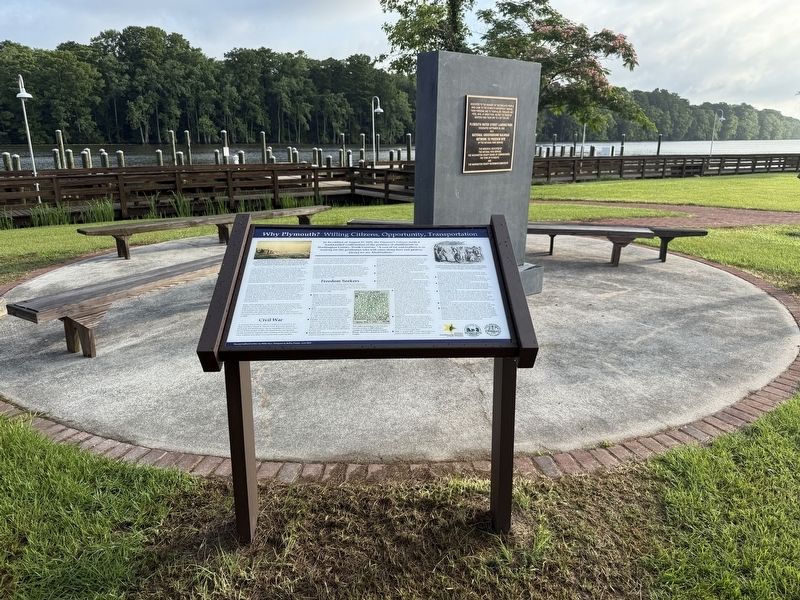
Location. 35° 51.988′ N, 76° 45.232′ W. Marker is in Plymouth, North Carolina, in Washington County. It is at the intersection of West Water Street and Monroe Street, on the right when traveling west on West Water Street. Touch for map. Marker is at or near this postal address: 215 W Water St, Plymouth NC 27962, United States of America. Touch for directions.

Regionally, this marker is in North Carolina’s Coastal Plain. It is also in the American South, specifically in the Upper South, in the Tidewater, and on the Eastern Seaboard. Globally, it is in the North Atlantic Region, North America, the Western Hemisphere, the Western World, and the Anglosphere. Historically, it finds itself in what was once the territory of the Mississippian Culture, one of the original Thirteen Colonies, one of the Confederate States of America, and the Antebellum South.
Other nearby markers. At least 8 other markers are within walking distance of this marker: Plymouth Water Street Landing Park (here, next to this marker); Plymouth was at the Center of the Underground Railroad in North Carolina (here, next to this marker); Roanoke River Lighthouse (a few steps from this marker); Hampton Academy (approx. 0.2 miles away); Brick House Landing (approx. 0.2 miles away); Augustin Daly (approx. ¼ mile away); Battle of Plymouth (approx. ¼ mile away); Cushing’s Torpedo (approx. ¼ mile away). Touch for a list and map of all markers in Plymouth.
Another marker is no longer nearby. Battle of Plymouth (was approx. ¼ mile away but has been replaced with another marker now near it).
Credits. This page was last revised on June 22, 2025. It was originally submitted on June 22, 2025, by Devry Becker Jones of Washington, District of Columbia. This page has been viewed 190 times since then and 37 times this year. Photos: 1, 2. submitted on June 22, 2025, by Devry Becker Jones of Washington, District of Columbia.
