Edenton in Chowan County, North Carolina — The American South (South Atlantic)
Maritime Underground Railroad
Escape by Sea
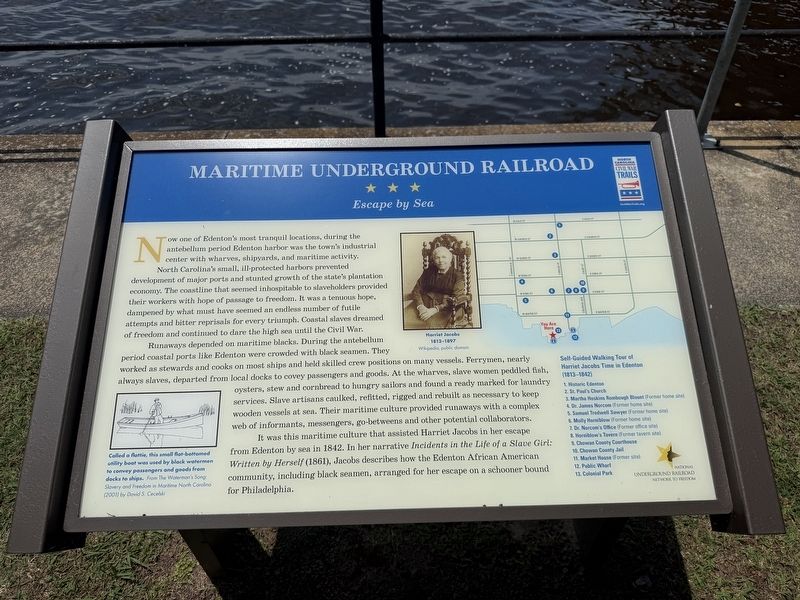
Now one of Edenton's most tranquil locations, during the antebellum period Edenton harbor was the town's industrial center with wharves, shipyards, and maritime activity. North Carolina's small ill-protected harbors prevented development of major ports and stunted growth of the state's plantation economy. The coastline that seemed inhospitable to slaveholders provided their workers with hope and of passage to freedom. It was a tenuous hope, dampened by what must have seemed an endless number of futile attempts and bitter reprisals for every triumph. Coastal slaves dreamed of freedom and continued to dare the high sea until the Civil War.
Runaways depended on maritime blacks. During the antebellum period coastal ports like Edenton were crowded with black seamen. They worked as stewards and cooks on most ships and held skilled crew positions on many vessels. Ferrymen, nearly always slaves, departed from local docks to covey passengers and goods. At the wharves, slave women peddled fish, oysters, stew and cornbread to hungry sailors and found a ready marked for laundry services. Slave artisans caulked, refitted, rigged
this page online
It was this maritime culture that assisted Harriet Jacobs in her escape from Edenton by sea in 1842. In her narrative Incidents in the Life of a Slave Girl: Written by Herself (1861), Jacobs describes how the Edenton African American community, including black seamen, arranged for her escape on a schooner bound for Philadelphia.
[Captions:]
Called a flattie, this small flat-bottomed utility boat was used by black watermen to convey passengers and goods from docks to ships. From The Waterman's Song: Slavery and Freedom in Maritime North Carolina (2001) by David S. Cecelski
Self-Guided Walking Tour of Harriet Jacobs Time in Edenton (1813-1842)
Erected by North Carolina Civil War Trails; National Underground Railroad Network to Freedom.
Topics and series. This historical marker is listed in these topic lists: Abolition & Underground RR • African Americans • Waterways & Vessels • Women. In addition, it is included

Location. 36° 3.37′ N, 76° 36.644′ W. Marker is in Edenton, North Carolina, in Chowan County. It is on Dock Street south of West Water Street, on the left when traveling south. Touch for map. Marker is at or near this postal address: 7 Dock St, Edenton NC 27932, United States of America. Touch for directions.

Regionally, this marker is in the Coastal Plain. It is also in the American South, specifically in the Upper South, in the Tidewater, and on the Eastern Seaboard. Globally, it is in the North Atlantic Region, North America, the Western Hemisphere, the Western World, and the Anglosphere. Historically, it finds itself in what was once the territory of the Mississippian Culture, one of the original Thirteen Colonies, one of the Confederate States of America, and the Antebellum South.
Other nearby markers. At least 8 other markers are within walking distance of this marker: 1886 Roanoke River Lighthouse (a few steps from this marker); Roanoke River Lighthouse (within shouting distance of this marker); Silent Service Memorial (about 300 feet away, measured in a direct line); Edenton (about 300 feet away); Penelope Barker (about 300 feet away); Penelope Barker House (about 300 feet away); Edenton Bell Battery (about 400 feet away); Sea Port Fame Brings Famous Forefathers — Nation's Leaders, to Edenton (about 400 feet away). Touch for a list and map of all markers in Edenton.
Another marker is no longer nearby. Escape Via Maritime Underground Railroad (was within shouting distance of this marker but has been replaced with another marker now near it).
Related marker. Click here for another marker that is related to this marker. This marker has replaced the linked marker.
Credits. This page was last revised on June 22, 2025. It was originally submitted on June 22, 2025, by Devry Becker Jones of Washington, District of Columbia. This page has been viewed 184 times since then and 29 times this year. Photos: 1, 2. submitted on June 22, 2025, by Devry Becker Jones of Washington, District of Columbia.
