Courtland in Southampton County, Virginia — The American South (Mid-Atlantic)
Slave Revolts
Rising Up for Freedom
| — | Nat Turner Trail: 1831 Southampton Insurrection | — |
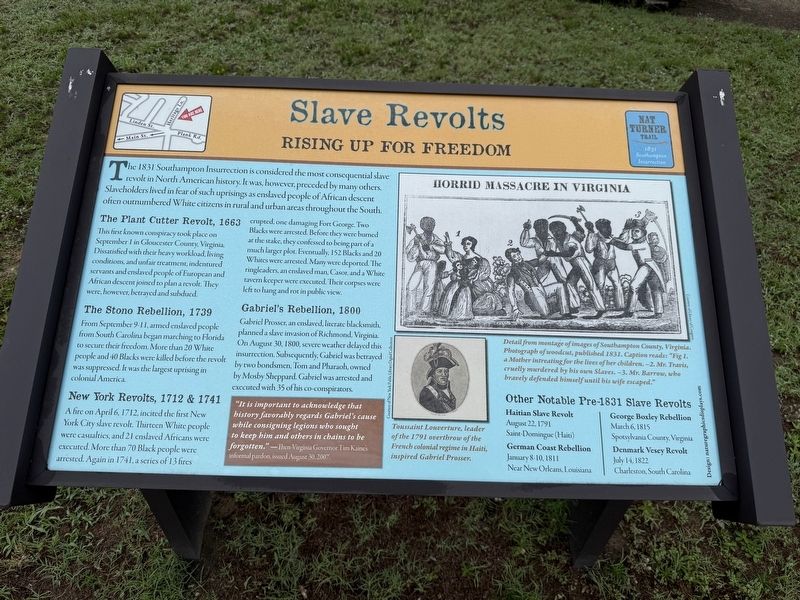
The 1831 Southampton Insurrection is considered the most consequential slave revolt in North American history. It was, however, preceded by many others. Slaveholders lived in fear of such uprisings as enslaved people of African descent often outnumbered White citizens in rural and urban areas throughout the South.
The Plant Cutter Revolt, 1663
This first known conspiracy took place on September 1 in Gloucester County, Virginia. Dissatisfied with their heavy workload, living conditions, and unfair treatment, indentured servants and enslaved people of European and African descent joined to plan a revolt. They were, however, betrayed and subdued.
The Stono Rebellion, 1739
From September 9-11, armed enslaved people from South Carolina began marching to Florida to secure their freedom. More than 20 Blacks were killed before the revolt was suppressed. It was the largest uprising in colonial America.
New York Revolts, 1712 & 1741
A fire on April 6, 1712, incited the first New York City slave revolt. Thirteen White people were casualties, and 21 enslaved Africans were executed. More than 70 Black people were arrested.
this page online
Gabriel's Rebellion, 1800
Gabriel Prosser, an enslaved, literate blacksmith, planned a slave invasion of Richmond, Virginia. ON August 30, 1800, severe weather delayed this insurrection. Subsequently, Gabriel was betrayed by two bondsmen, Tom and Pharaoh, owned by Mosby Sheppard. Gabriel was arrested and executed with 35 of his co-conspirators.
"It is important to acknowledge that history favorably regards Gabriel's cause while consigning legions who sought to keep him and others in chains to be forgotten." — Then-Virginia Governor Tim Kaine's informal pardon, issued August 30, 2007.
Other Notable Pre-1831 Slave Revolts
Haitian Slave Revolt
August 22, 1791
Saint-Domingue (Haiti)
German Coast Rebellion
January 8-10, 1811
Near New Orleans, Louisiana
George Boxley Rebellion
March 6, 1815
Spotsylvania County, Virginia
Denmark Vesey Revolt
July 14, 1822
Charleston, South Carolina
[Captions:]
Detail from montage of images of Southampton County, Virginia. Photograph of woodcut, published 1831. Captains reads: "Fig 1. a mother intreating for the lives of her children. —2. Mr. Travis, cruelly murdered by his own Slaves. —3. Mr. Barrow, who bravely defended himself until his wife escaped."
Toussaint Louverture, leader of the 1791 overthrow of the French colonial regime in Haiti, inspired Gabriel Prosser.
Erected by Nat
Topics and series. This historical marker is listed in these topic lists: Abolition & Underground RR • African Americans • Colonial Era • Law Enforcement. In addition, it is included in the Nat Turner Trail: 1831 Southampton Insurrection series list. A significant historical year for this entry is 1831.
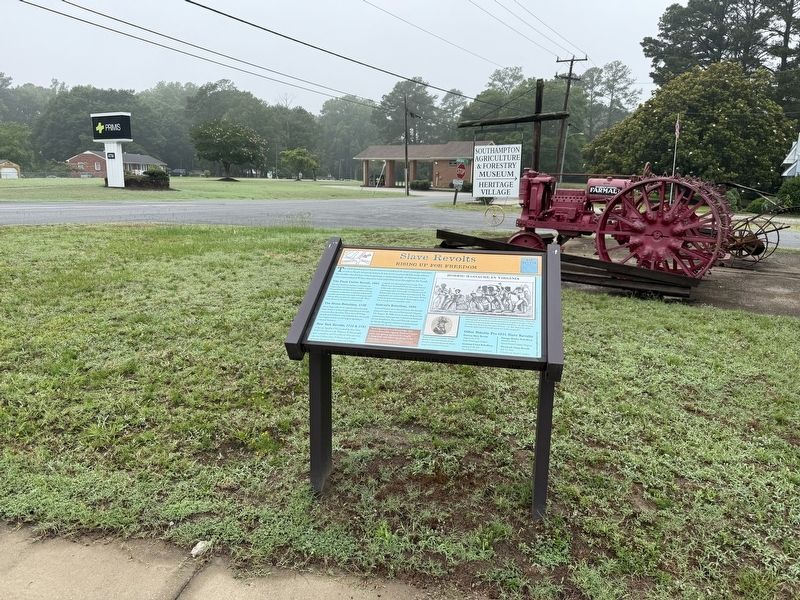
Location. 36° 42.646′ N, 77° 3.468′ W. Marker is in Courtland, Virginia, in Southampton County. It is at the intersection of Linden Street and Heritage Lane, on the right when traveling north on Linden Street. Touch for map. Marker is at or near this postal address: 22541 Linden St, Courtland VA 23837, United States of America. Touch for directions.

Regionally, this marker is in Coastal Virginia and in the Hampton Roads Metropolitan Area. It is also in the American South, specifically in the Upper South, and in the Tidewater. Globally, it is in North America, the Western Hemisphere, the Western World, and the Anglosphere. Historically, it finds itself in what was once the territory of the Mississippian Culture, one of the original Thirteen Colonies, one of the Confederate States of America, and the Antebellum South.
Other nearby markers. At least 8 other markers are within walking distance of this marker: Slavery's Roots (here, next to this marker); Conditions of Slavery (a few steps from this marker); The 1831 Insurrection (within shouting distance of this marker); Rebecca Vaughan House (within shouting distance of this marker); St. Luke's Church (approx. half a mile away); Seven Gables (approx. half a mile away); Rochelle-Prince House (approx. half a mile away); Southampton County (approx. half a mile away). Touch for a list and map of all markers in Courtland.
Another marker is no longer nearby. The Rebecca Vaughan House (was within shouting distance of this marker but has been replaced with another marker now near it).
Credits. This page was last revised on June 24, 2025. It was originally submitted on June 24, 2025, by Devry Becker Jones of Washington, District of Columbia. This page has been viewed 221 times since then and 36 times this year. Photos: 1, 2. submitted on June 24, 2025, by Devry Becker Jones of Washington, District of Columbia.
