Near Meeker in Rio Blanco County, Colorado — The American Mountains (Southwest)
Ute Indians at the Battle of Milk Creek
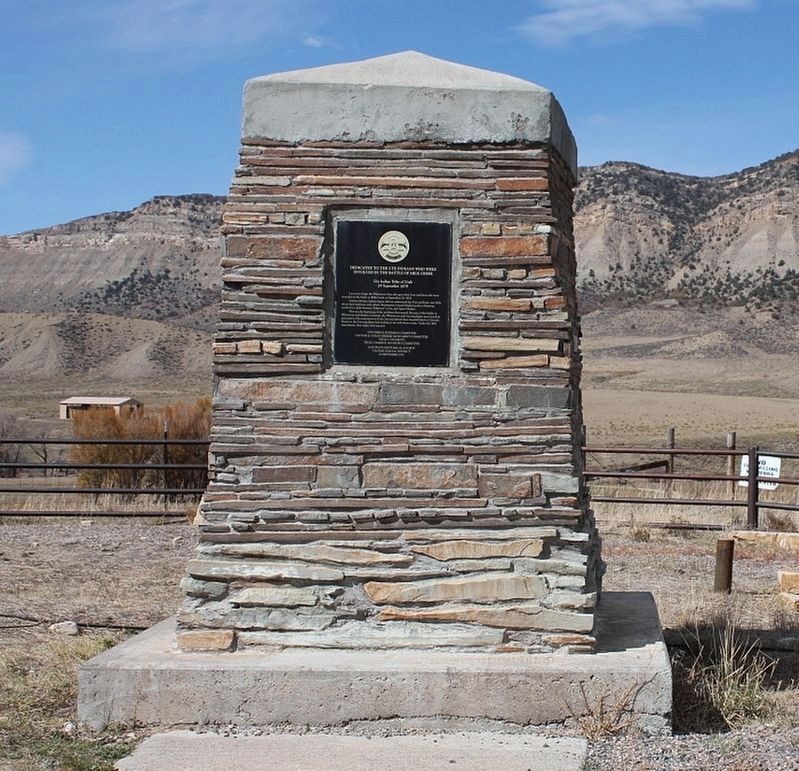
Photographed by Kurt J Reifschneider
1. Ute Indians at the Battle of Milk Creek
Dedicated to the Ute Indians who were involved in the Battle of Milk Creek
Ute Indian Tribe of Utah
29 September 1879
Let us not forget the Whiteriver Utes who gave their lives and those who were wounded in the battle at Milk Creek on September 29, 1879.
Nathan Meeker, Indian Agent, did not understand the Utes and knew very little about their traditions and culture. Resentment toward Meeker's policy of farming resulted in a fight between "Johnson," a Ute, and Agent Meeker.
This was the beginning of the problems that ensued. Because of the battles at Whiteriver and Meeker, Colorado, the Whiterivers and Uncompahgres were forced by gun-point to the reservation in Utah, leaving behind their beautiful land in Colorado. However, the Uncompahgres had nothing to do with those events. Under the 14th amendment, their rights were ignored.
Ute Tribal Business Committee
Uintah & Ouray Meeker Monument Committee
Title V Students
Title V Parent Advisory Committee
Colorado Historical Society
Uintah School District
29 September 1993
Erected by Ute Tribal Business Committee and others. (Marker Number 1993.)
Topics.
this page online
Location. 40° 12.131′ N, 107° 41.456′ W. Memorial is near Meeker, Colorado, in Rio Blanco County. It is on County Road 15 (County Route 15) north of County Route 51, on the left. The memorial is situated in a brush-lined canyon, looking much like it did in 1879, at the site of the Milk Creek Battlefield, about 20 miles northeast of Meeker. Touch for map. Memorial is at or near this postal address: 15791 Co Rd 15, Meeker CO 81641, United States of America. Touch for directions.

Regionally, this memorial is in the Western Slope. It is also in the American Mountain West. Globally, it is in North America, the Rocky Mountains, the Western Hemisphere, the Western World, and the Anglosphere. Historically, it finds itself in what was once Mexico’s Alta California.
Regarding Ute Indians at the Battle of Milk Creek. The rhythmic tick-tick-tick of the telegraph machine faded as the telegrapher at Fort Fred Steele, on September 16, 1879, gave Maj.
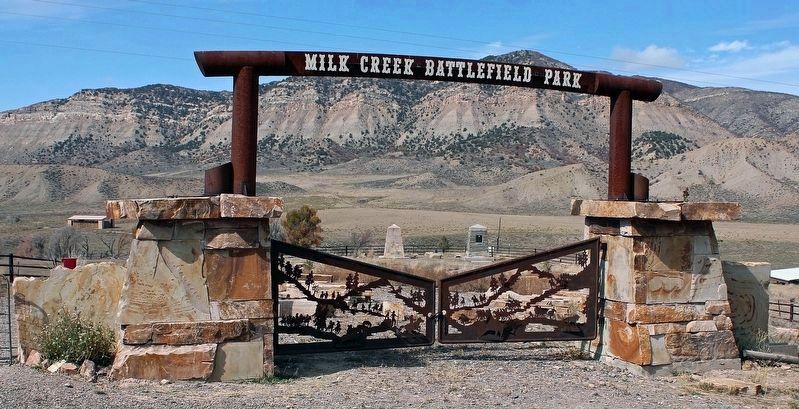
Photographed by Kurt J Reifschneider, June 29, 2025
2. Milk Creek Battlefield Park Gate and Marker
With a brief, sharp glance at the document, Thornburgh turned to his adjutant, Capt., the weight of the situation heavy in the air. The urgent letter commanded Thornburgh to the desolate Ute White River Agency to investigate a full-blown rebellion against Agent Nathan Meeker. General George Crook’s orders clearly stated the expedition’s aim was exploration and information gathering, not retribution, a policy intended to promote diplomacy over hostility.
East of Rawlins, Wyoming, a journey of some 200 miles across the harsh landscape separated the White River Agency in western Colorado from Fort Fred Steele, its nearest military post. With 50 men left behind at Fortification Creek, Thornburgh and the remaining 120 soldiers did not arrive at Milk Creek, the agency boundary, until September 29.
Ignoring earlier warnings from Ute Chiefs Jack and Colorow, Thornburgh’s White River Expedition marched into the Ute Agency. They insisted only Thornburgh and five others, their voices sharp and insistent, cross south of Milk Creek, the creek’s muddy banks visible in the distance. The Utes would then escort them back to the agency headquarters to talk.
In later sworn statements, several of the major’s officers and scouts recounted how their commander inexplicably overlooked several suitable campsites outside the reservation, choosing instead to cross Milk Creek with two companies of cavalry, protected only by a weak advance patrol. From their vantage point atop Yellow Jacket Pass, the chiefs watched in horrified fury as the reckless actions unfolded below, the chilly mountain air doing little to quell their anger.
At 11:30 a.m., on September 29, Lt. Samuel Cherry, leading Capt. Joseph Lawson’s 3rd Cavalry reconnaissance patrol took off his hat and waved it toward the Utes. A shot rang out, the sharp crack echoing through the trees, from a hidden rifleman. A tense silence hung heavy in the air for several seconds before the eruption at Yellow Jacket Pass; a furious, deafening storm of rifle fire.
While the present company remained unaware, twenty-five miles to the south, the sounds of the “Meeker Massacre” filled the air, a grim symphony of chaos and bloodshed.
As noon approached, the weight of desperation settled heavily upon Thornburgh’s expedition; they struggled desperately for their lives, their cries lost in the vast wilderness. The scent of gunpowder filled the air as a hail of rifle bullets, tearing through the stillness, erupted from a line of cedar trees, scrub oak, and serviceberry bushes at the base of Yellow Jacket Pass. The relentless barrage of gunfire and the thick, acrid smoke made it clear to some soldiers that the Utes outnumbered them three to one. Under a hail of bullets, the cavalry’s reconnaissance patrols began a fighting retreat, the smell of gunpowder thick in the air and fear palpable amongst the men.
With a strategic use of the high ground to their left, the Utes cleverly outflanked the cavalry, cutting them off from Lt. James V.S. Paddock’s D Company, which was protecting the wagon supply train on the butte above Milk Creek. Hearing the shots, Paddock immediately circled the wagons. This decisive action, a courageous move coupled with the expertly timed withdrawal of the forward detachment, literally saved the day.
But somewhere in the thorny, aromatic tangle of sagebrush leading up to the tree line on Yellow Jacket Pass, Major Thornburgh lay dead, his body hidden amongst the gnarled, gray-green bushes. For the next five days, his body would lie undisturbed, the sun bleaching his skin. Bleeding from a bullet wound to his left side and shoulder, Captain J. Scott Payne, Thornburgh’s second in command, had only narrowly escaped death. Payne’s and Lawson’s companies won the race back to the wagons.
The next six hours were a torturous dance with fate; one wrong move could doom the expedition. The consensus among some survivors and historians is that a well-orchestrated, full-scale Ute attack on the exposed wagon train and disorganized troops might have led to a rapid and successful outcome for the Native American forces. One can imagine the chaotic scene, the clash of steel, and the desperate cries of the dying. The Utes missed the opportunity. The command’s survival was a testament to rigorous discipline, relentless training, and the sheer courage of its members, each soldier holding their ground through grit and determination.
The cavalry troopers leaped from their mounts, a flurry of motion, and opened fire from behind a three-quarter circle of wagons, the air thick with the smell of gunpowder and sweat. A sheer drop of over 20 feet to Milk Creek formed the fourth side, the embankment so steep it felt impossible to climb down. Teamster’s unharnessed horses and mules that then became the Utes’ primary targets. The battle’s brutal toll included over 300 draft animals and cavalry horses; the stench of blood and death hung heavy in the air, the majority perishing in the first six hours. That alone doomed Ute Chief Colorow’s shortsighted plan; the imagined ambush, driving the troops back to Fort Fred Steele to negotiate a peace eliminating the despised Meeker, was unrealistic. With the sounds of suffering animals all around them, the defenders—following the cool, calculating orders of their veteran officers—worked swiftly, unloading the wagons, building sturdy breastworks, and distributing ammunition. The air hung heavy with the smell of blood and fear.
Frustrated and desperate, the Utes set fire to the parched grass and sage south of the wagons, sending plumes of acrid smoke into the air. Fueled by a southwesterly wind, the flames crackled and roared, a fiery serpent advancing on the corral just ahead of the charging attackers. The roar of the fire filled the air as troopers fired blindly into the thick, black smoke, their weapons hot to the touch, while Capt. Lawson and others scrambled across the damaged ramparts, the ground hot beneath their feet, beating back the flames with whatever they could find: blankets, jackets, and shovels. Yet, some wagons were set ablaze, the heat intense enough to make the air shimmer and the smell of burning wood heavy in the air. However, the troops were able to put out the flames and hold their position.
At the north end, Capt. Payne, using the same wind, set fire to the grass outside the corral. He intended to deprive the Indians of cover in their attempt to surround the barricade. He also wanted to burn a group of civilian wagons, 50 yards behind, so their precious cargo—likely food and supplies—wouldn’t fall into Ute hands; the acrid smell of burning wood and canvas filling the air. His backfire of the brush succeeded. The Indians moved into cover on the hill above the road.
As the night rolled in, the evening air, growing cooler with the setting sun, slowed the frenetic pace of the gun battle, the metallic scent of spent cartridges hanging heavy in the air. With heavy hearts, troopers exchanged their carbines for shovels, the metallic clang echoing in the grim silence as they buried the dead and dug trenches, the earth cold and unforgiving beneath their hands, to create makeshift hospitals for the wounded. The ground was a gruesome tapestry of dead and dying horses and mules, their decaying flesh causing a stench that clung to the air around the wagons, a nauseating mix of blood and rot. Before sunset, cold rations of hardtack and jerky were distributed. Payne banned fires, lanterns, and candles. Under the darkening sky of September 30th, four men bravely volunteered to ride for help, anticipating the helpful glow of the upcoming full moon.
Scout Joe Rankin rode practically nonstop to Rawlins the night of September 29; all day and night on September 30 and until about 1:00 a.m. on October 1—a total distance of over 140 miles. General Crook was roused from his sleep at Omaha Barracks at about 2:25 AM by a frantic message, the urgency palpable in the hushed stillness of the early morning.
Another messenger, name unknown, reached the 9th Cavalry, known as Buffalo Soldiers, D Company Capt. Francis Dodge, who left behind supply wagons containing food, medicine and ammunition and rode south nonstop, arriving at the Milk Creek battle site on October 2, unopposed. The sight of his roughly thirty Buffalo Soldiers, their faces etched with the hardships of the campaign, had a negligible military impact but significantly raised troop spirits. By dark, most of Dodge’s horses lay beside their predecessors.
Lieutenant-Gen. On October 1st, Phil Sheridan, after reading Rankin’s urgent telegram, immediately dispatched Crook’s orders to send a relief command under Gen. Wesley Merritt. Within an hour, Merritt, at Fort D.A. Russell near Cheyenne, had his troops and supplies ready—a scene of organized chaos with the clatter of equipment and shouts of commands. He commandeered railroad transportation, the powerful engines soon chugging to life, and planned his plan of attack.
Chief Jack, sensing the shift in the wind before Dodge’s company even appeared, had begun telling his warriors they were free to leave without shame, his words echoing through the camp. Between bouts of pugnacity, where his jaw tightened and his eyes flashed, Colorow drifted into complacency, a quiet stillness that masked his inner turmoil, before finally succumbing to a weary resignation, a sense of defeat that hung heavy in the air. The arrival of a Ute messenger, his buckskin clothes dusted with the trail, carrying Chief Ouray’s order of cessation, silenced the heated debate. Waving a flag of truce, he rode out to meet Merritt. The Milk Creek was now done; the battle lost and won.
Monumental problems—each a daunting challenge in its own right—remained. The rescue of three white women and two children stood out; they were the sole survivors of the brutal Meeker Massacre 25 miles south that had happened simultaneously as the Milk Creek battle. Second, the capture of the Ute Leaders thought responsible for the murders of 11 male civilian employees, the Meeker Massacre, at the White River Agency and for the ambush of the White River Expedition at Milk Creek.
With Chief Ouray’s help at the Los Pinos Agency, the former Ute agent, Charles Adams, persuaded the Utes to release the Meeker captives on October 21, in a tense negotiation filled with hushed tones and grave expressions. Adams met with the Utes, heard their side of the story, and then reported to the government: “My conclusions of the whole affair are, that if Major Thornburgh had gone to the agency with a Ute escort, the whole trouble would have been averted.”
Some researchers claim that proportionately more soldiers received the Medal of Honor at Milk Creek, with 11 out of the 175 being awarded, than in any other single battle in the history of the United States. Congress did award more commendations for bravery at Milk Creek, handing out at least 30, than in any other battle of the Indian Wars. Thirteen Army troopers and civilians died, while 44 received wounds. Chief Jack estimated about equal numbers of Ute casualties for his estimated 300-400 warriors.
Two hearings, one at the Los Pinos Agency with its hushed whispers and formal atmosphere, and another amidst the bustling halls of the House of Representatives in Washington, D.C., failed to definitively assign blame for the Meeker Massacre and the Milk Creek Battle. Dismissing the casualties and long-term consequences, the committees labeled the Milk Creek battle a minor skirmish, a negligible conflict between two separate nations. The Meeker Massacre, a brutal event on federal land, fell outside the jurisdiction of Colorado’s criminal statutes.
The bloodshed of the Milk Creek Battle and Meeker Massacre gave politicians, mining companies, and land speculators the justification they craved to invalidate the 1873 Brunot Treaty, which had granted the government control over much of the San Juan Mountains; the politicians, mining companies, and land speculators saw the violence to seize the land for themselves. The year following the death of Ute Chief Ouray at 47, September 1881 marked the complete and brutal forced displacement of all Colorado Utes to Utah, a grim chapter in their history. Today, they occupy the Southern Ute and Ute Mountain Ute reservations along the Colorado and New Mexico border.
By Kurt James Reifschneider
Credits. This page was last revised on November 25, 2025. It was originally submitted on July 2, 2025, by Kurt J Reifschneider of Henderson, CO, Colorado. This page has been viewed 553 times since then and 87 times this year. Photos: 1, 2. submitted on July 2, 2025, by Kurt J Reifschneider of Henderson, CO, Colorado. • J. Makali Bruton was the editor who published this page.
Editor’s want-list for this marker. A clear, close up of the marker. • Can you help?
