Mackinac Island in Mackinac County, Michigan — The American Midwest (Great Lakes)
Contest for the Island
| — | Native American Cultural History Trail | — |
Photographed by Joel Seewald, July 1, 2025
1. Contest for the Island Marker
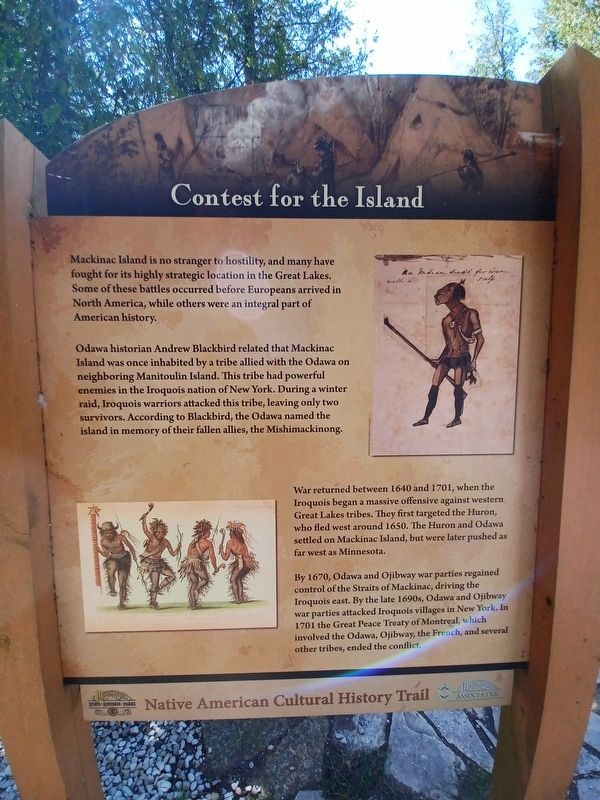
Mackinac Island is no stranger to hostility, and many have fought for its highly strategic location in the Great Lakes. Some of these battles occurred before Europeans arrived in North America, while others were an integral part of American history.
Odawa historian Andrew Blackbird related that Mackinac Island was once inhabited by a tribe allied with the Odawa on neighboring Manitoulin Island. This tribe had powerful enemies in the Iroquois nation of New York. During a winter raid, Iroquois warriors attacked this tribe, leaving only two survivors. According to Blackbird, the Odawa named the island in memory of their fallen allies, the Mishimackinong.
War returned between 1640 and 1701, when the Iroquois began a massive offensive against western Great Lakes tribes. They first targeted the Huron, who fled west around 1650. The Huron and Odawa settled on Mackinac Island, but were later pushed as far west as Minnesota.
By 1670, Odawa and Ojibway war parties regained control of the Straits of Mackinac, driving the Iroquois east. By the late 1690s, Odawa and Ojibway war parties attacked Iroquois villages in New York.
this page online
Reverse
Continued from other side
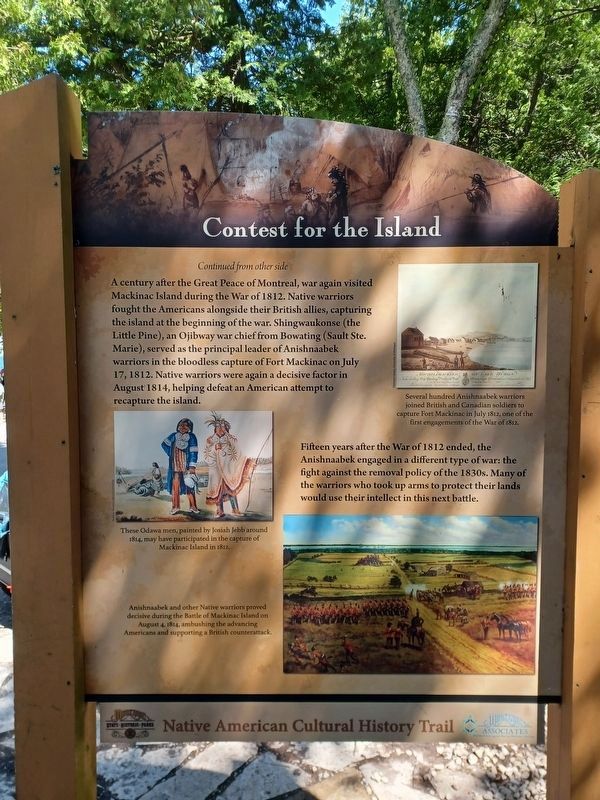
A century after the Great Peace of Montreal, war again visited Mackinac Island during the War of 1812. Native warriors fought the Americans alongside their British allies, capturing the island at the beginning of the war. Shingwaukonse (the Little Pine), and Ojibway war chief from Bowating (Sault Ste. Marie), served as the principal leader of Anishnaabek warriors in the bloodless capture of Fort Mackinac on July 17, 1812. Native warriors were again a decisive factor in August 1814, helping defeat an American attempt to recapture the island.
Fifteen years after the War of 1812 ended, the Anishnaabek engaged in a different type of war: the fight against the removal policy of the 1830s. Many of the warriors who took up arms to protect their lands would use their intellect in this next battle.
Top image caption: Several hundred Anishnaabek warriors joined British and Canadian soldiers to capture Fort Mackinac in July 1812, one of the first engagements of the
Photographed by Joel Seewald, July 1, 2025
2. Contest for the Island Marker Reverse
Middle image caption: These Odawa men, painted by Josiah Jebb around 1814, may have participated in the capture of Mackinac Island in 1812.
Bottom image caption: Anishnaabek and other Native warriors proved decisive during the Battle of Mackinac Island on August 4, 1814, ambushing the advancing Americans and supporting a British counterattack.
Erected 2017 by Mackinac State Historic Parks and Mackinac Associates.
Topics. This historical marker is listed in these topic lists: Colonial Era • Indigenous Peoples and Communities • War of 1812 • War, French and Indian. A significant historical date for this entry is July 17, 1812.
Location. 45° 52.682′ N, 84° 38.712′ W. Marker is on Mackinac Island, Michigan, in Mackinac County. It is on Lake Shore Boulevard (State Highway 185) north of British Landing Road, on the left when traveling south. Marker is near the British Landing Nature Center. Touch for map. Marker is at or near this postal address: 3494 Lake Shore Dr, Mackinac Island MI 49757, United States of America. Touch for directions.

Regionally, this marker is on the Upper Peninsula and on the Straits of
Photographed by Joel Seewald, July 1, 2025
3. Contest for the Island Marker
Other nearby markers. At least 8 other markers are within 2 miles of this marker, measured as the crow flies: Limestone Breccia (within shouting distance of this marker); The Mackinac Bridge (within shouting distance of this marker); The Ice Bridge (within shouting distance of this marker); British Landing (within shouting distance of this marker); People of the Water (approx. 0.7 miles away); The Treaty of Washington, 1836 (approx. 0.9 miles away); Sugar Loaf (approx. 1.8 miles away); Post Cemetery (approx. 1.8 miles away). Touch for a list and map of all markers in Mackinac Island.
Also see . . .
1. Complete history of Ottawa and Chippewa Indians of Michigan. Book by Andrew Blackbird on the Internet Archive. (Submitted on July 9, 2025, by Joel Seewald of Madison Heights, Michigan.)
2. Great Peace of Montreal. Wikipedia article about the Great Peace of Montreal. (Submitted on July 9, 2025, by Joel Seewald of Madison Heights, Michigan.)
Credits. This page was last revised on July 10, 2025. It was originally submitted on July 9, 2025, by Joel Seewald of Madison Heights, Michigan. This page has been viewed 260 times since then and 135 times this year. Photos: 1, 2, 3. submitted on July 9, 2025, by Joel Seewald of Madison Heights, Michigan.
