Ligonier in Westmoreland County, Pennsylvania — The American Northeast (Mid-Atlantic)
Diamond Park Ligonier, Penna.
Photographed by Bradley Owen, July 12, 2025
1. Diamond Park Ligonier, Penna. Marker
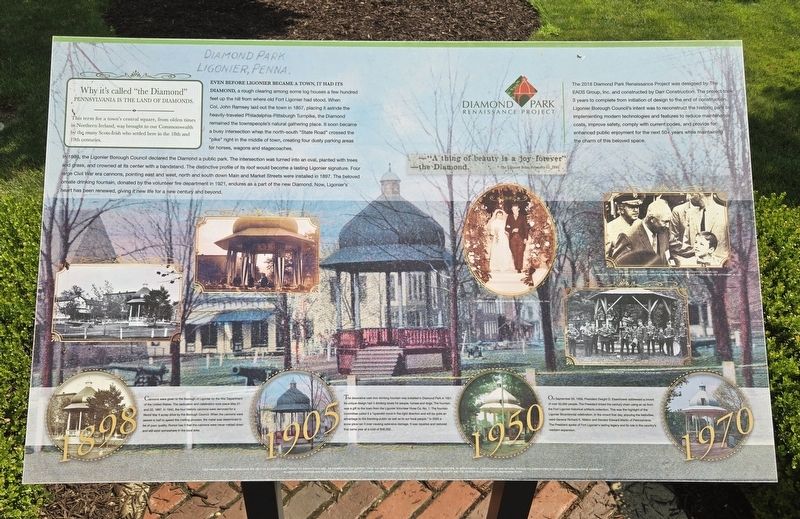
Why it's called "the Diamond"
Pennsylvania is the land of diamonds.
This term for a town's central square, from olden times in Northern Ireland, was brought to our Commonwealth by the many Scots-Irish who settled here in the 18th and 19th centuries.
Even before Ligonier became a town, it had its Diamond, a rough clearing among some log houses a few hundred feet up the hill from where old Fort Ligonier had stood. When Col. John Ramsey laid out the town in 1857, placing it astride the heavily-traveled Philadelphia-Pittsburgh Turnpike, the Diamond remained the townspeople's natural gathering place. It soon became a busy intersection when the north-south "State Road" crossed the "pike" right in the middle of town, creating four dusty parking areas for horses, wagons and stagecoaches.
In 1894, the Ligonier Borough Council declared the Diamond a public park. The intersection was turned into an oval, planted with trees and grass, and crowned at its center with a bandstand. The distinctive profile of its roof would become a lasting Ligonier signature. Four large Civil War era cannons, pointing east and west, north and
this page online
The 2018 Diamond Park Renaissance Project was designed by The EADS Group, Inc. and constructed by Darr Construction. The project took 3 years to complete from initiation of design to the end of construction. Ligonier Borough Council's intent was to reconstruct the historic park by implementing modern technologies and features to reduce maintenance costs, improve safety, comply with current codes, and provide for enhanced public enjoyment for the next 50+ years while maintaining the charm of this beloved space.
- "A thing of beauty is a joy forever" - the Diamond. The Ligonier Echo, February 11, 1891
Cannons were given to the Borough of Ligonier by the War Department of the United States. The dedication and celebration took place May 21 and 22, 1897. In 1942, the four historic cannons were removed for a World War II scrap drive by the Borough Council. When
Photographed by Bradley Owen, July 12, 2025
2. Diamond Park Ligonier, Penna. Marker
The decorative cast-iron drinking fountain was installed in Diamond Park in 1921. Its unique design had 3 drinking levels for people, horses and dogs. The fountain was a gift to the town from the Ligonier Volunteer Hose Co. No. 1. The fountain committee called it a "splendid move in the right direction and will be quite an advantage to the traveling public as well as to our local people." In 2003 a snow plow ran it over causing extensive damage. It was repaired and restored that same year at a cost of $48,000.
On September 26, 1958, President Dwight D. Eisenhower addressed a crowd of over 30,000 people. The President linked the century chain using an ax from the Fort Ligonier historical artifacts collection. This was the highlight of the Ligonier Bicentennial celebration. In the crowd that day, enjoying the festivities, were General Richard K. Mellon and Senator Edward Martin of Pennsylvania. The President spoke of Fort Ligonier's lasting legacy and its role in the country's western expansion.
(Captions):
The first bandstand built in 1894.
Governor Martin Grove Brumbaugh, 1915
Wedding of Miss Mary Jane Berkey and Robert E. Shaw, 1958
The day the President came to town at the invitation of General R.K. Mellon. President Dwight D. Eisenhower greets young Pat Regan during the Ligonier Bicentennial on September 26, 1958.
Ligonier coronet band in front of the old music pavillion which was replaced in 1894.
Erected 2021 by Diamond Park Renaissance Project.
Topics and series. This historical marker is listed in these topic lists: Immigration • Parks & Recreational Areas • Roads & Vehicles • Settlements & Settlers. In addition, it is included in the Former U.S. Presidents: #34 Dwight D. Eisenhower series list. A significant historical date for this entry is February 11, 1891.
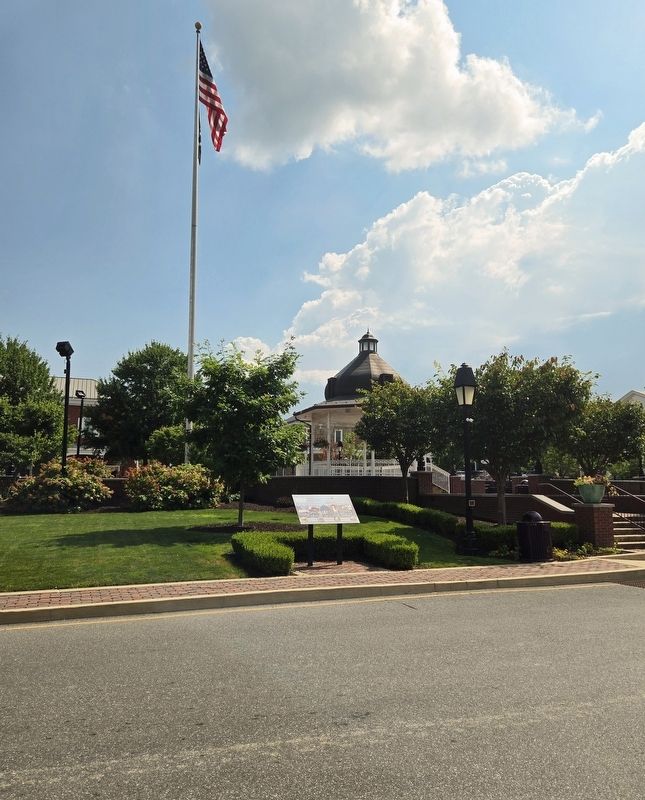
Location. 40° 14.579′ N, 79° 14.284′ W. Marker is in Ligonier, Pennsylvania, in Westmoreland County. It is at the intersection of West Main Street (Pennsylvania Route 711) and South Market Street ( Route 711), on the left when traveling south on West Main Street. Marker is located inside the traffic circle at The Diamond. Touch for map. Marker is at or near this postal address: 107 West Main Street, Ligonier PA 15658, United States of America. Touch for directions.

Regionally, this marker is in the Laurel Highlands and in Greater Pittsburgh. It is also in the American Northeast, in the Mid-Atlantic, in Appalachia, and specifically in Northern Appalachia. Globally, it is in North America, the Western Hemisphere, the Western World, and the Anglosphere. Historically, it finds itself in what was once the Viceroyalty of New France, the Haudenosaunee (Iroquois) Confederacy, and one of the original Thirteen Colonies.
Other nearby markers. At least 8 other markers are within walking distance of this marker: Ligonier War Memorial (within shouting distance of this marker); Fort Ligonier (within shouting distance of this marker); Ligonier Town Square Fountain (within shouting distance of this marker); Desert Storm Memorial (within shouting distance of this marker); Building the Highway (within shouting distance of this marker); Highway Enterprise (about 400 feet away, measured in a direct line); Ivy Manor (about 500 feet away); Roadside Enterprise (about 500 feet away). Touch for a list and map of all markers in Ligonier.
Credits. This page was last revised on July 25, 2025. It was originally submitted on July 25, 2025, by Bradley Owen of Morgantown, West Virginia. This page has been viewed 300 times since then and 133 times this year. Photos: 1, 2. submitted on July 25, 2025, by Bradley Owen of Morgantown, West Virginia.
