Monroe in Monroe County, Michigan — The American Midwest (Great Lakes)
River Raisin Legacy Project
Fish Passage 6

Photographed by Bill Coughlin, August 2, 2023
1. River Raisin Legacy Project Marker
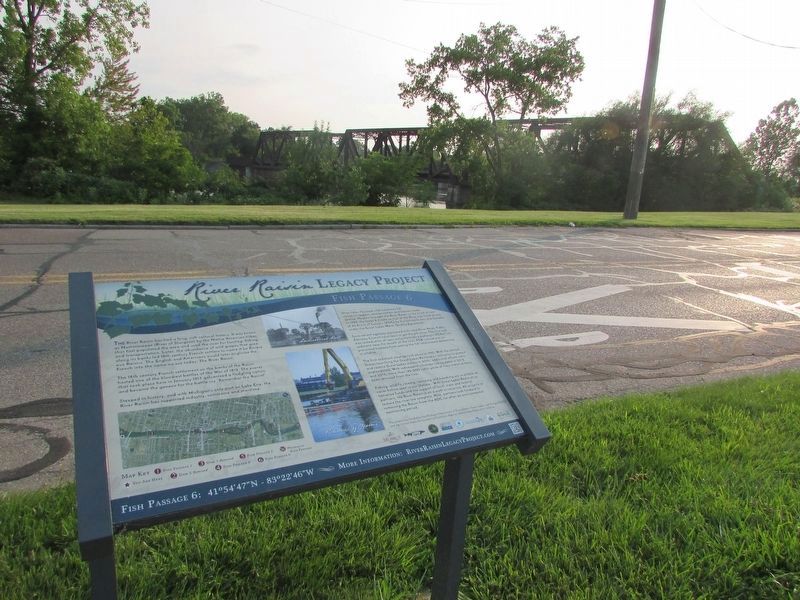
The River Raisin has had a long, rich cultural history. It was known as Nummasepee (River of Sturgeon) by the Native American tribes that first populated the area and used the river for hunting, fishing and transportation. Later, the abundance of wild grapes that grew along its banks led the 18th century French settlers to name it Le Riviere aux Raisins. The English and Americans would later anglicize the French into the name we use today: The River Raisin.
The 18th century French settlement on the banks of the Raisin hosted one of the bloodiest battles of the War of 1812. The events that took place here in January 1813 galvanized a fledgling nation and became the genesis for the battle cry “Remember the Raisin!”
Steeped in history, and with Michigan’s only port on Lake Erie, the River Raisin has supported industry, commerce and maritime.
Over time, this once vital waterway fell victim to neglect, contamination and human-made demise. Neglect brought the River Raisin to the brink of ruin. In 1987, the lower 2.6-mile section of the River was listed as one of 43 Areas of Concern (AOC) by the United States and Canada under the
this page online
Government agencies partnered with local River Raisin Public Advisory Council volunteers to get the job done. The first task was remediation of toxic polychlorinated biphenyls (PCBs) from sediment near the mouth of the river. PCB contamination prevented humans from eating the fish and caused deformities in wildlife.
The first sediment cleanup took place in 1997. With the United States launching the Great Lakes Restoration Initiative to protect and restore Great Lakes waters in 2010, additional efforts were implemented. With subsequent cleanups taking place in 2012 and 2016, more than 140,000 cubic yards of toxic material have been removed from the river.
Fishing, wildlife viewing, canoeing and kayaking are available as never before seen in our lifetime. With Great Lakes Restoration Initiative funds and the support of local, state and federal partners, the River Raisin is on a path to recovery. All projects to restore the river are complete. Now, partners look forward to removing the Raisin from the AOC list after an environmental monitoring period.
Topics. This historical marker is listed in these
Photographed by Bill Coughlin, August 2, 2023
2. River Raisin Legacy Project Marker
Location. 41° 54.774′ N, 83° 22.727′ W. Marker is in Monroe, Michigan, in Monroe County. It is on East Elm Avenue east of North Dixie Highway, on the left when traveling east. Touch for map. Marker is in this post office area: Monroe MI 48162, United States of America. Touch for directions.

Regionally, this marker is in Southeast Michigan and in Greater Detroit. It is also in the American Midwest. Globally, it is in North America, on the Great Lakes, in the Western Hemisphere, in the Western World, and in the Anglosphere. Historically, it finds itself in what was once the Northwest Territory.
Other nearby markers. At least 8 other markers are within walking distance of this marker: A different marker also named River Raisin Legacy Project (here, next to this marker); First District Court (here, next to this marker); Private Claim 236, Lot of George McDougal (a few steps from this marker); Private Claim 236 Lot of Jean (John) Baptiste Jerome (a few steps from this marker); Private Claim 236 Lot of Hubert Lacroix

Photographed by Bill Coughlin, August 2, 2023
3. River Raisin Legacy Project Marker
More about this marker. Photographs at the middle of the marker show the River Raisin in its industrial past, and a more recent picture of toxins being removed from the River. The bottom left contains a map identifying the locations of fish passages and removed dams.
Also see . . . River Raisin Legacy Project. (Submitted on July 31, 2025, by Bill Coughlin of Woodland Park, New Jersey.)
Credits. This page was last revised on August 9, 2025. It was originally submitted on July 31, 2025, by Bill Coughlin of Woodland Park, New Jersey. This page has been viewed 123 times since then and 47 times this year. Photos: 1, 2, 3. submitted on July 31, 2025, by Bill Coughlin of Woodland Park, New Jersey.
