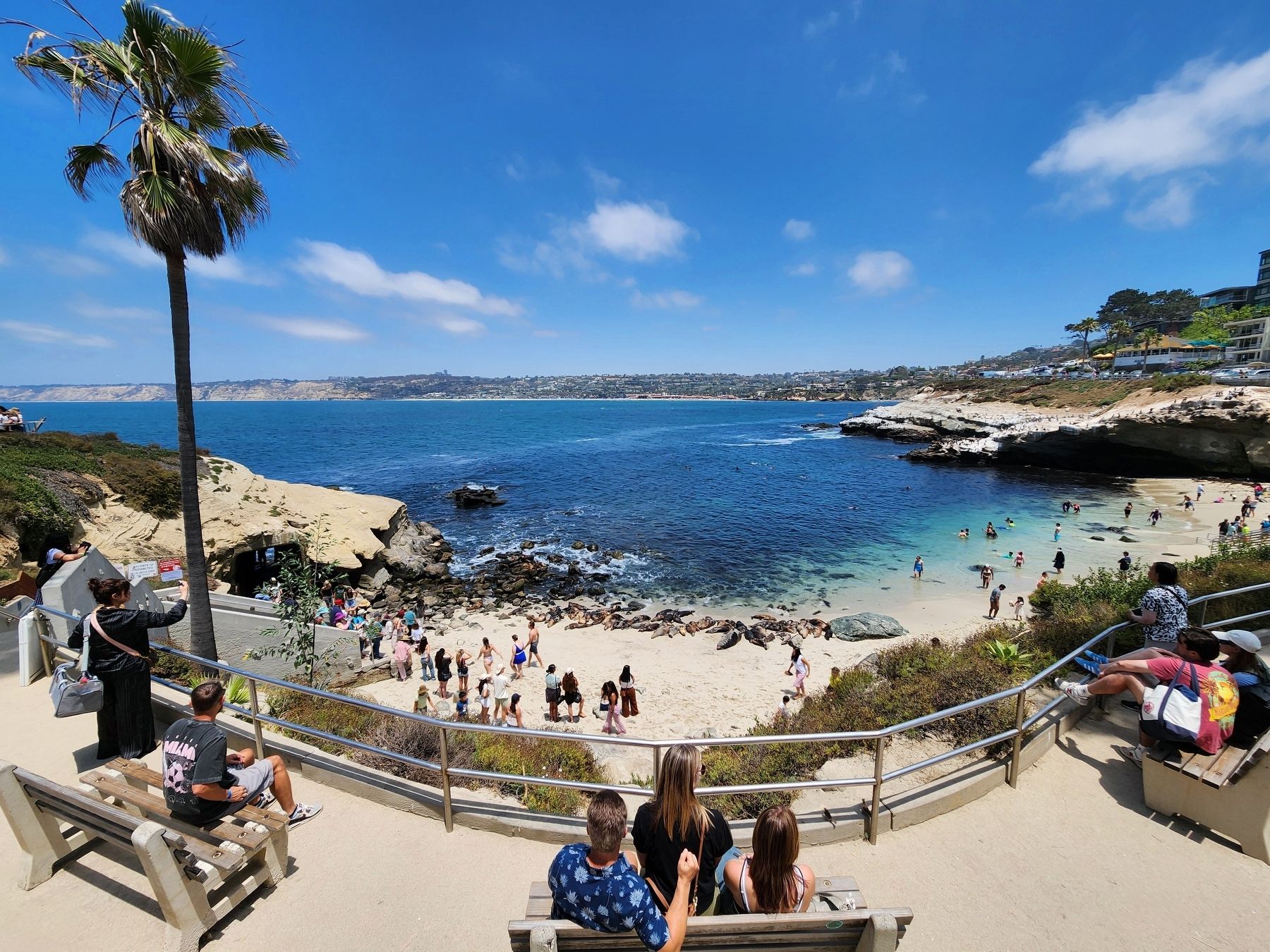
La Jolla in San Diego in San Diego County, California — The American West (Pacific Coastal)
San Diego-La Jolla Underwater Park
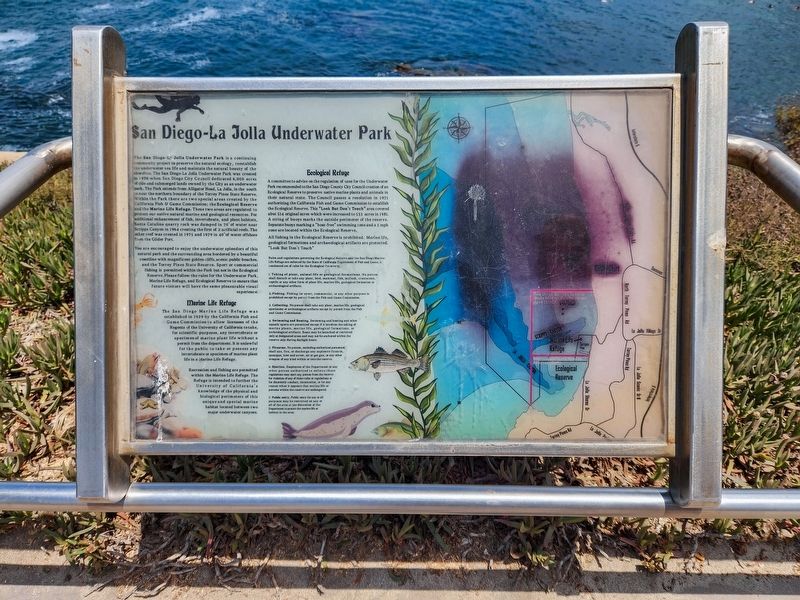
Photographed by Douglass Halvorsen, July 7, 2025
1. San Diego-La Jolla Underwater Park Marker
Inscription.
San Diego-La Jolla Underwater Park. . The San Diego-La Jolla Underwater Park is a continuing community project to preserve the natural ecology, reestablish the underwater sea life and maintain the natural beauty of the shoreline. The San Diego-La Jolla Underwater Park was created in 1970 when San Diego City Council dedicated 6,000 acres of tide and submerged lands owned by the City as an underwater park. The Park extends from Alligator Head, La Jolla, in the south to near the northern boundary of the Torrey Pines State Reserve. Within the Park there are two special areas created by the California Fish and Game Commission; the Ecological Reserve and the Marine Life Refuge. These two areas are regulated to protect our native natural marine and geological resources. For additional enhancement of fish, invertebrate, and plant habitats, Santa Catalina quarry rock was dumped in 70' of water near Scripps Canyon in 1964 creating the first of 2 artificial reefs. The other reef was created in 1975 and 1979 in 40' of water offshore from the Glider Port. , You are encouraged to enjoy the underwater splendors of this natural park and the surrounding area bordered by a beautiful coastline with magnificent golden cliffs, scenic public beaches, and the Torrey Pines State Reserve. Sport or commercial fishing is permitted within the Park but not in the Ecological Reserve. Please follow the rules for the Underwater Park, Marine Life Refuge, and Ecological Reserve to ensure that future visitors will have the same pleasurable visual experience. , Marine Life Refuge , The San Diego Marine Life Refuge was established in 1929 by the California Fish and Game Commission to allow licensees of the Regents of the University of California to take, for scientific purposes, any invertebrate ot specimen of marine plant life without a permit from the department. It is unlawful for the public to take or possess any invertebrate or specimen of marine plant life in a Marine Life Refuge. , Recreation and fishing are permitted within the Marine Life Refuge. The Refuge is intended to further the University of California’s knowledge of the physical and biological perimeters of this unique and special marine habitat located between two major underwater canyons. , Ecological Refuge , A committee to advise on the regulation of uses for the Underwater Park recommended to the San Diego County City Council creation of an Ecological Reserve to preserve native marine plants and animals in their natural state. The Council passes a resolution 1971 authorizing the Californa Fish and Game Commission to establish the Ecological Reserve. This “Look But Don’t Touch” area covered about 514 original acres which were increased to 533 acres in 1981. A string of buoys marks the outside perimter of the reserve. Separate buoys marking a “boat-free” swimming zone and a 5 mph zone are located within the Ecological Reserve., All fishing in the Ecological Reserve is prohibited. Marine life, geological formations and archeological artifacts are protected. , “Look But Don’t Touch”
The San Diego-La Jolla Underwater Park is a continuing community project to preserve the natural ecology, reestablish the underwater sea life and maintain the natural beauty of the shoreline. The San Diego-La Jolla Underwater Park was created in 1970 when San Diego City Council dedicated 6,000 acres of tide and submerged lands owned by the City as an underwater park. The Park extends from Alligator Head, La Jolla, in the south to near the northern boundary of the Torrey Pines State Reserve. Within the Park there are two special areas created by the California Fish & Game Commission; the Ecological Reserve and the Marine Life Refuge. These two areas are regulated to protect our native natural marine and geological resources. For additional enhancement of fish, invertebrate, and plant habitats, Santa Catalina quarry rock was dumped in 70' of water near Scripps Canyon in 1964 creating the first of 2 artificial reefs. The other reef was created in 1975 and 1979 in 40' of water offshore from the Glider Port.
You are encouraged to enjoy the underwater splendors of this natural park and the surrounding area bordered by a beautiful coastline with magnificent golden cliffs, scenic public beaches, and the Torrey Pines State Reserve. Sport or commercial fishing is permitted within the Park but not in the Ecological
Click or scan to see this page online
Reserve. Please follow the rules for the Underwater Park, Marine Life Refuge, and Ecological Reserve to ensure that future visitors will have the same pleasurable visual experience.
Marine Life Refuge
The San Diego Marine Life Refuge was established in 1929 by the California Fish and Game Commission to allow licensees of the Regents of the University of California to take, for scientific purposes, any invertebrate ot specimen of marine plant life without a permit from the department. It is unlawful for the public to take or possess any invertebrate or specimen of marine plant life in a Marine Life Refuge.
Recreation and fishing are permitted within the Marine Life Refuge. The Refuge is intended to further the University of California’s knowledge of the physical and biological perimeters of this unique and special marine habitat located between two major underwater canyons.
Ecological Refuge
A committee to advise on the regulation of uses for the Underwater Park recommended to the San Diego County City Council creation of an Ecological Reserve to preserve native marine plants and animals in their natural state. The Council passes a resolution 1971 authorizing the Californa Fish and Game Commission to establish the Ecological Reserve. This “Look But Don’t Touch” area covered about 514 original acres which were increased
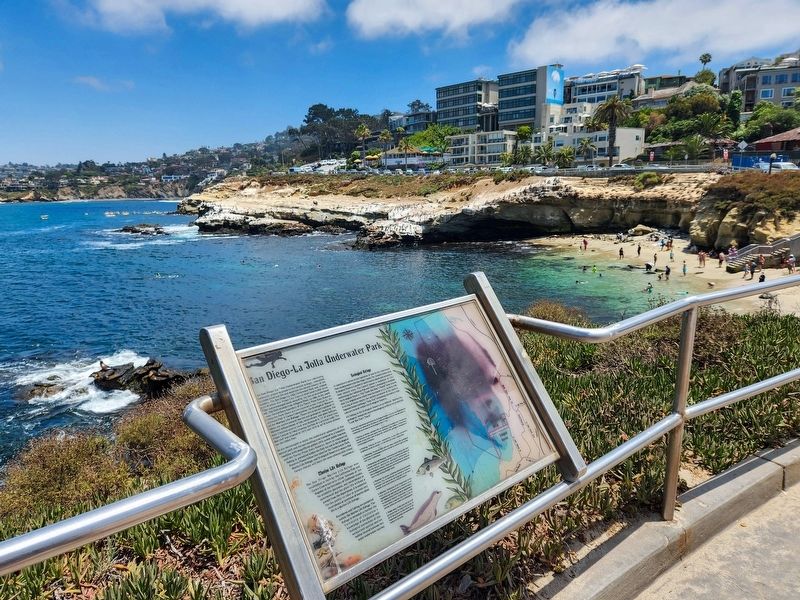
Photographed by Douglass Halvorsen, July 7, 2025
2. San Diego-La Jolla Underwater Park Marker
to 533 acres in 1981. A string of buoys marks the outside perimter of the reserve. Separate buoys marking a “boat-free” swimming zone and a 5 mph zone are located within the Ecological Reserve.
All fishing in the Ecological Reserve is prohibited. Marine life, geological formations and archeological artifacts are protected.
“Look But Don’t Touch”
Location. 32° 51.053′ N, 117° 16.387′ W. Marker is in San Diego, California, in San Diego County. It is in La Jolla. It can be reached from Coast Boulevard. Touch for map. Marker is at or near this postal address: 1160 Coast Boulevard, La Jolla CA 92037, United States of America. Touch for directions.
Regionally, this marker is in California’s Peninsular Ranges. It is also on the American Pacific Coast. Globally, it is in North America, on the Ring of Fire, in the Pacific Rim, in the Western Hemisphere, in the Western World, and in the Anglosphere. Historically, it finds itself in what was once New Spain and also Mexico’s Alta California.
Located next to the marker is a plaque that reads:
This Plaque in Commemoration of
Conrad F. Limbaugh and Harold F. Riley
For Their Efforts Toward the Creation of
The San Diego-La Jolla Underwater Park
Presented by
The San Diego Council of Diving Clubs, Inc.
1972
South Boundary

Credits. This page was last revised on August 5, 2025. It was originally submitted on August 4, 2025, by Douglass Halvorsen of Klamath Falls, Oregon. This page has been viewed 104 times since then and 20 times this year. Photos:1, 2, 3, 4. submitted on August 4, 2025, by Douglass Halvorsen of Klamath Falls, Oregon. • Andrew Ruppenstein was the editor who published this page.