Ferrisburgh in Addison County, Vermont — The American Northeast (New England)
Meet the Robinson Family
Photographed by William Fischer, Jr., July 31, 2025
1. Meet the Robinson Family Marker
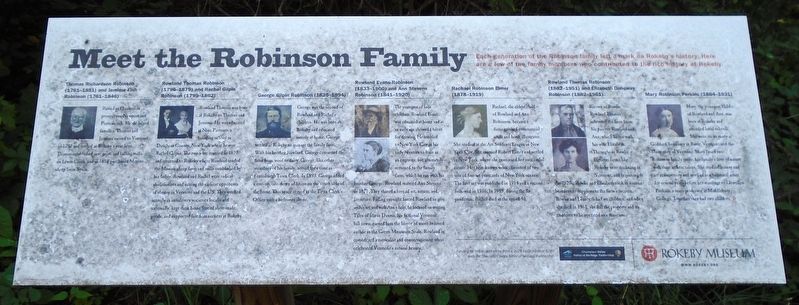
Each generation of the Robinson family left a mark on Rokeby's history. Here are a few of the family members who contributed to the rich history of Rokeby.
Thomas Richardson Robinson (1761-1851) and Jemima Fish Robinson (1761-1846)
Raised as Quakers in prosperous Newport and Portsmouth, Rhode Island families, Thomas and Jemima moved to Vermont in 1792 and settled at Rokeby a year later. Thomas established saw, grist, and fulling mills on Lewis Creek, and in 1810 purchased Merino sheep from Spain.
Rowland Thomas Robinson (1796-1879) and Rachel Gilpin Robinson (1799-1862)
Rowland Thomas was born at Rokeby to Thomas and Jemima. He was educated at Nine Partners, a boarding school in Dutchess County, New York where he met Rachel Gilpin. The two were married in 1820 and returned to Rokeby where Rowland tended the Merino sheep farm and mills established by his father. Rowland and Rachel were radical abolitionists and among the earliest opponents of slavery in Vermont and the US. They worked actively in antislavery societies locally and nationally, kept their home free of slave-made goods, and supported freedom seekers at
this page online
George Gilpin Robinson (1825-1894)
George was the second of Rowland and Rachel's children. He was born at Rokeby and educated mostly at home. George settled at Rokeby to manage the family farm. With his brother Rowland, George converted the farm from wool to dairy. George, like other members of his family, served for a time as Ferrisburgh Town Clerk. In 1893, George added a one-up, one-down addition to the south side of the home. This space served as the Town Clerk's Office with a bedroom above.
Rowland Evans Robinson (1833-1900) and Ann Stevens Robinson (1841-1920)
The youngest of four children, Rowland Evans was educated at home and at an early age showed a talent for drawing. He traveled to New York City in his early twenties to train as an engraver, but ultimately returned to the family farm, which he ran with his brother George. Rowland married Ann Stevens in 1870. They shared a love of art, nature, and literature. Failing eyesight forced Rowland to give up his art, and with Ann's help, he focused on writing. Tales of life in Danvis, his fictional Vermont hill town, earned him the honor of most-beloved author in the

Photographed by William Fischer, Jr., July 31, 2025
2. Meet the Robinson Family Marker
Rachael Robinson Elmer (1878-1919)
Rachael, the eldest child of Rowland and Ann Robinson, became a distinguished commercial artist and book illustrator. She studied at the Art Students League in New York City. She married Robert Elmer and settled in New York, where she continued her successful career. Her best-known work consisted of two sets of fine-art postcards of New York scenes. The first set was published in 1914 and a second followed in 1916. In 1919, during the flu pandemic, Rach[a]el died at the age of 40.
Rowland Thomas Robinson (1882-1951) and Elizabeth Donoway Robinson (1882-1961)
Known as Rowlie, Rowland Thomas inherited the farm from his parents Rowland and Ann, which he ran with his wife Elizabeth. Throughout Rowlie's lifetime, farms like Rokeby were declining in Vermont, and beginning in the 1920s, Rowlie and Elizabeth took in tourist boarders to supplement the farm's income. Rowlie and Elizabeth had no children, and when she died in 1961, she left the property and its contents to be operated as a museum.
Mary Robinson Perkins (1884-1931)
Mary, the youngest child of Rowland and Ann, was born at Rokeby and attended local schools. She went on to study at Goddard Seminary in Barre, Vermont, and the University of Vermont. Mary fused two Robinson family traits: her family's love of nature with their artistic talent. She studied botany and art at university and worked as a botanical artist for several years before her marriage to Llewellyn Perkins, a math professor at Middlebury College. Together they had two children.
Erected by Rokeby Museum and Champlain Valley National Heritage Partnership.
Topics. This historical marker is listed in these topic lists: Abolition & Underground RR • Agriculture • Arts, Letters, Music • Women. A significant historical year for this entry is 1792.
Location. 44° 13.42′ N, 73° 14.28′ W. Marker is in Ferrisburgh, Vermont, in Addison County. It can be reached from U.S. 7. Marker is along the Green Trail, on the Rokeby Museum grounds. Touch for map. Marker is at or near this postal address: 4334 US Highway 7, Ferrisburgh VT 05456, United States of America. Touch for directions.

Regionally, this marker is in the Champlain Valley. It is also in the American Northeast and in New England. Globally, it is in North America, the Western Hemisphere, the Western World, and the Anglosphere. Historically, it finds itself in what was once the Viceroyalty of New France and also the Vermont Republic.
Other nearby markers. At least 8 other markers are within 2 miles of this marker, measured as the crow flies: The Robinson Farm (within shouting distance of this marker); Your Questions Answered (within shouting distance of this marker); Ferrisburgh Academy (within shouting distance of this marker); Dairy Barn (within shouting distance of this marker); Welcome to Rokeby Museum's Hiking Trails (about 300 feet away, measured in a direct line); The Historic Robinson Home (about 400 feet away); "Rokeby" (about 500 feet away); The Great Convention (approx. 1.3 miles away). Touch for a list and map of all markers in Ferrisburgh.
More about this marker. Geocoords are estimated.
Also see . . . Rokeby Museum. (Submitted on August 9, 2025, by William Fischer, Jr. of Reynoldsburg, Ohio.)
Credits. This page was last revised on August 9, 2025. It was originally submitted on August 9, 2025, by William Fischer, Jr. of Reynoldsburg, Ohio. This page has been viewed 229 times since then and 77 times this year. Photos: 1, 2. submitted on August 9, 2025, by William Fischer, Jr. of Reynoldsburg, Ohio.
