Fort Walton Beach in Okaloosa County, Florida — The American South (South Atlantic)
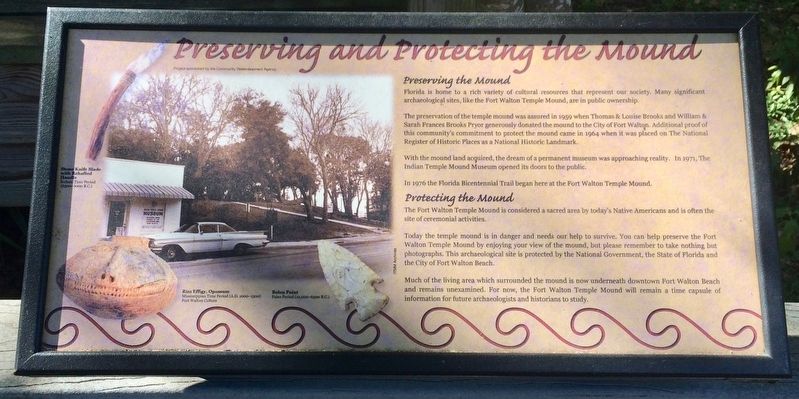
Preserving and Protecting the Mound
Photographed by Mark Hilton, October 29, 2016
1. Preserving and Protecting the Mound Marker
Preserving the Mound
Florida is home to a rich variety of cultural resources that represent our society. Many significant archaeological sites, like the Fort Walton Temple Mound, are in public ownership.
The preservation of the temple mound was assured in 1959 when Thomas & Louise Brooks and William & Sarah Frances Brooks Pryor generously donated the mound to the City of Fort Walton. Additional proof of this community's commitment to protect the mound came in 1964 when it was placed on The National Register of Historic Places as a National Historic Landmark.
With the mound land acquired, the dream of a permanent museum was approaching reality. In 1971, The Indian Temple Mound Museum opened its doors to the public.
In 1976 the Florida Bicentennial Trail began here at the Fort Walton Temple Mound.
Protecting the Mound
The Fort Walton Temple Mound is considered a sacred area by today's Native Americans and is often the site of ceremonial activities.
Today the temple mound is in danger and needs our help to survive. You can help preserve the Fort Walton Temple Mound by enjoying your view of the mound, but
this page online
Much of the living area which surrounded the mound is now underneath downtown Fort Walton Beach and remains unexamined. For now, the Fort Walton Temple Mound will remain a time capsule of information for future archaeologists and historians to study.
Photo Captions
Large photo - Former Temple Mound Museum building at foot of mound.
Top left photo inset - Stone Knife Blade with Rehafted Handle - Archaic Time Period (6500 - 1000 B.C.)
Bottom left photo inset - Rim Effigy, Opossum Mississippian Time Period (A.D. 1000-1500) Fort Walton Culture
Middle inset photo - Bolen Point Paleo Period (12,000-6500 B.C.)
Erected by the Community Redevelopment Agency.
Topics and series. This historical marker is listed in these topic lists: Anthropology & Archaeology • Cemeteries & Burial Sites • Indigenous Peoples and Communities • Landmarks. In addition, it is included in the National Historic Landmarks, and the National Register of Historic Places (NRHP)
Photographed by Mark Hilton, October 29, 2016
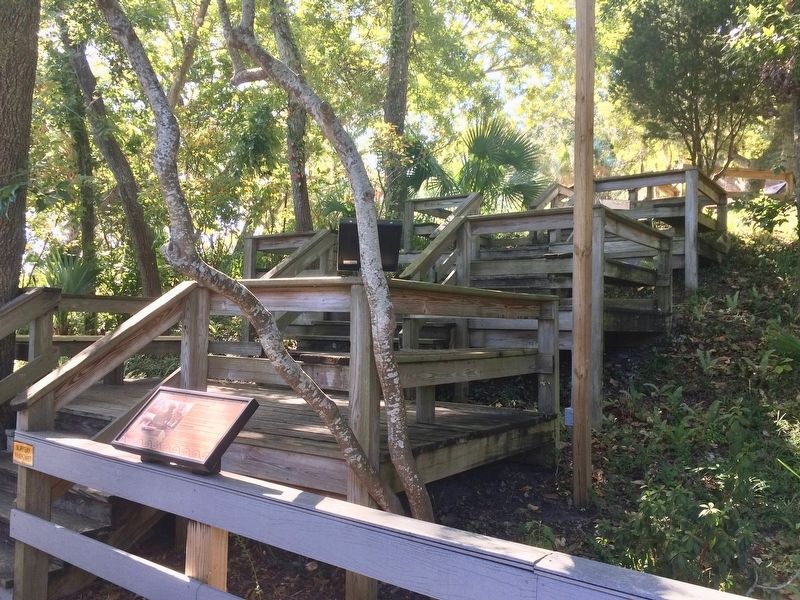
2. Marker with Indian Temple Mound in background.
Location. 30° 24.255′ N, 86° 36.413′ W. Marker is in Fort Walton Beach, Florida, in Okaloosa County. It can be reached from the intersection of Miracle Strip Parkway SE and Eglin Parkway SE. Located at the City of Fort Walton Beach Indian Temple Mound and Museum and the Heritage Park and Cultural Center. Touch for map. Marker is at or near this postal address: 139 Miracle Strip Parkway SE, Fort Walton Beach FL 32548, United States of America. Touch for directions.

Regionally, this marker is on the Florida Panhandle. It is also in the American South, specifically in the Deep South, and on the Gulf Coast. Globally, it is in the North Atlantic Region, North America, a Gulf of Mexico state, the Western Hemisphere, the Western World, and the Anglosphere. Historically, it finds itself in what was once New Spain, the territory of the Mississippian Culture, one of the Confederate States of America, and the Antebellum South.
Other nearby markers. At least 8 other markers are within walking distance of this marker: Story of the Fort Walton Temple Mound (a few steps from
Public Domain, 2007
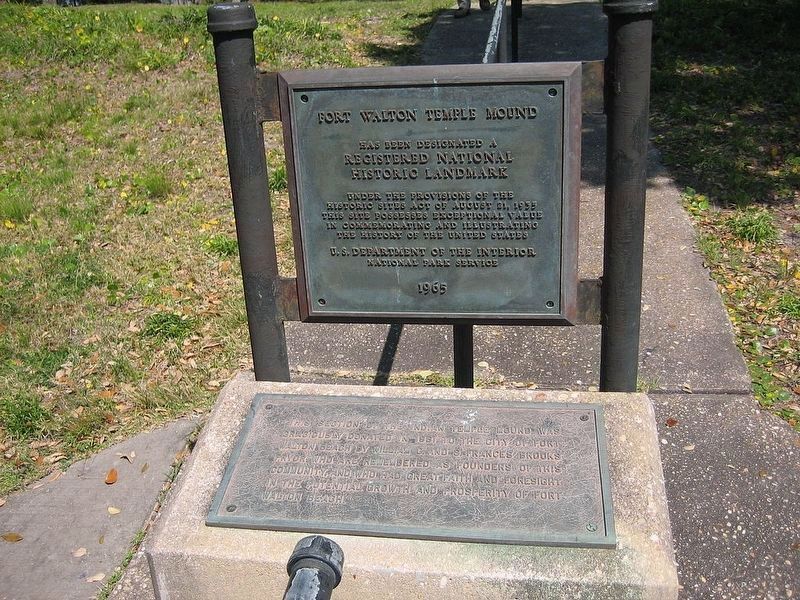
3. 1965 National Historic Landmark plaque.
Below the marker is a plaque recognizing the 1961 donation of Temple Mound land to the City of Fort Walton Beach by William C. & S. Frances Brooks Pryor.
Regarding Preserving and Protecting the Mound. In 1962 the Indian Temple Mound Museum opened as the first municipally owned and operated museum in the State of Florida.
Also see . . . Wikipedia article on the Fort Walton Mound. (Submitted on October 30, 2016, by Mark Hilton of Montgomery, Alabama.)
Photographed by Mark Hilton, October 29, 2016
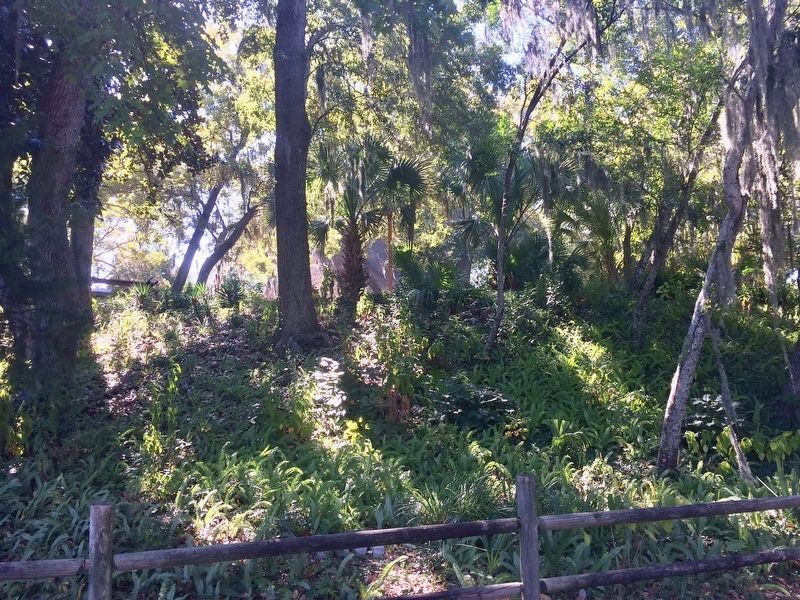
4. A reconstructed temple structure can just be seen atop the mound.
Credits. This page was last revised on December 26, 2025. It was originally submitted on October 30, 2016, by Mark Hilton of Montgomery, Alabama. This page has been viewed 1,231 times since then and 62 times this year. Last updated on August 12, 2025, by Douglass Halvorsen of Klamath Falls, Oregon. Photos: 1, 2, 3, 4. submitted on October 30, 2016, by Mark Hilton of Montgomery, Alabama. • Bernard Fisher was the editor who published this page.
