Near Gadsden in Richland County, South Carolina — The American South (South Atlantic)
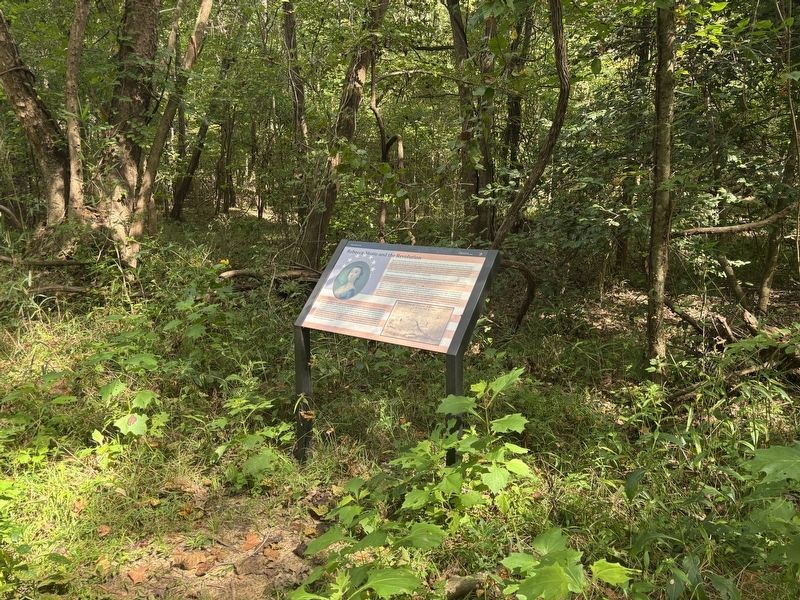
Rebecca Motte and the Revolution
| — | Congaree National Park | — |

Photographed by Benjamin Rubin, August 30, 2025
1. Rebecca Motte and the Revolution Marker
When travellers heading south had crossed over the Congaree River via McCord's Ferry, they would then follow this road (today's Bates Ferry Trail) past the nearby Mt. Joseph Plantation. In 1781, the plantation had become the home of Rebecca Brewton Motte. Her brother, Miles Brewton, was one of the wealthiest men and the largest slave trader in colonial South Carolina. Miles and his family were lost at sea while travelling to Philadelphia in 1775, where he was to serve as a delegate to the Second Continental Congress. Rebecca inherited her brother's fortune, which included Mt. Joseph Plantation. In 1780, her husband Jacob died suddenly and she inherited his fortunes too. Likely the wealthiest woman in South Carolina at that time, Rebecca Motte owned two working plantations, elegant homes in Charleston, and over 240 enslaved people.
When Charleston surrendered to the British on May 12, 1780, British commander Sir Henry Clinton made one of Rebecca's homes his headquarters and forced her and her three daughters to live in the servant quarters upstairs. Shortly thereafter, Mrs. Motte and her children left Charleston for
this page online
Rebecca Motte was a devoted supporter of the Revolution. She and her late husband contributed food from their plantations for the war effort and she opened her house at Mt. Joseph to be used as a hospital for sick and wounded soldiers. It must have been difficult for her to watch as the nearby British garrison left Belleville and came to Mt. Joseph in early 1781. This was now the second time one of her homes had been taken over by the British. Her home was transformed into a fortified outpost for the purpose of guarding McCord's Ferry and the road to Camden. Because of what would happen soon after the unwelcome British takeover, her home would become better known in American history as "Fort Motte." The ensuing struggle for her strategically important home would be a critical event that would help lead to the American victory in South Carolina's backcountry.
(caption)
The drawing to the right shows Belleville Plantation (largest house in the foreground), home of wealthy landowner
Photographed by Benjamin Rubin, August 30, 2025
2. Rebecca Motte and the Revolution Marker
Erected by National Park Service, U.S. Department of the Interior.
Topics. This historical marker is listed in these topic lists: Colonial Era • Parks & Recreational Areas • Patriots & Patriotism • War, US Revolutionary • Women.
Location. 33° 46.571′ N, 80° 39.06′ W. Marker is near Gadsden, South Carolina, in Richland County. It can be reached from U.S. 601 0.6 miles south of Bluff Road (South Carolina Route 48), on the right when traveling south. Located on the Bates Ferry Trail, 1 mile west of the Congaree National Park trailhead. Touch for map. Marker is in this post office area: Eastover SC 29044, United States of America. Touch for directions.

Regionally, this marker is in the Midlands, in the Greater Columbia Area, and in Congaree Country. It is also in the American South and specifically in the Deep South. Globally, it is in North America, the Western Hemisphere, the Western World, and the Anglosphere. Historically, it finds itself in what was once the territory of the Mississippian Culture, one of the original Thirteen Colonies, one of the Confederate States of America, and the Antebellum South.
Other nearby markers. At least 8 other markers are within walking distance of this marker: "Obstinate and Strong" (approx. 0.2 miles away); Leading the Way to Victory (approx. ¼ mile away); Challenging the Rebellion (approx. half a mile away); The Key to the Carolinas (approx. 0.7 miles away); McCord's Ferry: The Charleston to Camden Connection (approx. 0.9 miles away); Crossing the Congaree (approx. 0.9 miles away); What Happened to the Ferries? (approx. 0.9 miles away); Bates Ferry Trail (approx. 0.9 miles away). Touch for a list and map of all markers in Gadsden.
Also see . . . Congaree National Park. National Park Service (Submitted on September 1, 2025.)
Credits. This page was last revised on September 1, 2025. It was originally submitted on August 30, 2025, by Benjamin Rubin of Columbia, South Carolina. This page has been viewed 193 times since then and 88 times this year. Photos: 1, 2. submitted on August 30, 2025, by Benjamin Rubin of Columbia, South Carolina. • Bernard Fisher was the editor who published this page.
