Fairmount Cemetery in Spokane in Spokane County, Washington — The American West (Northwest)
Herbert Bolster
Father of the Interstate Fair
| — | 1855-1903 | — |
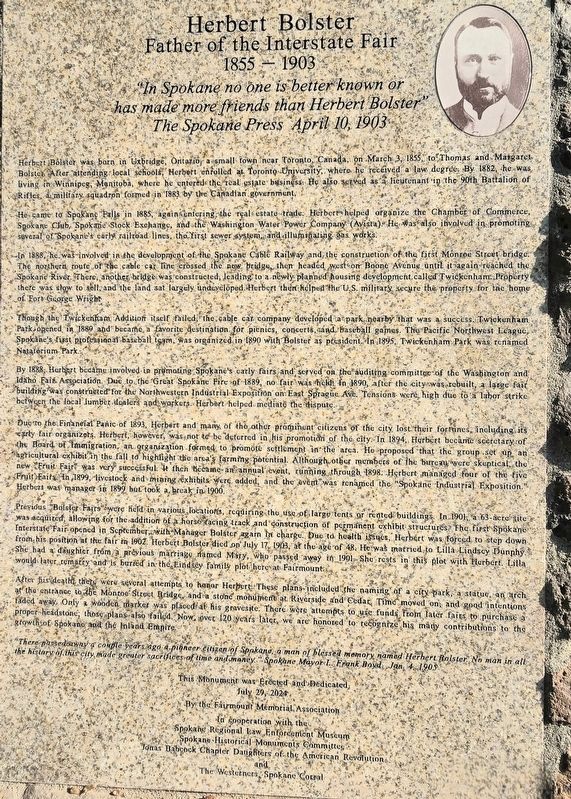
Photographed by Shirley A Stirling, August 30, 2025
1. Herbert Bolster Marker
Herbert Bolster was born in Uxbridge, Ontario, a small town near Toronto, Canada, on March 3, 1855, to Thomas and Margaret Bolster. After attending local schools, Herbert enrolled at Toronto University, where he received a law degree. By 1882, he was living in Winnipeg, Manitoba, where he entered the real estate business. He also served as a lieutenant in the 90th Battalion of Rifles, a military squadron formed in 1883 by the Canadian government.
He came to Spokane Falls in 1885, again entering, the real estate trade. Herbert helped organize the Chamber of Commerce, Spokane Club, Spokane Stock Exchange, and the Washington Water Power Company (Avista). He was also involved in promoting several of Spokane's early railroad lines, the first sewer system, and illuminating gas works.
In 1888, he was involved in the development of the Spokane Cable Railway and the construction of the first Monroe Street bridge. The northern route of the cable car line crossed the new bridge, then headed west on Boone Avenue
this page online
Though the Twickenham Addition itself failed, the cable car company developed a park nearby that was a success. Twickenham Park opened in 1889 and became, a favorite destination for picnics, concerts, and baseball games. The Pacific Northwest League, Spokane's first professional baseball team, was organized in 1890 with Bolster as president. In 1895, Twickenham Park was renamed Natatorium Park.
By 1888, Herbert became involved in promoting Spokane's early fairs and served on the auditing committee of the Washington and Idaho Fair Association. Due to the Great Spokane Fire of 1889, no fair was held in 1890, after the city was rebuilt, a large fair building was constructed for the Northwestern Industrial Exposition on East Sprague Ave. Tensions were high due to a labor strike between the local lumber dealers and workers. Herbert
Photographed by Shirley A Stirling, August 30, 2025
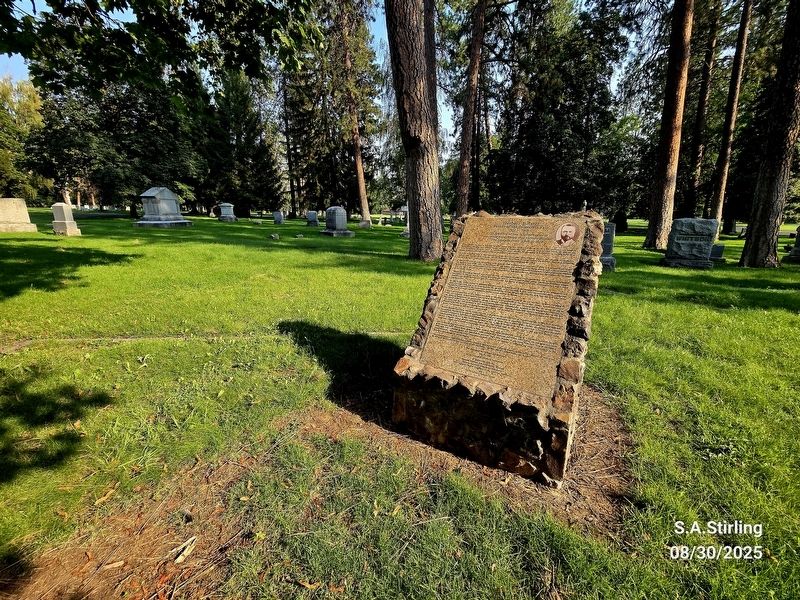
2. Wide shot of Herbert Bolster Marker.
Due to the Financial Panic of 1893, Herbert and many of the other prominent citizens of the city lost their fortunes, including its early fair organizers. Herbert, however, was not to be deterred in his promotion of the city. In 1894, Herbert became secretary of the Board of Immigration, an organization formed to promote settlement in the area. He proposed that the group set up an agricultural exhibit in the fall to highlight the area's farming potential. Although other members of the bureau were skeptical, the new "Fruit Fair" was very successful. It then became an annual event, running through 1898. Herbert managed four of the five Fruit Fairs. In 1899, livestock and mining exhibits were added, and the event was renamed the "Spokane Industrial Exposition." Herbert was manager in 1899 but took a break in 1900.
Previous "Bolster Fairs" were held in various locations, requiring the use of large tents or rented buildings. In 1901, a 63-acre site was acquired, allowing for the addition of a horse racing track and construction of permanent exhibit structures. The first Spokane Interstate Fair opened in September, with Manager Bolster again in charge. Due to health issues, Herbert was forced to step down from his position at the fair in 1902. Herbert Bolster died on July 17, 1903, at the age of 48. He was married to Lilla Lindsey Dunphy. She had a daughter from previous marriage named Mary, who passed away in 1901. She rests in this plot with Herbert. Lilla would later remarry and is buried in the Lindsey family plot here at Fairmount.
After his death there were several attempts to honor Herbert. These plans included the naming of a city park, a statue, an arch at the entrance to the Monroe Street Bridge, and a stone monument at Riverside and Cedar. Time moved on, and good intentions faded away. Only a wooden marker was placed at his gravesite. There were attempts to use funds from later fairs to purchase a proper headstone, those plans also failed. Now, over 120 years later, we are honored to recognize his many contributions to the growth of Spokane and the Inland Empire.
"There passed away a couple years ago a pioneer citizen of Spokane, a man of blessed memory named Herbert Bolster. No man in all the history of this city made greater sacrifices of time and money." Spokane Mayor L. Frank Boyd, Jan. 4, 1905.
Erected 2024 by Fairmount Memorial Association in cooperation with the Spokane Regional Law Enforcement Museum, Spokane Historical Monuments Committee, Jonas Babcock Chapter Daughters of the American Revolution and The Westerners Spokane Corral.
Topics. This historical marker is listed in these topic lists: Agriculture • Cemeteries & Burial Sites • Parks & Recreational Areas • Railroads & Streetcars. A significant historical year for this entry is 1855.
Location. 47° 42.157′ N, 117° 29.344′ W. Marker is in Spokane, Washington, in Spokane County. It is in Fairmount Cemetery. It can be reached from Wellesley Avenue, on the right when traveling west. The marker is within Fairmount Cemetery, at the end of Wellesley. Touch for map. Marker is at or near this postal address: 5200 Wellesley, Spokane WA 99205, United States of America. Touch for directions.

Regionally, this marker is in the American Mountain West and in the Lewis & Clark Corridor. Globally, it is in North America, on the Pacific Rim, in the Western Hemisphere, in the Western World, and in the Anglosphere.
Other nearby markers. At least 8 other markers are within 3 miles of this marker, measured as the crow flies: Byron C. Riblet (within shouting distance of this marker); Elizabeth Tappan Tannatt Memorial (about 400 feet away, measured in a direct line); Thomas Redding Tannatt / Elizabeth Forster Tappan (about 400 feet away); Matsutaro and Hatsume Kawaguchi (about 400 feet away); A Legacy of Joy and Wonderful Memories (about 700 feet away); Jesse Ray Drowley (approx. 0.4 miles away); Never Forget Garden (approx. 0.6 miles away); Whist-Alks Way (approx. 2.3 miles away). Touch for a list and map of all markers in Spokane.
Another marker is no longer nearby. Col. George Wright (was approx. 2.3 miles away but has been permanently removed).
Credits. This page was last revised on September 4, 2025. It was originally submitted on August 30, 2025, by Shirley A Stirling of Lacey, Washington. This page has been viewed 97 times since then and 39 times this year. Photos: 1, 2. submitted on August 30, 2025, by Shirley A Stirling of Lacey, Washington. • James Hulse was the editor who published this page.
