Niagara-on-the-Lake in Niagara Region, Ontario — Central Canada (North America)
Courting International Tennis
How Niagara-on-the-Lake won the hearts of the international world of tennis.
Photographed by Kevin Westell, August 31, 2025
1. Courting International Tennis - panels 1, 2, 3
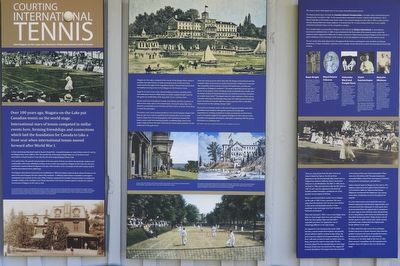
Over 100 years ago, Niagara-on-the-Lake put Canadian tennis on the world stage. International stars of tennis competed in stellar events here, forming friendships and connections which laid the foundation for Canada to take a front seat when international tennis moved forward after World War I.
A short stroll along King Street leads to Queen's Royal Park - a beautiful location on Lake Ontario where it's met by the Niagara River. From 1869 to 1927, this was the site of the Queen's Royal Hotel, one of the finest resort destinations in North America. It was also the site of the original Niagara Tennis Club.
In its earliest days, the growth and promotion of the new sport of tennis was driven by passionate amateurs and communities, with many individuals creating courts on their own properties. Niagara-on-the-Lake was one such community. A perfect blend of elegance and ease, with a location at the crossroads of USA and Canada, made it ideal for international tennis gatherings.
The Niagara International tournament was established in 1884 and staged continuously for almost 40 years. It
this page online
[Panel 2]
Niagara-on-the-Lake is situated at the mouth of the Niagara River, where it empties into Lake Ontario. A visitor arriving by boat would have been impressed by the sight of the magnificent Queen's Royal Hotel dominating the lakefront, facing across to Fort Niagara on the American shore.
Huge for its time, it was a four-storey building, painted a dazzling white with dark green shutters. Wide breezy verandas supplied ample room for the guests to comfortably while away their time in rocking chairs.
Guests came from throughout Canada, Great Britain and the continent, as well as from many cities in the United States. During the glory days, four steamers arrived daily across the lake and three trains ran down to the dock
Photographed by Kevin Westell, August 31, 2025
2. Courting International Tennis - panels 4, 5
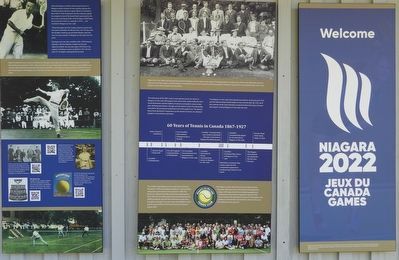
The tennis courts were located parallel to Front Street between Regent and King, an area now used as a parking lot for tourists who come to enjoy Queen's Royal Park. The bowling greens were located just beyond the tennis courts, near Front and King Streets. A walkway fairly close to the water's edge led from the hotel itself past the casino (dance pavilion) to the clubhouse of the golf course.
There are many accounts which describe the Niagara International and the Canadian Open as the most successful tournaments of their era. It was said "the hospitality of the Canucks is famous the world over", and this was especially so of Niagara's residents. "The week is generally wound up with a dinner to the players, when everybody drinks everybody else's health, and the bonds of eternal friendship between the Americans and the Canadians are sealed many times." "The players dress for their matches in their rooms; and when they have finished play they jump into bathing suits and plunge down the bank and into the lake for a swim, a process that is a decided improvement on the ordinary
Photographed by Kevin Westell, August 31, 2025
3. Niagara-on-the-Lake Tennis Club - Clubhouse
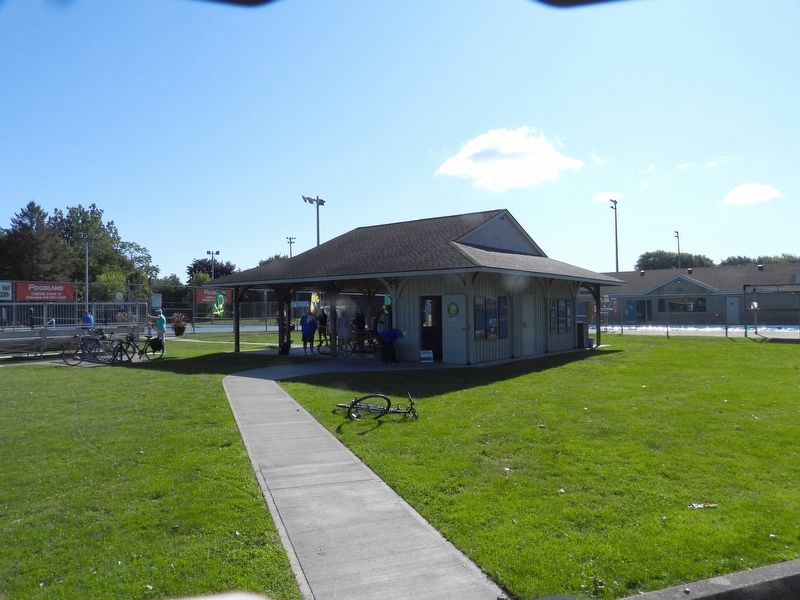
Photo faces east from Veterans Lane. This marker is on south-west wall of the clubhouse. On the left are tennis courts; on the right is the Niagara Pool. Beyond the pool are lights for one of soccer fields. A lighted ball diamond is also nearby.
During the tournament weeks at the end of August and early September, prominent local residents held garden parties for friends and acquaintances, inviting competitors to play social games on their tennis courts. The parties added to the appeal of Niagara-on-the-Lake as a most desirable and enjoyable destination, ultimately competing with the games themselves as a drawing card.
With thanks to Kaye Toye, included in Bicentennial Stories of Niagara-on-the-Lake.
[Panel 3]
The Queen's Royal Hotel played host to two major international tennis events.
The National Bank Open, formerly the Canadian National Championships, is Canada's open international tennis championship. Founded in 1881, it's the second oldest tournament in tennis - behind only Wimbledon (1877). Played originally at the Toronto Lawn Tennis Club, it was moved to Niagara-on-the-Lake in 1895 in order to find a stronger playing field and a larger audience. It remained here for 14 years, during which time it was a highly celebrated and festive fixture on the competition calendar.
The Canadian Open was preceded in Niagara-on-the-Lake by the Niagara International, an extraordinary tournament established here in 1884. It was scheduled for the final weeks of the summer, across Labor Day weekend, which happened to follow the US Open at that time. Players loved coming to Niagara-on-the-Lake for a joyful celebration at the conclusion of the summer circuit and adopted it as the jewel of the summer circuit.
The two events drew great players from throughout North America and beyond, many of whom are Olympic champions, US Open champions, inductees in the Canadian Tennis Hall of Fame and in the International Tennis Hall of Fame.
There are many stories from the days of tennis at Queen's Royal, but high on the list are three appearances by the incomparable May Sutton. Born in England but raised in California, Sutton was the first American to win Wimbledon. She did it in 1905, lost in the finals in 1906, and returned to take the title again in 1907. In each case, her opponent in the final was Dorothy Lambert Chambers, considered one of the greatest women players of all time.
When it was learned Sutton would come to Niagara- on-the-Lake in 1907, it was a sensation. She was a larger-than-life character, and "the press were effusive in their praise and absolutely bonkers in their reporting". It was front-page news from Toronto to Rochester and beyond.
When she returned in 1909, it was an even bigger story. With her "short length white linen skirt and blouse, fluffy hair full of golden lights and tied with a coquettish pink bow", her appearance was as refreshingly different as her style of play. Her opponent in the championship match, Edith Hannam, a recent emigré from England, was graceful, tall and refined: a distinct contrast to May Sutton. No game had ever enjoyed such pregame buildup. More than 1,500 were on hand to watch as Sutton came out firing, and won the match in short order. The live orchestra played The Star-Spangled Banner and a large bouquet of pink roses was presented. This capped off an event described as "the largest and most successful in the history of the Lawn Tennis Association." There were over 250 entries, with "the play having been unusually brilliant, most of the crack players of America being present and playing in splendid form".
Sutton returned again to Niagara-on-the-Lake in 1911, playing a topsy-turvy final against Hazel Hotchkiss, an arch-rival from California. Hazel married George Wightman and donated the Wightman Cup, among many other contributions to tennis throughout her long life.
[Panel 4]
Ichiya Kumagae is another interesting character in Niagara's tennis history. He was among a group who introduced lawn tennis to Japan. When he traveled to New York in 1916, he became the first Japanese player to compete in one of the Grand Slam tournaments. He lost in the semi-finals of the 1918 US Open to Bill Tilden, but rose to in the U.S. rankings in 1919 ... and traveled to Niagara-on-the-Lake.
"Ichiya Kumagae won the singles, playing a game that was quite irresistible. He did not lose a set." He also won the doubles, teaming up with Beals Wright, who had won so many matches in Niagara-on-the Lake over the years.
Kumagae won two silver medals at the 1920 Antwerp Olympics, the first Olympic medals won by any Japanese athlete. He was also Japan's first Davis Cup captain, including a runner-up finish in 1921. He was only 5'5" in height, and played left-handed.
Robert Lindley Murray, two time US National Champion, was a three time winner of the Niagara-on-the-Lake International tournament in 1921, 1922 and 1923. Born and educated in California, Murray came to Buffalo as a chemist with Hooker Electrochemical during the war effort, eventually becoming president and CEO. He was a prominent figure in the Niagara area, retiring to Lewiston. He is an inductee of the International Tennis Hall of Fame.
[Panel 5]
The early years of the 20th century were glorious times for tennis in Niagara-on-the-Lake. Elite players from around the world made this their social destination and the leaders of industry and politics came to take part. Nothing lasts forever, though, and the advent of the First World War and shift in the economy marked the end of this golden era. The Queens Royal hotel declined in importance as the advent of motor cars allowed people to travel farther and faster.
The Niagara-on-the-Lake International tournament continued until 1923 and the Queens Royal slowly began to close shortly after. By 1935, all of the contents of the hotel had been auctioned off and the days of tennis' elite players visiting Niagara-on-the-Lake was over.
The modern-day Niagara-on-the-Lake Tennis Club was founded in 1970 and worked tirelessly for 15 years before seeing four courts built on this location in 1986. This photo was taken at the 40th anniversary celebrations in 2010. Plans for the 50th anniversary were derailed by the COVID pandemic, but the club continues to grow from strength to strength. Two new courts were added in 2021, and the venue will host the Canada Summer Games in August 2022.
The Niagara-on-the-Lake Tennis Club is all about Tennis Everyone, offering a warm and inclusive atmosphere for players of all ages and all levels of playing experience. Looking for a way into this magnificent sport-for-life? You've come to the right place! Here you'll find support and guidance, and will meet new friends to share the fun and the challenge of your pursuit.
Erected 2022 by Niagara-on-the-Lake Tennis Club.
Topics. This historical marker is listed in these topic lists: Entertainment • Parks & Recreational Areas • Sports • Women. A significant historical year for this entry is 1869.
Location. 43° 15.028′ N, 79° 4.392′ W. Marker is in Niagara-on-the-Lake, Ontario, in Niagara Region. It is on Veterans Lane, on the right when traveling west. The marker is on the south-west wall of the clubhouse of the Niagara-on-the-Lake tennis club. Touch for map. Marker is at or near this postal address: 232 Veterans Lane, Niagara-on-the-Lake ON L0S 1J0, Canada. Touch for directions.

Regionally, this marker is on the Golden Horseshoe and in Niagara Canada. It is also in Central Canada. Globally, it is in North America, on the Great Lakes, in the Western Hemisphere, in the Western World, and in the Anglosphere. Historically, it finds itself in what was once a British colony, the Viceroyalty of New France, the Haudenosaunee (Iroquois) Confederacy, and Rupert’s Land.
Other nearby markers. At least 8 other markers are within walking distance of this marker: Memorial Park (about 90 meters away, measured in a direct line); Even before Canada was an independent nation (about 150 meters away); The Parliament Oak (about 150 meters away); Niagara Land Purchases (about 210 meters away); Memorial Hall, 1906 (about 210 meters away); Ontario's First Railroad - The Erie and Ontario Railroad. (about 210 meters away); Janet Carnochan 1839 - 1926 (about 210 meters away); The Canada Constellation (about 210 meters away). Touch for a list and map of all markers in Niagara-on-the-Lake.
Regarding Courting International Tennis. Tennis was a amateur sport before 1926; touring tennis players were all wealthy.
Credits. This page was last revised on September 7, 2025. It was originally submitted on September 1, 2025, by Kevin Westell of St. Catharines, Ontario. This page has been viewed 81 times since then and 24 times this year. Photos: 1, 2, 3. submitted on September 1, 2025, by Kevin Westell of St. Catharines, Ontario. • Andrew Ruppenstein was the editor who published this page.
