
Bellvue in Larimer County, Colorado — The American Mountains (Southwest)
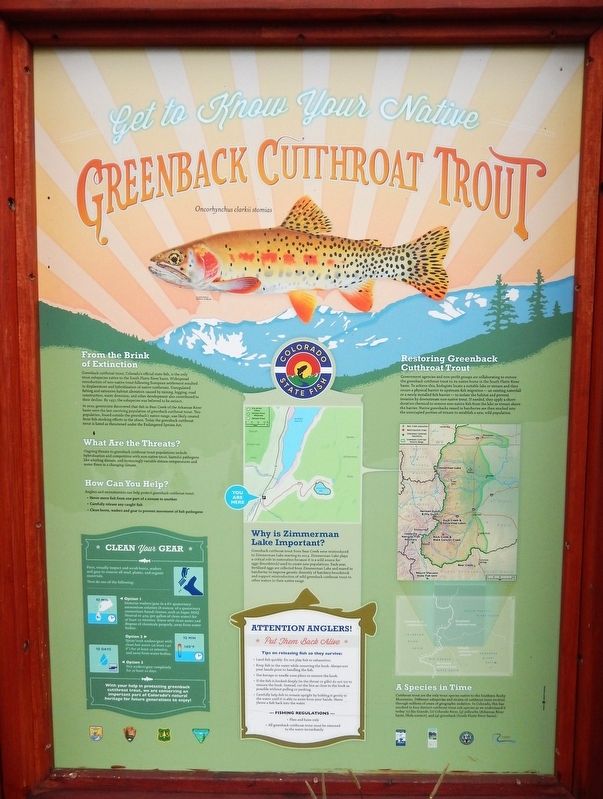
Get to Know your Native Greenback Cutthroat Trout
Oncorhynchus clarkii stomias
| — | Colorado State Fish | — |
Photographed by Cosmos Mariner, July 29, 2025
1. Get to Know your Native Greenback Cutthroat Trout Marker
From the Brink of Extinction
Greenback cutthroat trout, Colorado's official state fish, is the only trout subspecies native to the South Platte River basin. Widespread introduction of non-native trout following European settlement resulted in displacement and hybridization of native cutthroats. Unregulated fishing and extensive habitat alteration caused by mining, logging, road construction, water diversion, and other development also contributed to their decline. By 1937, the subspecies was believed to be extinct.
In 2012, geneticists discovered that fish in Bear Creek of the Arkansas River basin were the last surviving population of greenback cutthroat trout. This population, found outside the greenback's native range, was likely created from fish stocking efforts in the 1800s. Today the greenback cutthroat trout is listed as threatened under the Endangered Species Act.
What Are the Threats?
Ongoing threats to greenback cutthroat trout populations include hybridization and competition with non-native trout, harmful pathogens like whirling disease, and increasingly variable stream temperatures and water flows in a changing
this page online
How Can You Help?
Anglers and recreationists can help protect greenback cutthroat trout:
• Never move fish from one part of a stream to another
• Carefully release any caught fish
• Clean boots, waders and gear to prevent movement of fish pathogens
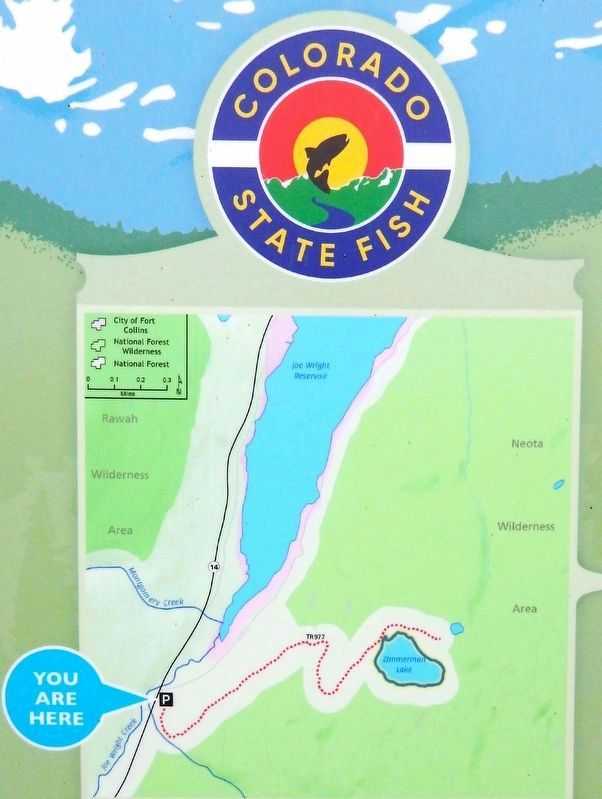
Why is Zimmerman Lake Important?
Greenback cutthroat trout from Bear Creek were reintroduced to Zimmerman Lake starting in 2014. Zimmerman Lake plays a critical role in restoration because it is a wild source for eggs (broodstock) used to create new populations. Each year, fertilized eggs are collected from Zimmerman Lake and reared in hatcheries to improve genetic diversity of hatchery broodstock and support reintroduction of wild greenback cutthroat trout to other waters in their native range.
Restoring Greenback Cutthroat Trout
Government agencies and non-profit groups are collaborating to restore the greenback cutthroat trout to its native home in the South Platte River basin. To achieve this, biologists locate a suitable lake or stream and then secure a physical barrier to upstream fish migration — an existing waterfall or a newly installed fish barrier — to isolate the habitat and
2. Marker detail: Zimmerman Lake Trailhead
A Species in Time
Cutthroat trout are the only trout species native to the Southern Rocky Mountains. Different subspecies and strains of cutthroat trout evolved through millions of years of geographic isolation. In Colorado, this has resulted in four distinct cutthroat trout sub-species as we understand it today: (1) Rio Grande, (2) Colorado River, (3) yellowfin (Arkansas River basin, likely extinct), and (4) greenback (South Platte River basin).
Topics. This historical marker is listed in these topic lists: Animals • Environment • Parks & Recreational Areas • Waterways & Vessels. A significant historical year for this entry is 2014.
Location. 40° 32.357′ N, 105° 52.937′ W. Marker is in Bellvue, Colorado, in Larimer County. It can be reached from the intersection of Poudre Canyon Road (State Highway 14 at milepost 66.5) and Forest

3. Marker detail: Clean Your Gear
First, visually inspect and scrub boots, waders and gear to remove all mud, plants, and organic materials.
Then do one of the following:
• Option 1
Immerse waders/gear in a 6% quaternary-ammonium solution (6 ounces of a quaternary ammonium-based cleaner, such as Super HDQ Neutral or 409, per gallon of clean water) for at least 10 minutes. Rinse with clean water and dispose of chemicals properly, away from water bodies.
• Option 2
Spray/soak waders/gear with clean hot water (at least 140 °F) for at least 10 minutes, and away from water bodies.
• Option 3
Dry waders/gear completely for at least 10 days.——— With your help in protecting greenback cutthroat trout, we are conserving an important part of Colorado's natural heritage for future generations to enjoy!
Then do one of the following:
• Option 1
Immerse waders/gear in a 6% quaternary-ammonium solution (6 ounces of a quaternary ammonium-based cleaner, such as Super HDQ Neutral or 409, per gallon of clean water) for at least 10 minutes. Rinse with clean water and dispose of chemicals properly, away from water bodies.
• Option 2
Spray/soak waders/gear with clean hot water (at least 140 °F) for at least 10 minutes, and away from water bodies.
• Option 3
Dry waders/gear completely for at least 10 days.

Regionally, this marker is in Colorado’s Front Range. It is also in the American Mountain West. Globally, it is in North America, the Rocky Mountains, the Western Hemisphere, the Western World, and the Anglosphere. Historically, it finds itself in what was once the Louisiana Purchase.
Other nearby markers. At least 8 other markers are within 9 miles of this marker, measured as the crow flies: Joe Wright Reservoir (here, next to this marker); Poudre Pioneer Tourism (here, next to this marker); Cameron Pass Country (approx. 1.4 miles away); The Industrial Frontier (approx. 1.4 miles away); Forest Conservation (approx. 1.4 miles away); Auto Tourism (approx. 1.4 miles away); The Colorado State Forest Management Complex (approx. 5.1 miles away); Beaver Trade (approx. 9 miles away). Touch for a list and map of all markers in Bellvue.
Also see . . . Greenback Cutthroat Trout (Wikipedia).
4. Marker detail: Attention Anglers!
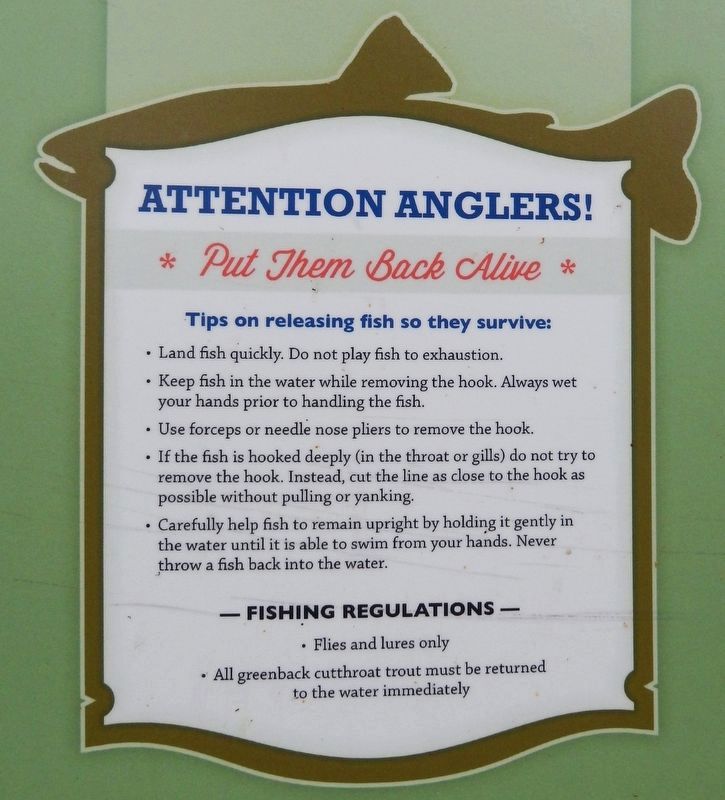
• Land fish quickly. Do not play fish to exhaustion.
• Keep fish in the water while removing the hook. Always wet your hands prior to handling the fish.
• Use forceps or needle nose pliers to remove the hook.
• If the fish is hooked deeply (in the throat or gills) do not try to remove the hook. Instead, cut the line as close to the hook as possible without pulling or yanking.
• Carefully help fish to remain upright by holding it gently in the water until it is able to swim from your hands. Never throw a fish back into the water.
• All greenback cutthroat trout must be returned to the water immediately
Excerpt: The greenback cutthroat, once widespread in the Arkansas and South Platte River drainages of Eastern Colorado and Southeast Wyoming, today occupies less than 1% of its historical range. It is currently listed as threatened under the Endangered Species Act. It was adopted as the state fish of Colorado on March 15, 1994, replacing the unofficial rainbow trout.(Submitted on September 2, 2025, by Cosmos Mariner of Cape Canaveral, Florida.)
Although the greenback cutthroat was considered extinct by the 1930s, in 1957 a population was discovered in Rocky Mountain National Park in the Big Thompson River, a tributary of the South Platte. Additional populations were found in 1965 and 1970, making possible the 1978 reclassification of the subspecies as threatened under the 1973 Endangered Species Act.
Recovery efforts for the greenback cutthroat by the U.S. Fish and Wildlife Service, assisted by Trout Unlimited, are ongoing. Catch and release fishing of the greenback cutthroat is currently permitted in parts of both the South Platte and Arkansas River basins.
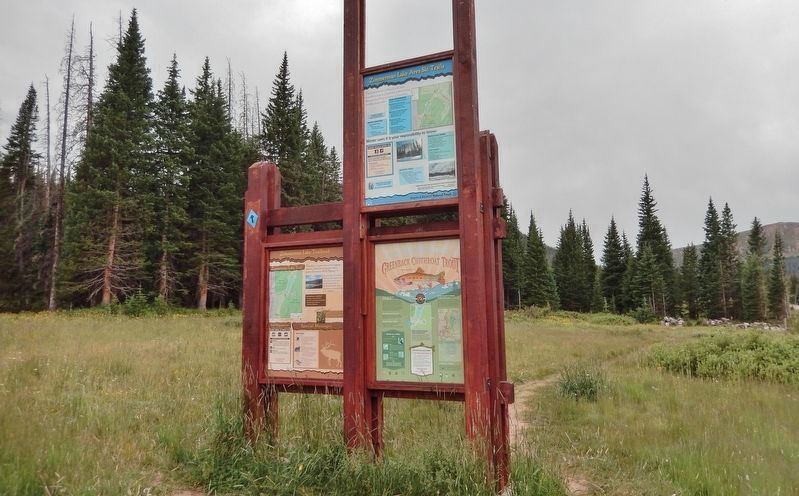
In 2012, a genetic study that compared DNA samples both from modern populations and historical samples dating back to the 19th century revealed thatthe only remaining population of pure greenback cutthroat trout is found in a 4-mile stretch of Bear Creek, a tributary of the Arkansas River. Many of the populations previously identified as greenback cutthroat were actually of the similar Colorado River and Rio Grande cutthroat subspecies. In 2022, Colorado Parks and Wildlife announced that the greenback cutthroat trout was discovered to be naturally reproducing having been reintroduced in Herman Gulch.Photographed by Cosmos Mariner, July 29, 20255. Get to Know your Native Greenback Cutthroat Trout MarkerLooking east from the Zimmerman Lake Trailhead parking lot. This historical marker is the bottom right panel.
Photographed by Cosmos Mariner, July 29, 2025
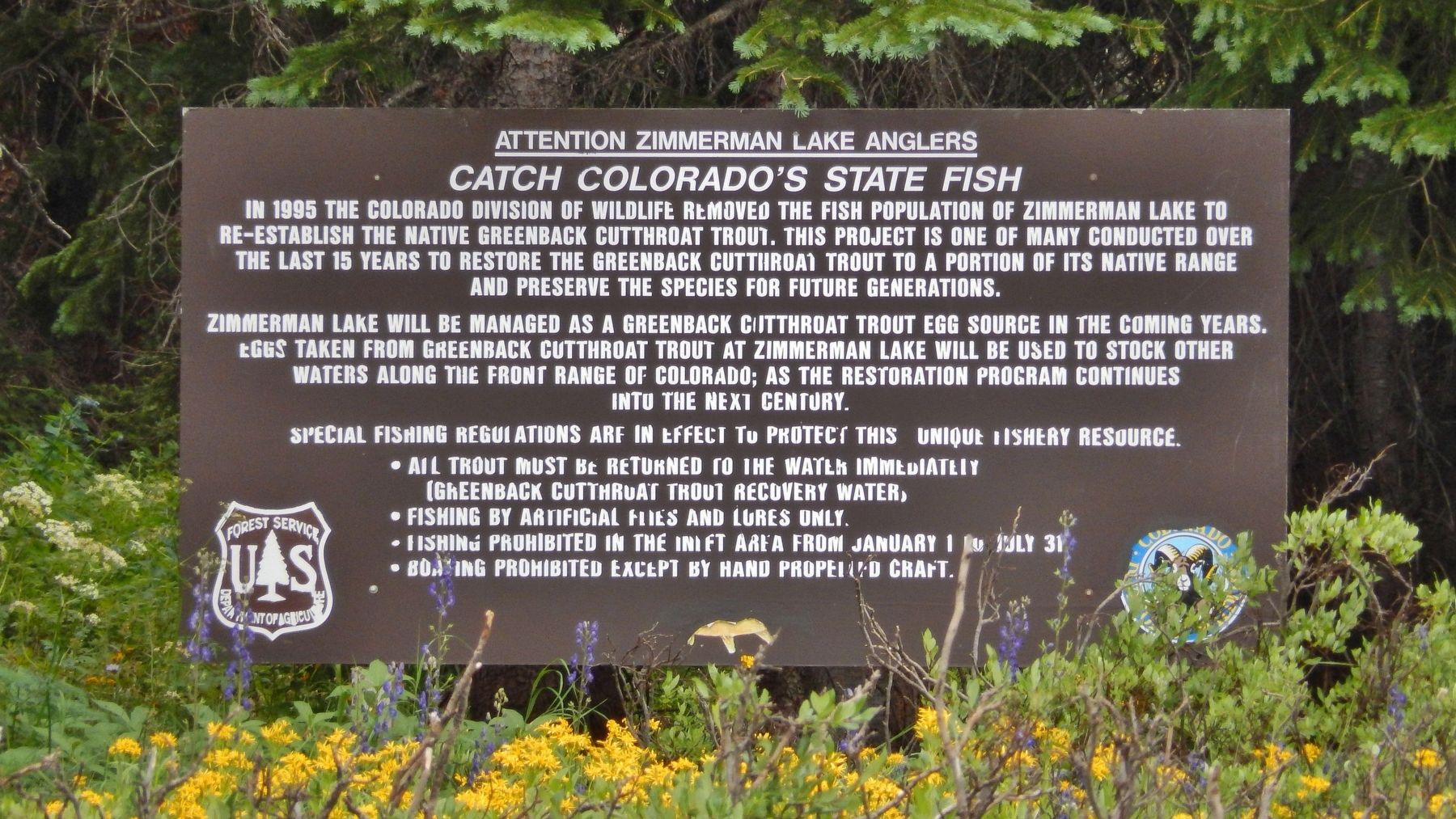
6. U.S. Forest Service & Colorado Division of Wildlife Sign at the Trailhead
Catch Colorado’s State Fish
Zimmerman Lake will be managed as a Greenback Cutthroat Trout egg source in the coming years. Eggs taken from Greenback Cutthroat Trout at Zimmerman Lake will be used to stock other waters along the Front Range of Colorado; as the restoration program continues into the next century.
Special fishing regulations are in effect to protect this unique fishery resource.
• All trout must be returned to the water immediately (Greenback Cutthroat Trout Recovery Water)
• Fishing by artificial flies and lures only.
• Fishing prohibited in the inlet area from January 1 to July 31.
• Boating prohibited except by hand propelled craft.
Credits. This page was last revised on September 2, 2025. It was originally submitted on September 2, 2025, by Cosmos Mariner of Cape Canaveral, Florida. This page has been viewed 94 times since then and 13 times this year. Photos: 1, 2, 3, 4, 5, 6. submitted on September 2, 2025, by Cosmos Mariner of Cape Canaveral, Florida.
