
Niagara Falls in Niagara Region, Ontario — Central Canada (North America)
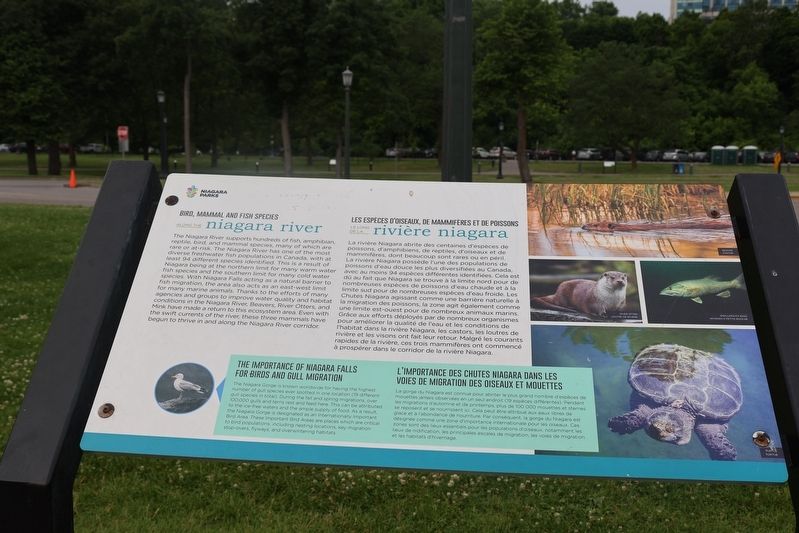
Bird, Mammal, and Fish Species along the Niagara River
Les Espèces d'Oiseaux, de Mammifères et de Poissons le long de la Rivière Niagara
| — | Niagara Parks | — |
Photographed by Sandra Hughes Tidwell, June 25, 2024
1. Bird, Mammal, and Fish Species along the Niagara River Marker

The Niagara River supports hundreds of fish, amphibian, reptile, bird, and mammal species, many of which are rare or at-risk. The Niagara River has one of the most diverse freshwater fish populations in Canada, with at least 94 different species identified. This is a result of Niagara being at the northern limit for many warm water fish species and the southern limit for many cold water species. With Niagara Falls acting as a natural barrier to fish migration, the area also acts as an east-west limit for many marine animals. Thanks to the efforts of many agencies and groups to improve water quality and habitat conditions in the Niagara River, beavers, river otters, and mink have made a return to this ecosystem area. Even with the swift currents of the river, these three mammals have begun to thrive in and along the Niagara corridor.
The Importance of Niagara Falls for Birds and Gull Migration
The Niagara Gorge is known worldwide for having the highest number of gull species ever spotted in one location (19 different gull species in total). During the fall and spring migrations,
this page online
_____________________
La rivière Niagara abrite des centaines d'espèces de poissons, d'amphibiens, de reptiles, d'oiseaux et de mammifères, dont beaucoup sont rares ou en péril. La rivière Niagara possède l'une des populations de poissons d'eau douce les plus diversifiées au Canada, avec au moins 94 espèces différentes identifiées. Cela est dû au fait que Niagara se trouve à la limite nord pour de nombreuses espèces de poisson d'eau chaude et à la limite sud pour de nombreuses espèces d'eau froide. Les Chutes Niagara agissant comme une barrière naturelle à la migration des poissons, la zone agit également comme une limite est-ouest pour de nombreux animaux marins. Grâce aux efforts déployés par de nombreux organismes pour améliorer

Photographed by Kevin Westell, July 3, 2025
2. Marker in context
Photo faces west and south-west from the Trans Canada walking/biking trail. That traffic booth (left) is the entrance to the southern of the two bus loops.
L'importance Des Chutes Niagara Dans Les Voies De Migration Des Oiseaux Et Mouettes
La gorge du Niagara est connue pour abriter le plus grand nombre d'espèces de mouettes jamais observées en un seul endroit (19 espèces différentes). Pendant les migrations d'automne et de printemps, plue de 100,000 mouettes et sternes se reposent et se nourrissent ici. Cela peut être attribué aux eaux libres de glace et à l'abondance de nourriture. Par conséquent, la gorge du Niagara est désignée comme une zone d'importance internationale pour les oiseaux. Ces zones sont des lieux essentiels pour les populations d'oiseaux, notamment les lieux de nidificaiton, les principales escales de migration, les voies de migration et les habitats d'hivernage.
Erected by Niagara Parks.
Topics. This historical marker is listed in these topic lists: Animals • Environment • Parks & Recreational Areas • Waterways & Vessels.
Location. 43° 4.628′ N, 79° 4.739′ W. Marker is in Niagara Falls, Ontario, in Niagara Region. It is on Niagara River Pkwy, on the right when traveling north. The marker is 40 metres east of the road, beside the Trans Canada walking/biking trail, near the southern of the two bus loops, 250 metres south of the Falls. Touch for map. Marker is at or near this postal address: 6760 Niagara River Pkwy, Niagara Falls ON L2G 7B7, Canada. Touch for directions.

Regionally, this marker is on Ontario’s Golden Horseshoe and in Niagara Canada. It is also in Central Canada. Globally, it is in North America, on the Great Lakes, in the Western Hemisphere, in the Western World, and in the Anglosphere. Historically, it finds itself in what was once a British colony, the Viceroyalty of New France, the Haudenosaunee (Iroquois) Confederacy, and Rupert’s Land.
Other nearby markers. At least 8 other markers are within walking distance of this marker: The History of Tourism around Niagara Falls (within shouting distance of this marker); Why Is This Canada And That's America? (about 90 meters away, measured in a direct line); Geological Formation of Niagara Falls and the Niagara River (about 90 meters away); Wm. B. Rankine (about 120 meters away); The Niagara Parks Commission / Commission Des Parcs Du Niagara (about 120 meters away); Niagara Falls Park and River Railway Powerhouse (about 120 meters away); Environmental Stewardship at Niagara Parks / Le Gérance Environnementale de Niagara Parks (about 120 meters away); Indigenous Culture / Approaches to Water (about 150 meters away). Touch for a list and map of all markers in Niagara Falls.
Credits. This page was last revised on September 12, 2025. It was originally submitted on July 11, 2024, by Sandra Hughes Tidwell of Killen, Alabama, USA. This page has been viewed 328 times since then and 68 times this year. Last updated on September 6, 2025, by Kevin Westell of St. Catharines, Ontario. Photos: 1. submitted on July 11, 2024, by Sandra Hughes Tidwell of Killen, Alabama, USA. 2. submitted on September 6, 2025, by Kevin Westell of St. Catharines, Ontario. • Devry Becker Jones was the editor who published this page.
