Winnabow in Brunswick County, North Carolina — The American South (South Atlantic)
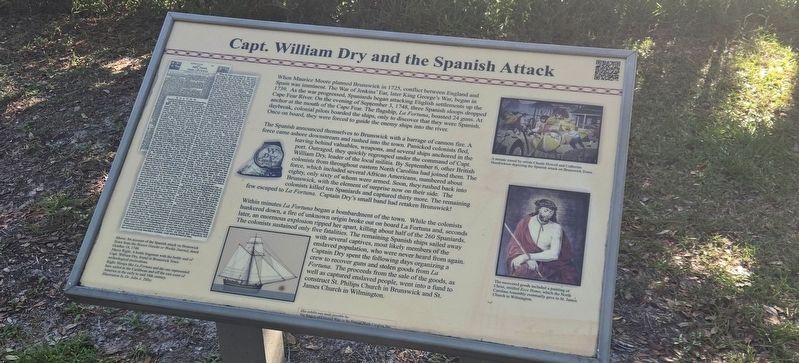
Capt. William Dry and the Spanish Attack
Photographed by Mike McKeown
1. Capt. William Dry and the Spanish Attack Marker
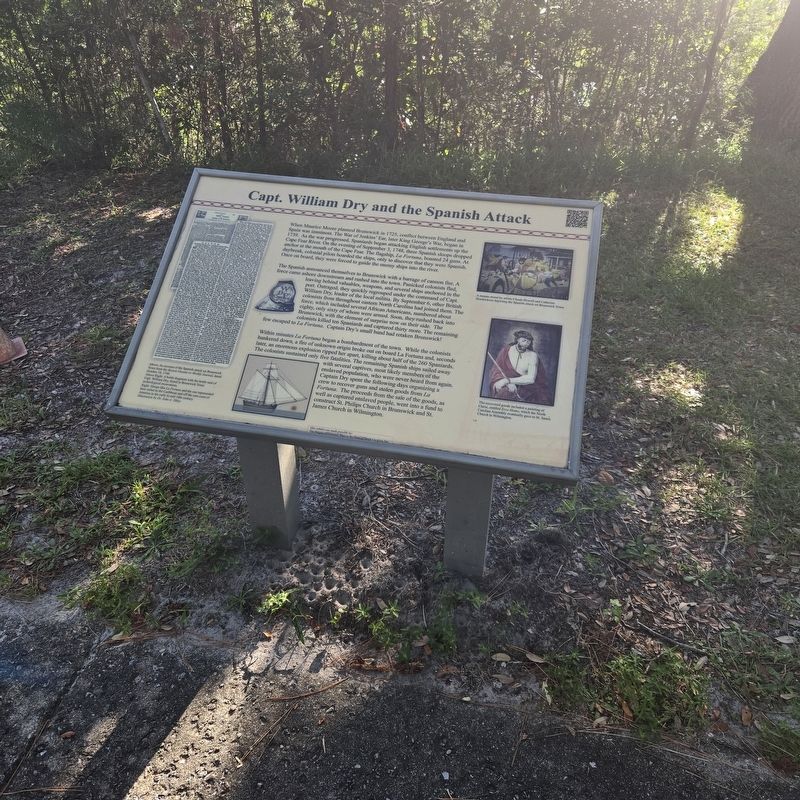
When Maurice Moore planned Brunswick in 1725, conflict between England and Spain was imminent. The War of Jenkins' Ear, later King George's War, began in 1739. As the war progressed, Spaniards began attacking English settlements up the Cape Fear River. On the evening of September 3, 1748, three Spanish sloops dropped anchor at the mouth of the Cape Fear. The flagship, La Fortuna boasted 24 guns. At daybreak, colonial pilots boarded the ships, only to discover that they were Spanish. Once on board, they were forced to guide the enemy ships into the river.
The Spanish announced themselves to Brunswick with a barrage of cannon fire. A force came ashore downstream and rushed into the town. Panicked colonists fled, leaving behind valuables, weapons, and several ships anchored in the port. Outraged, they quickly regrouped under the command of Capt. William Dry, leader of the local militia. By September 6, other British colonists from throughout eastern North Carolina had joined them. The force, which included several African Americans, numbered about eighty, only sixty of whom were armed. Soon, they rushed back into Brunswick,
this page online
Within minutes La Fortuna began a bombardment of the town. While the colonists hunkered down, a fire of unknown origin broke out on board La Fortuna and, seconds later, an enormous explosion ripped her apart, killing about half of the 260 Spaniards. The colonists sustained only five fatalities. The remaining Spanish ships sailed away with several captives, most likely members of the enslaved population, who were never heard from again. Captain Dry spent the following days organizing a crew to recover guns and stolen goods from La Fortuna. The proceeds from the sale of the goods, as well as captured enslaved people, went into a fund to construct St. Philips Church in Brunswick and St James Church in Wilmington.
(captions)
Above: An Account of the Spanish attack on Brunswick Town from the Boston Gazette or Weekly Journal dated October 18, 1748.
Above Right: A bottle fragment with the bottle seal of Capt. William Dry, found in Brunswick Town archeological excavations.
Right: Sloops like La Fortuna and the one represented here sailed in the Caribbean and off the east Coast of America in the early to mid 18th century. Illustration by Dr. John A. Tilley
A mosaic mural by artists Claude Howell and Catherine Hendricksen depicting the Spanish attack on Brunswick Town.
The recovered goods included a painting of Christ entitled Ecce Homo which the North Carolina Assembly eventually gave to St. James Church in Wilmington.
Erected by The
Photographed by Mike McKeown, September 12, 2025
2. Capt. William Dry and the Spanish Attack Marker
Topics. This historical marker is listed in these topic lists: Colonial Era • Settlements & Settlers • Wars, Non-US • Waterways & Vessels. A significant historical date for this entry is September 3, 1748.
Location. 34° 2.272′ N, 77° 56.671′ W. Marker is in Winnabow, North Carolina, in Brunswick County. It can be reached from St Phillips Road SE. Along the trail at the Brunswick Town/Fort Anderson Historic site. Touch for map. Marker is at or near this postal address: 8884 St Phillips Rd SE Winnabow NC 28479, Winnabow NC 28479, United States of America. Touch for directions.

Regionally, this marker is in the Coastal Plain and on the Cape Fear Coast. It is also in the American South, specifically in the Upper South, in the Tidewater, and on the Eastern Seaboard. Globally, it is in the North Atlantic Region, North America, the Western Hemisphere, the Western World, and the Anglosphere. Historically, it finds itself in what was once the territory of the Mississippian Culture, one of the original Thirteen Colonies, one of the Confederate States of America, and
Photographed by Mike McKeown, September 12, 2025
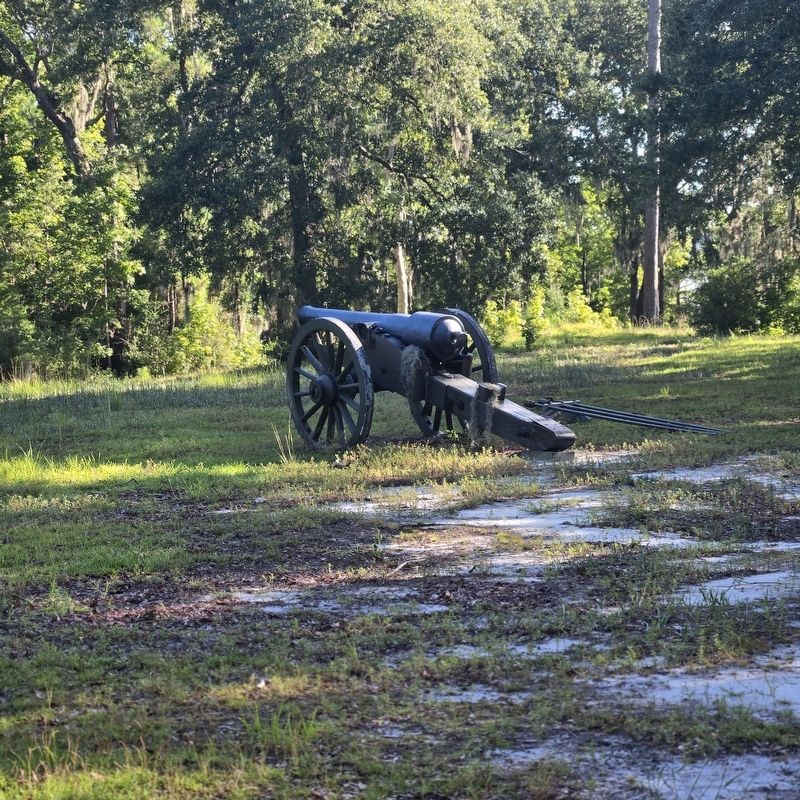
3. Replica 18th Century cannon at Brunswick Town
Other nearby markers. At least 8 other markers are within walking distance of this marker: Yankee Catchers & Infernal Machines (about 400 feet away, measured in a direct line); A Home at Brunswick: Hepburn-Reonolds Site (about 400 feet away); Fort Anderson (about 500 feet away); The Big Guns Of Fort Anderson (about 500 feet away); 32-Pounder Rifled Cannon (about 600 feet away); Margaret McCorkall: A Brunswick Woman (about 600 feet away); a different marker also named Fort Anderson (approx. 0.2 miles away); Colonel Maurice Moore (approx. 0.2 miles away). Touch for a list and map of all markers in Winnabow.
Also see . . .
1. Brunswick Town Raid (Wikipedia). (Submitted on September 17, 2025, by Mike McKeown of Baltimore, Maryland.)
2. Brunswick Town/Fort Anderson (North Carolina Historic Sites). (Submitted on September 17, 2025, by Mike McKeown of Baltimore, Maryland.)
Credits. This page was last revised on October 3, 2025. It was originally submitted on September 17, 2025, by Mike McKeown of Baltimore, Maryland. This page has been viewed 117 times since then and 38 times this year. Photos: 1, 2, 3. submitted on September 17, 2025, by Mike McKeown of Baltimore, Maryland. • Bernard Fisher was the editor who published this page.
