
Leesylvania in Prince William County, Virginia — The American South (Mid-Atlantic)
The Burying Ground
Rippon Lodge
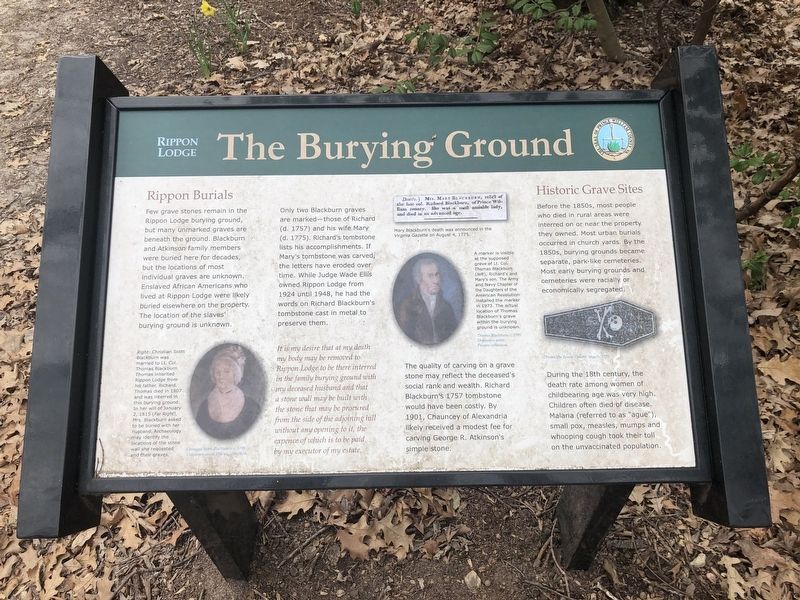
Few grave stones remain in the Rippon Lodge burying ground, but many unmarked graves are beneath the ground. Blackburn and Atkinson family members were buried here for decades, but the locations of most individual graves are unknown. Enslaved African Americans who lived at Rippon Lodge were likely buried elsewhere on the property. The location of the slaves' burying ground is unknown.
Only two Blackburn graves are marked—those of Richard (d. 1757) and his wife Mary (d. 1775). Richard's tombstone lists his accomplishments. If Mary's tombstone was carved, the letters have eroded over time. While Judge Wade Ellis owned Rippon Lodge from 1924 until 1948, he had the words on Richard Blackburn's tombstone cast in metal to preserve them.
The quality of carving on a grave stone may reflect the deceased's social rank and wealth. Richard Blackburn's 1757 tombstone would have been costly. By 1901, Chauncey of Alexandra likely received a modest fee for carving George R. Atkinson's simple stone.
Historic Grave Sites
Before the 1850s, most people who died in rural areas were interred on or near the property
this page online
During the 18th century, the death rate among women of childbearing age was very high. Children often died of disease. Malaria (referred to as "ague"), small pox, measles, mumps and whooping cough took their tool on the unvaccinated population.
[Image captions:]
Right: Christian Scott Blackburn was married to Lt. Col. Thomas Blackburn. Thomas inherited Rippon Lodge from his father, Richard. Thomas died in 1807 and was interred in this burying ground. In her will of January 2, 1815 (Far Right), Mrs. Blackburn asked to be buried with her husband. Archaeology may identify the locations of the stone wall she requested and their graves.
It is my desire that at my death my body be removed to Rippon Lodge to be there interred in the family burying ground with my deceased husband and that a stone wall may be built with the stone that may be procured from the side of the adjoining hill without any opening to it, the experience
Mary Blackburn's death was announced in the Virginia Gazette on August 4, 1775.
A marker is visible at the supposed grave of Lt. Col. Thomas Blackburn (left), Richard's and Mary's son. The Army and Navy Chapter of the Daughters of the American Revolution installed the marker in 1973. The actual location of Thomas Blackburn's grave within the burying ground is unknown.
Erected by Prince William County Department of Public Works, Historic Preservation Division.
Topics and series. This historical marker is listed in these topic lists: African Americans • Cemeteries & Burial Sites • Science & Medicine • Women. In addition, it is included in the Daughters of the American Revolution series list. A significant historical year for this entry is 1924.
Location. 38° 36.829′ N, 77° 16.688′ W. Marker is in Leesylvania, Virginia, in Prince William County. It can be reached from Admiral Black Drive west of Blackburn Road when traveling west. Touch for map. Marker is at or near this postal address: 15520 Blackburn Road, Woodbridge VA 22191, United States of America. Touch for directions.

Regionally, this marker is in the Washington Metropolitan Area, in Northern Virginia, and in the Piedmont. It is also in the American South, specifically in the Upper South, and in the Mid-Atlantic. Globally, it is in the North Atlantic Region, North America, the Western Hemisphere, the Western World, and the Anglosphere. Historically, it finds itself in what was once the territory of the Mississippian Culture, one of the original Thirteen Colonies, one of the Confederate States of America, and the Antebellum South.
Other nearby markers. At least 8 other markers are within walking distance of this marker: Stones, but No Bones (a few steps from this marker); Neabsco Creek (within shouting distance of this marker); Collo. Richard Blackburn (about 300 feet away, measured in a direct line); Rippon Lodge (about 300 feet away); a different marker also named Latrobe's View (about 500 feet away); Historic Landscape (about 600 feet away); a different marker also named Centuries of History (about 600 feet away); The Doeg People (approx. 0.2 miles away). Touch for a list and map of all markers in Leesylvania.
Other markers no longer nearby. Latrobe's View (was about 400 feet away but has been replaced with another marker now near it); a different marker also named Historic Landscape (was about 600 feet away but has been replaced with another marker now near it); Centuries of History (was about 600 feet away but has been replaced with another marker now near it).
Additional commentary.
1.
Thomas Blackburn gravesite is in the Rippon Lodge Family Cemetery, Map coordinates: 38.61325, -77.27808. Located within the cemetery on the Rippon Lodge Historical Site along the southbound side of Blackburn Road.
He joined the Virginia Militia as a volunteer. He fought at the battle of Germantown, Pennsylvania in October 1777. During this battle, he was wounded in the leg which ended his military career. He returned to Rippon Lodge in Woodbridge, Virginia to continue farming and entertaining his many friends.
Daughters of the American Revolution Chapters placed these markers here.
Patriot Marker:
Col Thomas Blackburn
15 Jan 1742 - 27 October 1807
Placed By George Washington Chapter
NSSAR 2016
Plaque:
Col. Thomas Blackburn
1742-1807
Placed by Army-Navy Chapter D.C. D.A.R
— Submitted March 19, 2024, by Carolyn Sanders of Plano, Texas.
Credits. This page was last revised on October 2, 2025. It was originally submitted on March 29, 2019, by Devry Becker Jones of Washington, District of Columbia. This page has been viewed 703 times since then and 49 times this year. Last updated on October 1, 2025, by N. Jozsa of Woodbridge, Virginia. Photos: 1, 2. submitted on March 29, 2019, by Devry Becker Jones of Washington, District of Columbia. • Bernard Fisher was the editor who published this page.
