Angeles National Forest near Santa Clarita in Los Angeles County, California — The American West (Pacific Coastal)
Before the Dam
Saint Francis Dam Disaster National Memorial and National Monument
| — | An Area Rich in History | — |

Photographed by Craig Baker, October 1, 2025
1. Before the Dam
Tataviam Native Americans
The Tataviam - a name applied to the people occupying this region by other tribal groups, and varying in meaning from "people facing the sun" to "people of the south facing slope" - lived in approximately 20 various-sized villages within the upper reaches of the Santa Clara River drainage east of Piru Creek, with one village situated within San Francisquito Canyon. The Tataviam territory extended over the Sawmill Mountains to the north and included the southwestern fringes of the Antelope Valley. They relied on southern California's abundant natural food supply for sustenance. After the Mission period, they were assimilated into the Fernando Tataviam Band of Mission Indians. Those that survived enslavement at Mission San Fernando formed a Fernandeño coalition. Today, their descendants are known as the Fernandeño Tataviam Band of Mission Indians.
Historical Travel Route
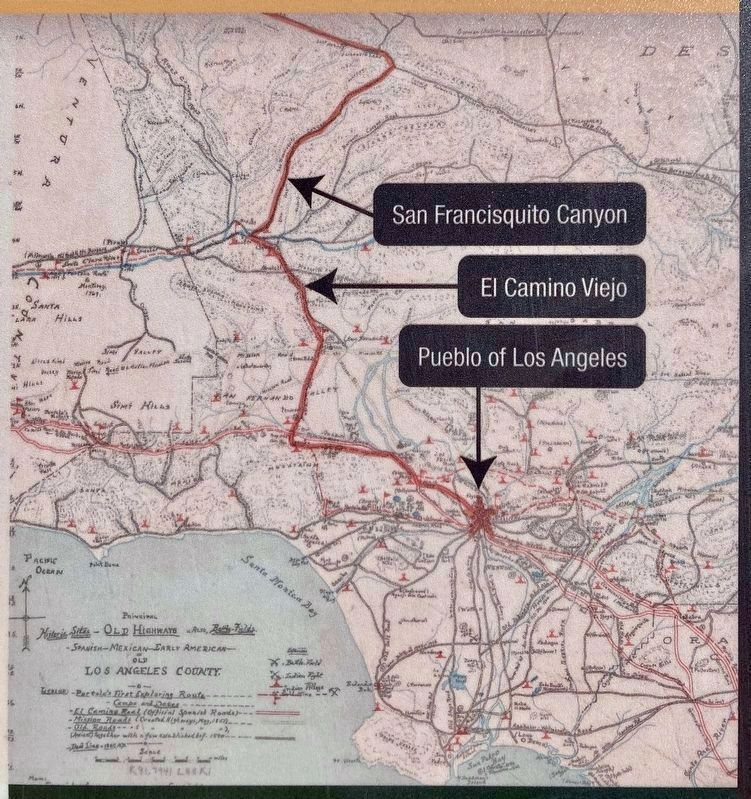
Historically, the San Francisquito Creek and its canyon was a major route for wagons and stagecoaches northward from Los Angeles into the San Joaquin Valley. "El Camino Viejo" was a route in use as early as 1780, and it ran
this page online
Placer Gold-Mining
It is believed that gold was first discovered in Placerita Canyon by Francisco Lopez. Placer gold-mining was primarily conducted by Spanish missionaries in this region prior to the Gold Rush. There is very little physical evidence left of early placer-mining due to the dam collapse. Access to gold and water by settling communities further dispossessed the local Tataviam of their homelands.
450 AD · Archaeological research supports presence of Tataviam in Santa Clarita.
1769 · Arrival of Spanish settlers.
1797 · Mission San Fernando established.
1810 · Majority of the Tataviam are baptized at Mission San Fernando and are renamed Fernandeño.
1842 · Gold discovered near Santa Clarita.
1848 · California gold rush begins.
1900 · Only 5 Fernandeño
Photographed by Craig Baker, October 1, 2025
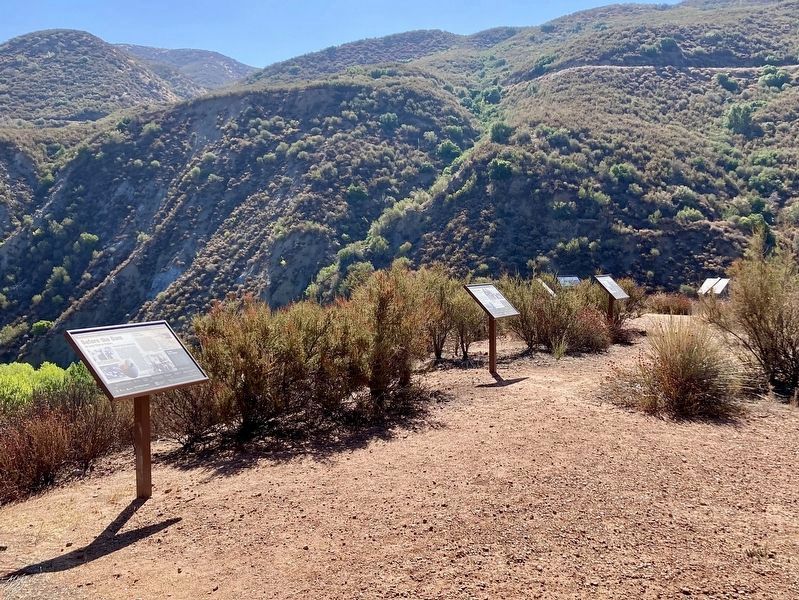
2. Before the Dam marker
One of eight interpretive signs here.
Erected by U.S. Forest Service, Student Conservation Association, and National Fish and Wildlife Foundation.
Topics. This historical marker is listed in these topic lists: Disasters • Indigenous Peoples and Communities • Man-Made Features • Notable Events. A significant historical year for this entry is 450 CE.
Location. 34° 32.832′ N, 118° 30.869′ W. Marker is near Santa Clarita, California, in Los Angeles County. It is in Angeles National Forest. It can be reached from San Francisquito Canyon Road just north of San Francisquito Motorway, on the right when traveling north. Walk ¼-mile south along the abandoned roadway to the dam site. The trail to the markers is 0.2-mile past the dam site, on the right. Touch for map. Marker is at or near this postal address: 35618 San Francisquito Canyon Rd, Santa Clarita CA 91390, United States of America. Touch for directions.

Regionally, this marker is in Greater Los Angeles and in the Transverse Ranges. It is also on the American Pacific Coast. Globally, it is in North America, on the Ring of Fire, on the Pacific Rim, in the Western Hemisphere, in the Western
Photographed by Craig Baker, October 1, 2025
3. Historical Map of Los Angeles County
Click on photos to see full size.
Other nearby markers. At least 8 other markers are within one mile of this marker, measured as the crow flies: Water Wars (here, next to this marker); William Mulholland (a few steps from this marker); Construction of the Dam (a few steps from this marker); Night of the Disaster (a few steps from this marker); Geology of the Canyon (a few steps from this marker); The Aftermath (a few steps from this marker); The Lives That Were Lost (a few steps from this marker); a different marker also named St. Francis Dam Disaster Site (approx. one mile away). Touch for a list and map of all markers in Santa Clarita.
Another marker is no longer nearby. St. Francis Dam Disaster Site (was within shouting distance of this marker but has been confirmed missing).
More about this marker. Plans are underway to build a trail directly from the highway to the marker.
Related markers. Click here for a list of markers that are related to this marker. - Saint Francis Dam Disaster sites.
Photographed by Craig Baker, October 1, 2025
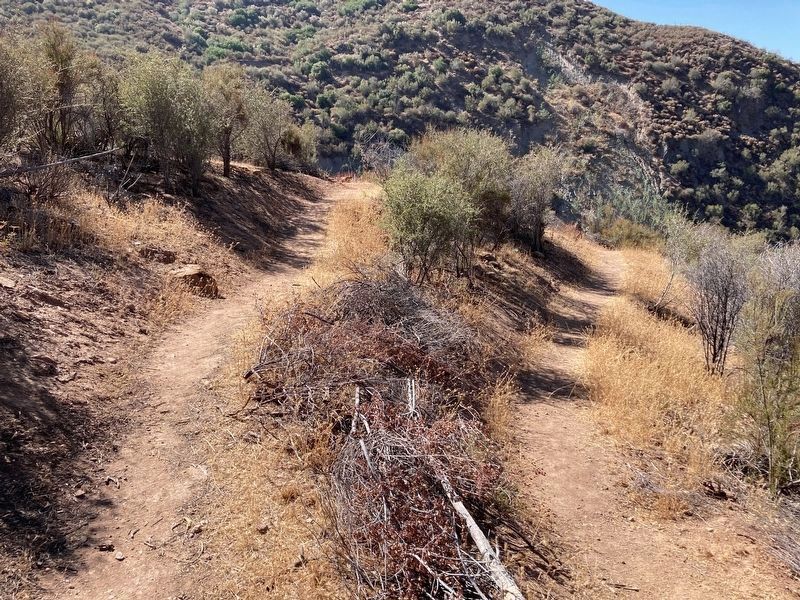
4. Trail to the Markers
The trail begins at the abandoned road, south of the dam site.
Photographed by Craig Baker, October 1, 2025
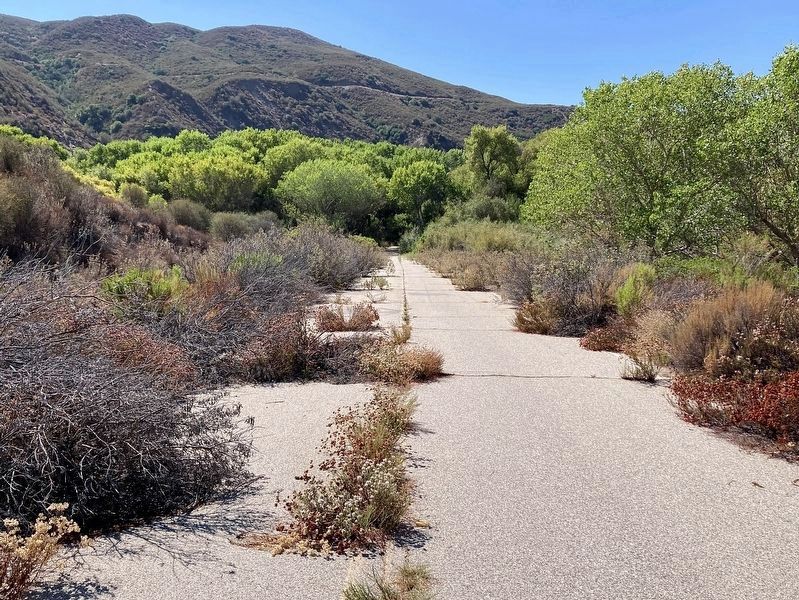
5. Abandoned Road
Along the walk to the Dam site.
Photographed by Craig Baker, October 1, 2025
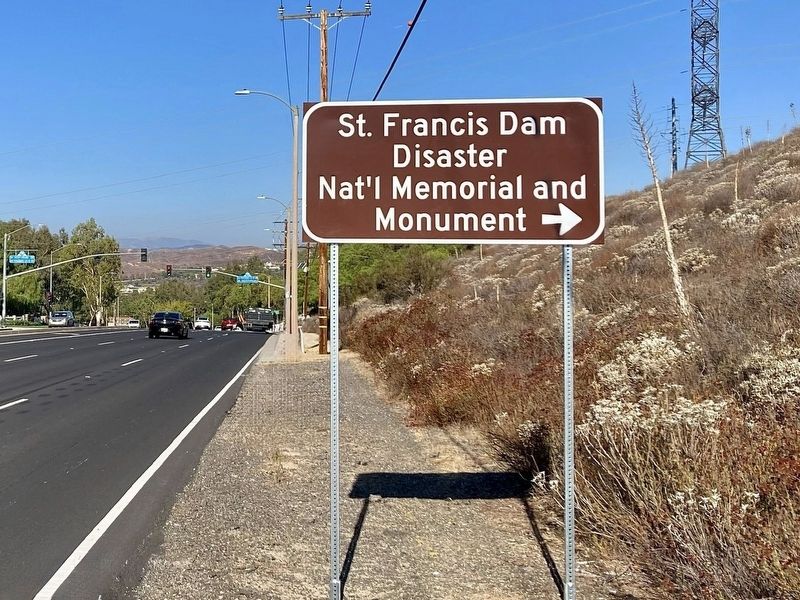
6. Road Sign
On Copper Hill Road at San Francisquito Canyon Road, 7½ miles south of the dam site.
Credits. This page was last revised on October 25, 2025. It was originally submitted on October 2, 2025, by Craig Baker of Sylmar, California. This page has been viewed 755 times since then and 62 times this year. Photos: 1, 2, 3, 4, 5, 6. submitted on October 2, 2025, by Craig Baker of Sylmar, California.
