Prairie Village in Johnson County, Kansas — The American Midwest (Upper Plains)
From Farms to Suburbs: Land in Transition

Photographed by William Fischer, Jr., October 18, 2025
1. From Farms to Suburbs: Land in Transition Marker
Like the majority of Johnson County's landscape, the land around you at Meadowbrook Park has undergone numerous changes over time. Residents' needs and preferences in different eras shaped how the land was used and who used it. In the mid-19th century traditional Native hunting territory was divided into European-style farms. These family farms ultimately became residential neighborhoods in the early-to mid-20th century.
[Top left photo caption reads]
This aerial view of Prairie Village, Kansas from the 1940s shows changing farmland to residential subdivisions.
NATIVE LANDS
For generations the area that is now Prairie Village was part of the communally held ancestral hunting territory of the Kanza and Osage tribes. In the 1820s, the federal government removed the Kanza and Osage people to reservations elsewhere in what is now Kansas. The government then removed the Shawnee from their ancestral territory in the Ohio River Valley and placed them on a reservation that spanned modern-day Johnson County. In 1854, Congress formed the Kansas Territory and again removed the Shawnee. The influence of Indigenous
this page online
FAMILY FARMS
After Congress created Kansas Territory in 1854, Euro-Americans migrated to the area and purchased land on which to live and farm. These migrants brought with them ideas of individual land ownership that directly opposed Indigenous peoples' belief in communal land use. Rolling prairies and forested streamways soon became agricultural fields and grazing pastures. Farmers raised dairy cows, operated truck gardens for large scale vegetable cultivation, and grew row crops such as corn and wheat.
Around 1900, Col. Andy James developed the Meadow Brook Stock Farm near here and began breeding Shorthorn cattle, hogs, and mules. Although the exact origin of the area's name is unknown, it is possible that James' farm and the park today are named for one of the many creeks that once crisscrossed the area.
[Photo caption reads] The Porter (above), Lewis, and Nall families operated farms near here - some for more than 75 years.
THE GENTLEMAN'S FARM
In the early 20th century, gentleman's farms took the place of

Photographed by William Fischer, Jr., October 18, 2025
2. From Farms to Suburbs: Land in Transition Marker
[Bottom left photo captions read]
Left: Herbert Woolf with his horse, Lawrin, and jockey Eddie Arcaro after winning the Kentucky Derby in 1938.
Right: The Mission Valley Hunt Club hosted fox hunts that spanned the area's farm fields. Some of the region's wealthiest residents were members.
BUILDING MIDDLE-CLASS SUBURBIA
In 1914, J.C.

Photographed by William Fischer, Jr., October 18, 2025
3. From Farms to Suburbs: Land in Transition Marker
View from behind marker toward the park clubhouse
The suburbs became affordable to more Americans during the Great Depression when a government mortgage program from the Federal Housing Administration (FHA) began offering favorable lending terms for the first time. Terms included low money down, low monthly payments, and longer loan periods. The program was generally open only to white homebuyers until the Fair Housing Act passed in 1968. Nichols' Prairie Village development, started in 1941 and finished after World War II, was filled with homes that qualified for FHA mortgages. Most included deed restrictions against African American ownership, as had all of Nichols' developments for decades. Census records show Prairie Village's
Photographed by William Fischer, Jr., October 18, 2025
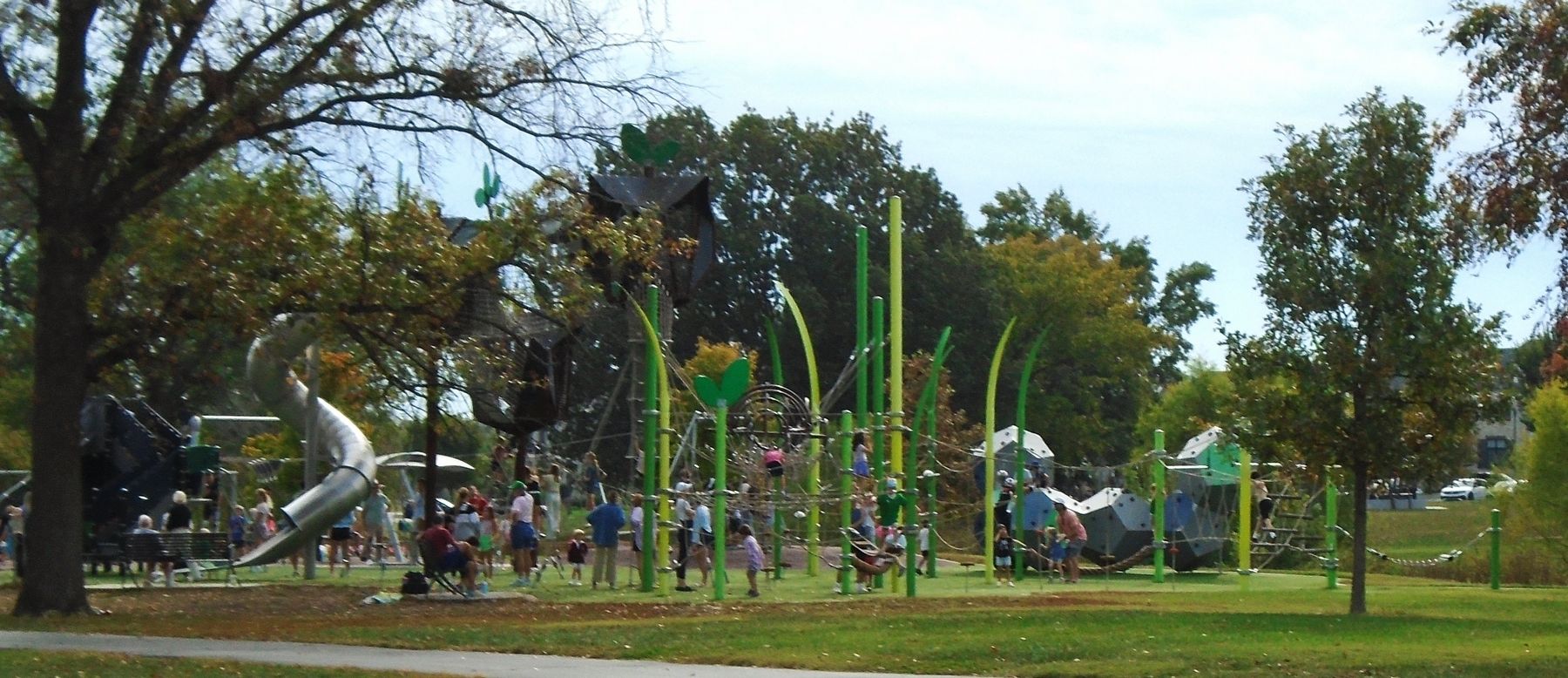
4. Families Enjoying the Playscape on a Beautiful Autumn Day
[Top right photo captions read]
Above The Porter family, whose home and farm once stood at the center of today's Prairie Village Shopping Center, owned land in the area since 1858. When J.C. Nichols bought nearby farms in anticipation of developing Prairie Village, Elizabeth "Betty" Porter refused to sell. Betty and her brother Edgar eventually sold to Nichols in 1947. Nichols moved them into a new suburban home nearby and demolished the Porter home to begin construction on the shopping center.
Left: Prairie Village grew to eight subdivisions and won the National Association of Home Builders' award for "Best Complete Community Development" in 1949. By 1957, Prairie Village had surpassed the required 15,000 residents to become a first-class city, and was one of the largest cities in Johnson County at the time.
AN OPEN MEMBERSHIP COUNTRY CLUB
At the same time that Nichols and others were developing suburban communities near Prairie Village, members of Kansas City, Missouri's Jewish community were moving to the Kansas suburbs. They brought with them places of worship,

Photographed by William Fischer, Jr., October 18, 2025
5. Meadowbrook Park Main Entrance Sign
When it opened in 1954, Meadowbrook Golf and Country Club had an open membership policy that permitted Jewish members. Only one other club in the Kansas City metro allowed Jewish membership at the time. Meadowbrook's open membership attracted hundreds of members and, eventually, new residents to the surrounding neighborhoods. By the end of the century, membership declined and attempts were made to sell the golf course and redevelop the property. Meadowbrook Golf and Country Club closed in October 2014.
[Photo captions read]
Left: Paul Berman was the first president of the Meadowbrook Golf and Country Club and, along with a group of interested Jewish businessmen, was instrumental in its formation and open membership policy.
Right: The cover of this 1985 membership booklet shows the 1970s golf clubhouse where the Meadowbrook Clubhouse stands today. Two earlier golf links had operated on this land: the Belle Air Golf Club and Meadowbrook Club Acres of the 1930s and 1940s.
CREATING A PUBLIC GREEN SPACE
The park you stand in today is the product of a unique public-private partnership. VanTrust, a real estate development firm, purchased the 135-acre Meadowbrook property with the intent of building luxury homes and devoting 30 acres to public green space. Johnson County Park and Recreation District (JCPRD) had an interest in creating parkland in northeastern Johnson County. Together with the City of Prairie Village, the public and private partners worked to increase the density of the proposed housing development, making it possible to devote 80 acres - 60% of the total land - to public green space. The creation of a TIF district (tax increment financing) helped fund the park using future property tax revenues. The 1974 golf clubhouse was replaced with a new facility and the spillways were reconstructed. Meadowbrook Park, operated by JCPRD, opened to the public in June 2019, and the innovative partnership that led to its creation has served as a model for other projects across the nation.
[Bottom right photo captions read] A present-day view of Meadowbrook Park's new Clubhouse and the Great Lawn.
Part of JCPRD's Public Art Program, "Gateway," by Arnie Jacobsen is a 12-foot-tall Kansas sunflower. It features illustrated panels that represent the history of Meadowbrook Park and the Prairie Village area. The piece was installed in October 2022.
Erected 2023 by Johnson County Parks & Recreation District and Johnson County Kansas Museum.
Topics. This historical marker is listed in these topic lists: Immigration • Indigenous Peoples and Communities • Parks & Recreational Areas • Settlements & Settlers. A significant historical month for this entry is October 2014.
Location. 38° 57.79′ N, 94° 38.868′ W. Marker is in Prairie Village, Kansas, in Johnson County. It can be reached from Nall Avenue. Marker is adjacent to the Meadowbrook Park Clubhouse. Touch for map. Marker is at or near this postal address: 9101 Nall Avenue, Overland Park KS 66207, United States of America. Touch for directions.

Regionally, this marker is in Eastern Kansas and specifically in Greater Kansas City. It is also in the American Midwest, in the Corn Belt, on the prairies, on the Southern Plains, and on the Santa Fe Trail Corridor. Globally, it is in North America, the Western Hemisphere, the Western World, and the Anglosphere. Historically, it finds itself in what was once the Louisiana Purchase.
Other nearby markers. At least 8 other markers are within 2 miles of this marker, measured as the crow flies: Meadowbrook Park (a few steps from this marker); Heritage of Johnson County, Kansas (approx. 1.2 miles away); Hedrick-Fleming Hall & Post Office (approx. 1.9 miles away); Overland Park State Bank Building (approx. 1.9 miles away); Two Ways West from Westport (approx. 1.9 miles away); Wilson-Weldon Buildings (approx. 1.9 miles away); William B. Strang, Jr. (approx. 1.9 miles away); "A Day on the Trail" (approx. 1.9 miles away).
Also see . . . Meadowbrook Park (JCPRD). (Submitted on October 19, 2025, by William Fischer, Jr. of Reynoldsburg, Ohio.)
Credits. This page was last revised on October 19, 2025. It was originally submitted on October 19, 2025, by William Fischer, Jr. of Reynoldsburg, Ohio. This page has been viewed 56 times since then and 32 times this year. Photos: 1, 2, 3, 4, 5. submitted on October 19, 2025, by William Fischer, Jr. of Reynoldsburg, Ohio.
