Central Office District in Richmond, Virginia — The American South (Mid-Atlantic)
Evacuation of Richmond
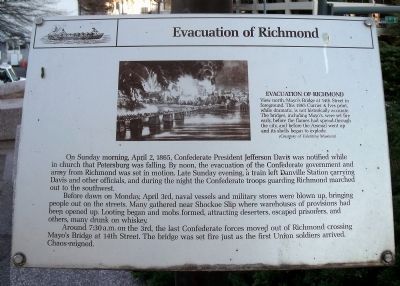
Photographed by Bernard Fisher, January 13, 2010
1. Evacuation of Richmond Marker
Before dawn on Monday, April 3rd, naval vessels and military stores were blown up, bringing people out on the streets. Many gathered near Shockoe Slip where warehouses of provisions had been opened up. Looting began and mobs formed, attracting deserters, escaped prisoners, and others, many drunk on whiskey.
Around 7:30 a.m. on the 3rd, the last Confederate forces moved out of Richmond crossing Mayo’s Bridge at 14th Street. The bridge was set fire just as the first Union soldiers arrived. Chaos reigned.
Topics. This historical marker is listed in these topic lists: Notable Events • War, US Civil. A significant historical date for this entry is April 2, 1800.
Location. Marker has been reported missing. It was located near 37° 32.267′ N, 77° 26.302′ W.
this page online

Regionally, this marker was in Central Virginia. It was also in the American South and specifically in the Upper South. Globally, it was in North America, the Western Hemisphere, the Western World, and the Anglosphere. Historically, it found itself in what was once the territory of the Mississippian Culture, one of the original Thirteen Colonies, one of the Confederate States of America, and the Antebellum South.
Other nearby markers. At least 8 other markers are within walking distance of this location: Kanawha Plaza (about 400 feet away, measured in a direct line); The First National Bank Building (about 500 feet away); Richmond Evacuation Fire (about 700 feet away); Great Turning Basin (about 800 feet
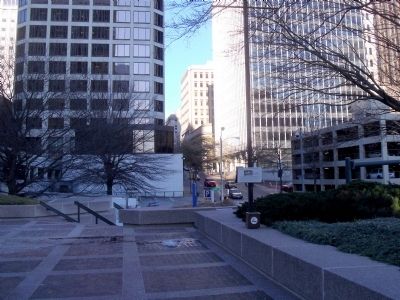
Photographed by Bernard Fisher, January 13, 2010
2. Evacuation of Richmond Marker
Other markers no longer nearby. Evacuation Fire (was here, next to this marker but has been confirmed missing); Downtown Richmond Millsites (was within shouting distance of this marker but has been confirmed missing); Basin Race (was within shouting distance of this marker but has been confirmed missing); Canal Walk (was about 400 feet away but has been confirmed missing).
More about this marker. On top is an image of the "Evacuation of Richmond" with the caption, "View north, Mayo’s Bridge at 14th Street in foreground. This 1865 Currier & Ives print, while dramatic, is not historically accurate. The bridges, including Mayo’s, were set fire early, before the flames had spread through the city, and before the Arsenal went up and its shells began to explode. (Courtesy of Valentine Museum)"
Also see . . .
1. Reaction to the Fall of Richmond.
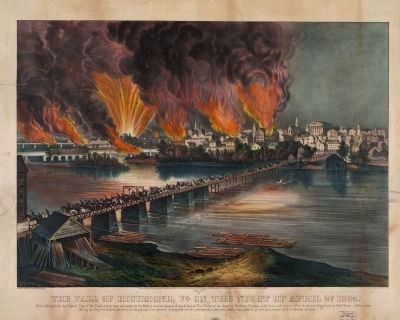
Photographed by Currier & Ives, circa 1865
3. The fall of Richmond, Va. on the night of April 2d. 1865
This strong hold the Capital City of the Confederacy, was evacuated by the Rebels in consequence of the defeat at "Five forks" of the Army of Northern Virginia under Lee, and capture of the South side Rail-Road by Genl Grant. Before abandoning the City, the Rebels set fire to it, destroying a vast amount of property; and the conflagration continued until it was subdued by the Union troops on the following morning.
Library of Congress [LC-DIG-pga-03629]
Library of Congress [LC-DIG-pga-03629]
2. America’s Civil War: The Fall of Richmond. Historynet (Submitted on January 18, 2010.)
3. Fall of Richmond. Civil War Richmond (Submitted on January 18, 2010.)
Credits. This page was last revised on October 22, 2025. It was originally submitted on January 18, 2010, by Bernard Fisher of Richmond, Virginia. This page has been viewed 2,835 times since then and 86 times this year. Last updated on October 20, 2025, by Evan Dwyer of Richmond, Virginia. Photos: 1, 2, 3. submitted on January 18, 2010, by Bernard Fisher of Richmond, Virginia.
