Wilmington in New Castle County, Delaware — The American Northeast (Mid-Atlantic)
USS Monitor – America's First National Marine Sanctuary
Photographed by Devry Becker Jones (CC0), October 25, 2025
1. USS Monitor – America's First National Marine Sanctuary Marker
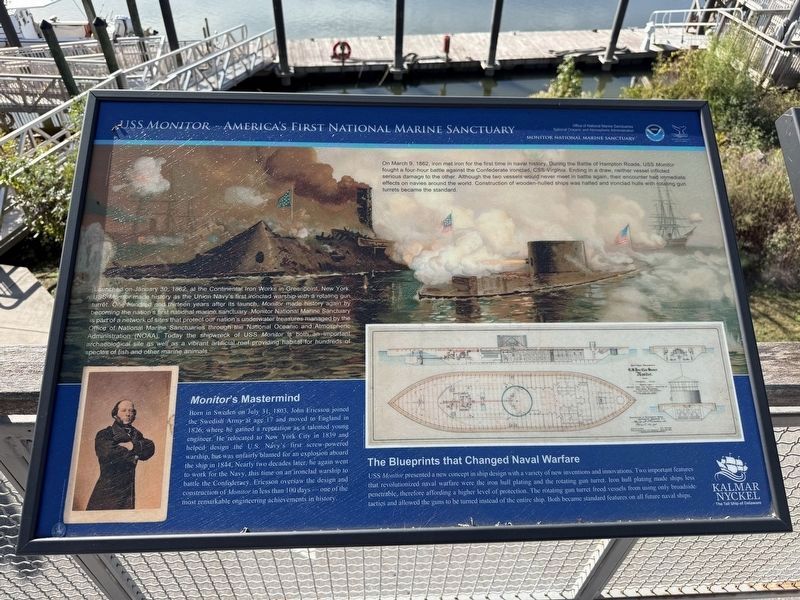
On March 9, 1862, iron met iron for the first time in naval history. During the Battle of Hampton Roads, USS Monitor fought a four-hour battle against the Confederate ironclad, CSS Virginia. Ending in a draw, neither vessel inflicted serious damage to the other. Although the two vessels would never meet in battle again, their encounter had immediate effects on navies around the world. Construction of wooden-hulled ships was halted and ironclad hulls with rotating gun turrets became the standard.
Launched on January 30, 1862, at the Continental Iron Worlds in Greenpoint, New York, USS Monitor made history as the Union Navy's first ironclad warship with a rotating gun turret. One hundred and thirteen years after its launch, Monitor made history again by becoming the nation's first national marine sanctuary. Monitor National Marine Sanctuary is part of a network of sites that protect our nation's underwater treasures managed by the Office of National Marine Sanctuaries through the National Oceanic and Atmospheric Administration (NOAA). Today the shipwreck of USS Monitor is both an important archaeological site as well
this page online
Monitor's Mastermind
Born in Sweden on July 31, 1803, John Ericsson joined the Swedish Army at age 17 and moved to England in 1826, where he gained a reputation as a talented young engineer. He relocated to New York City in 1839 and helped design the U.S. Navy's first screw-powered warship, but was unfairly blamed for an explosion aboard the ship in 1844. Nearly two decades later, he again went to work for the Navy, this time on an ironclad warship to battle the Confederacy. Ericsson' oversaw the design and construction of the Monitor in less than 100 days — one of the most remarkable engineering achievements in history.
The Blueprints that Changed Naval Warfare
USS Monitor presented a new concept in ship design with a variety of new inventions and innovations. Two important features that revolutionized naval warfare were the iron hull plating and the rotating gun turret. Iron bull plating made ships less penetrable, therefore affording a higher level of protection. The rotating gun turret freed vessels from using only broadside
Photographed by Devry Becker Jones (CC0), October 25, 2025
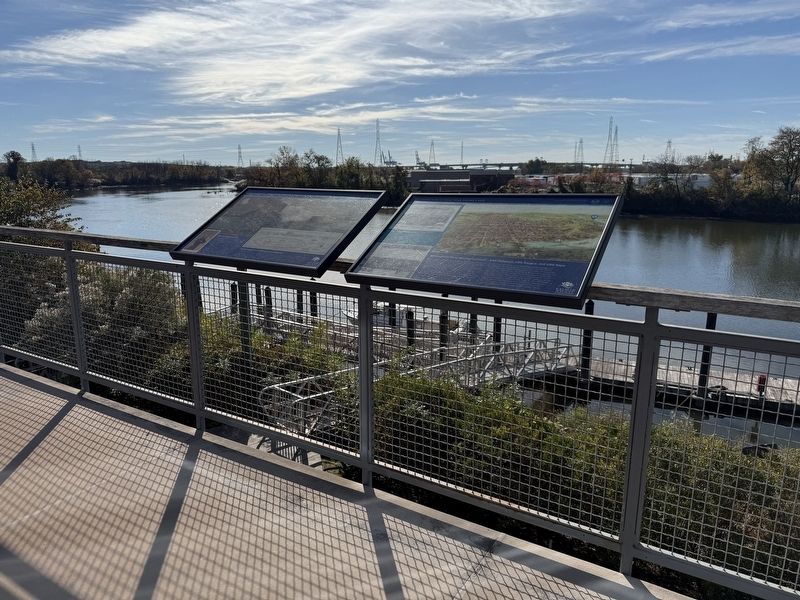
2. Two markers on the second-story balcony of the Kalmar Nyckel Foundation Museum
Erected by Monitor National Marine Sanctuary, Office of National Marine Sanctuaries, National Oceanic and Atmospheric Administration, U.S. Department of Commerce; Kalmar Nyckel Foundation Museum.
Topics and series. This historical marker is listed in these topic lists: Environment • War, US Civil • Waterways & Vessels. In addition, it is included in the National Oceanic and Atmospheric Administration (NOAA) series list. A significant historical date for this entry is January 30, 1862.
Location. 39° 44.222′ N, 75° 32.194′ W. Marker is in Wilmington, Delaware, in New Castle County. It can be reached from East 7th Street east of Swedes Landing Road, on the right when traveling east. The marker is affixed to the railing on the second-story balcony of the Kalmar Nyckel Foundation Museum. An entrance fee is charged to access balcony. Touch for map. Marker is at or near this postal address: 1126 E 7th St, Wilmington DE 19801, United States of America. Touch for directions.

Regionally, this marker is in Greater Philadelphia. It is also in the American Mid-Atlantic, on the Delmarva Peninsula, and on the Eastern Seaboard. Globally, it is in the North Atlantic Region, North America, the Western Hemisphere, the Western World, and the Anglosphere. Historically, it finds itself in what was once New Netherland and also one of the original Thirteen Colonies.
Other nearby markers. At least 8 other markers are within walking distance of this marker: Wilmington's Civil War Ironclads (here, next to this marker); Escape by Sea (a few steps from this marker); Lifeboat 39 (about 300 feet away, measured in a direct line); a different marker also named Lifeboat 39 (about 300 feet away); The Monument (about 500 feet away); a different marker also named The Monument (about 500 feet away); Fort Christina (about 500 feet away); Fort Christina Monument (about 600 feet away). Touch for a list and map of all markers in Wilmington.
Credits. This page was last revised on October 26, 2025. It was originally submitted on October 26, 2025, by Devry Becker Jones of Washington, District of Columbia. This page has been viewed 99 times since then and 46 times this year. Photos: 1, 2. submitted on October 26, 2025, by Devry Becker Jones of Washington, District of Columbia.
