West Lampeter Township in Lancaster in Lancaster County, Pennsylvania — The American Northeast (Mid-Atlantic)
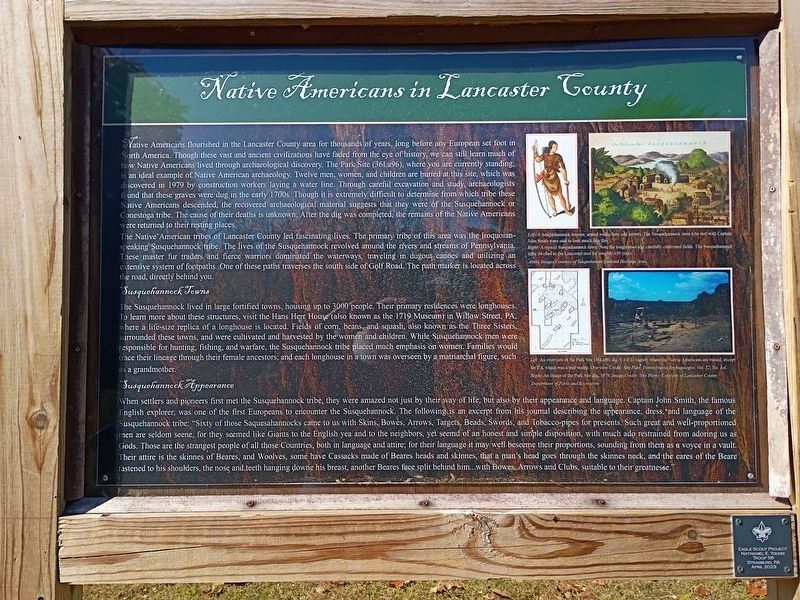
Native Americans in Lancaster County
Photographed by William Pope, October 26, 2025
1. Native Americans in Lancaster County Marker
The Native American tribes of Lancaster County led fascinating lives. The primary tribe of this area was the Iroquoian-speaking Susquehannock tribe.
this page online
Susquehannock Towns
The Susquehannock lived in large fortified towns, housing up to 3000 people. Their primary residences were longhouses. To learn more about these structures, visit the Hans Herr House (also known as the 1719 Museum) in Willow Street, PA. where a life-size replica of a longhouse is located. Fields of com, beans, and squash, also known as the Three Sisters surrounded these towns, and were cultivated and harvested by the women and children. While Susquehannock men were responsible for hunting, fishing, and warfare, the Susquehannock tribe placed much emphasis on women, Families would trace their lineage through their female ancestors, and each longhouse in a town was overseen by a matriarchal figure, such as a grandmother.
Susquehannock Appearance
When settlers and

Photographed by William Pope, October 26, 2025
2. Native Americans in Lancaster County Marker
(captions)
Left: A Susquehannock warrior, armed with a bow and arrows. The Susquehannock men who met with Captain John Smith were said to look much like this.
Right: A typical Susquehannock town. Note the longhouses and carefully cultivated fields. The Susquehannock tribe dwelled in the Lancaster area for roughly 150 years.
Above images courtesy of Susquehanna National Heritage Area.
Left: An overview of the Park Site (36La96) dig. F.1-F1.1 signify where the Native Americans are buried, except for F.4, which was a tree stump. Overview Credit: Site Plan: Pennsylvania Archaeologist, Vol. 52, No. 3-4, Right: An image of the Park Site dig, 1979. Image Credit: Site Photo; Courtesy of Lancaster County Department of Parks and Recreation.
Topics. This historical marker is listed in these topic lists: Anthropology & Archaeology • Cemeteries & Burial Sites • Indigenous Peoples and Communities.
Location. 40° 1.108′ N, 76° 17.078′ W. Marker is in Lancaster, Pennsylvania, in Lancaster County. It is in West Lampeter Township. It is on Golf Road 0.2 miles north of General Hand Lane, on the left when traveling north. This marker is located in Lancaster County Central Park. Touch for map. Marker is at or near this postal address: 649 Golf Road, Lancaster PA 17602, United States of America. Touch for directions.

Regionally, this marker is in South-Central Pennsylvania, specifically in Pennsylvania Dutch Country, and in the Susquehanna Valley. It is also in the American Northeast and in the Mid-Atlantic. Globally, it is in North America, the Western Hemisphere, the Western World, and the Anglosphere. Historically, it finds itself in what was once the Haudenosaunee (Iroquois) Confederacy and also one of the original Thirteen Colonies.
Other nearby markers. At least 8 other markers are within walking distance of this marker: A Dedication (here, next to this marker); Great Indian Warrior Trading Path (within shouting distance of this marker); Tenant Farmer's House (approx. 0.2 miles away); Rock Ford (approx. 0.2 miles away); Kurtz's Mill Covered Bridge (approx. ¼ mile away); a different marker also named Rock Ford (approx. 0.4 miles away); At Rockford near here lived & died General Edward Hand, M.D. (approx. 0.4 miles away); Proclamation (approx. 0.4 miles away). Touch for a list and map of all markers in Lancaster.
Credits. This page was last revised on November 5, 2025. It was originally submitted on October 26, 2025, by William Pope of Marietta, Pennsylvania. This page has been viewed 73 times since then and 33 times this year. Photos: 1, 2. submitted on October 26, 2025, by William Pope of Marietta, Pennsylvania. • Bill Pfingsten was the editor who published this page.
