Woodland in Southeast Washington in Washington, District of Columbia — The American Northeast (Mid-Atlantic)
The Anacostia River: Pride and Preservation

The Anacostia Community Museum works to highlight the history of the Anacostia watershed and its surrounding neighborhoods through the lenses of faith, race, class, development, politics, and culture.
The museum seeks to cultivate deeper engagement between the river and residents to spur preservation and instill pride in communities.
"I learned the Anacostia River, even with all its problems, was a source of healing for a people who are often forsaken and ignored in our nation's capital. My hope is the river can become a bridge…"
- Brenda Richardson, community leader
It's Our River
Throughout the 20th century and into the 21st, residents in neighborhoods along the Anacostia River have continually fought for environmental justice.
Communities have rallied against environmental hazards, such as utility generators, landfills, and incinerators, and have prevented their neighborhoods from being destroyed by freeway and bridge construction proposals.
,br> Community organizations, including Seafarers Yacht Club, Earth Conservation Corps, and the Anacostia Watershed Society have worked to encourage a sense of
this page online
[Captions:]
It's Up To Us!
Our actions can have a positive or negative impact on the Anacostia River. In small ways and big, we can take care of our waterways and repair years of neglect to achieve the swimmable, fishable urban river many desire.
Protecting Our Environment
This Smithsonian Gardens exhibit was designed to protect our waterways and restore native habitat. The bioretention swale, pictured below, works to capture and retain stormwater runoff from the parking lot, improving water quality and reducing pollutants. The plants you see in this garden are native to the area and provide food and shelter for native species of birds, insects and other animals.
Far right: Volunteers pick up litter during the Anacostia Watershed Society's Earth Day cleanup at Bladensburg Waterfront Park.
Right: Third graders from Northeast Washington's Maury Elementary School prepare to plant rice seedlings at Kenilworth Aquatic Gardens as part of the Anacostia Watershed Society's "Rice Ranger" program.
Kevin Laden and his daughter Ruby enjoy a canoe ride during the 2012 Anacostia River Festival.
Left: Earth Conservation Corps (ECC) volunteer LaVette Spears with Mr. Hoots. Since 1992, the ECC has encouraged at-risk youth to take pride in their community and help clean up the Anacostia River.
Background illustration: A hearty native species, the soft rush (Juncus effusus) tolerates both seasonal flooding and drought.
Erected by Smithsonian
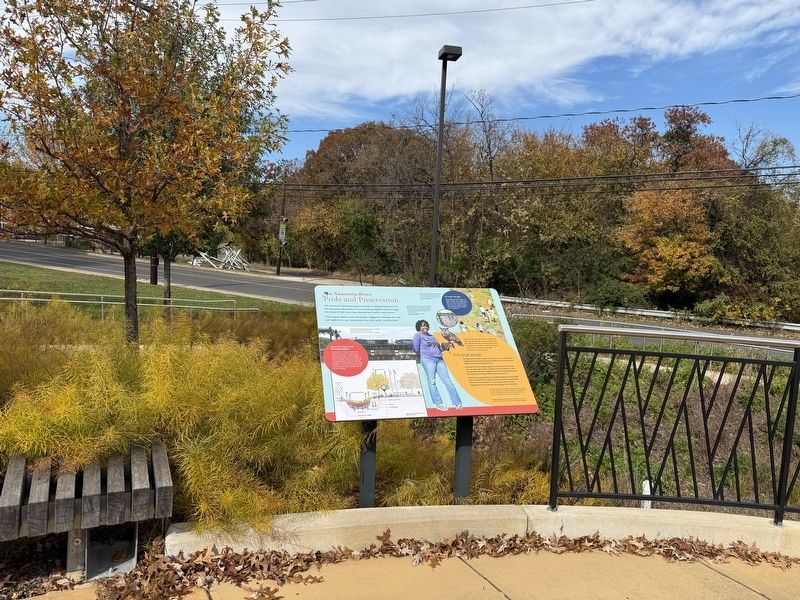
Photographed by Devry Becker Jones (CC0), November 4, 2025
2. The Anacostia River: Pride and Preservation Marker
Topics. This historical marker is listed in these topic lists: Charity & Public Work • Environment • Roads & Vehicles • Waterways & Vessels. A significant historical year for this entry is 2012.
Location. 38° 51.421′ N, 76° 58.618′ W. Marker is in Southeast Washington in Washington, District of Columbia. It is in Woodland. It is at the intersection of Fort Place Southeast and Pearson Place Southeast, on the right on Fort Place Southeast. Touch for map. Marker is at or near this postal address: 1901 Fort Pl SE, Washington DC 20020, United States of America. Touch for directions.

Regionally, this marker is in the Washington Metropolitan Area. It is also in the American Northeast, in the Upper South, in the Mid-Atlantic, in the Tidewater, and in the Chesapeake Bay Region. Globally, it is in North America, the Western Hemisphere, the Western World, and the Anglosphere.
Other nearby markers. At least 8 other markers are within walking distance of this marker: The Anacostia River: People and Places (here, next to this marker); The Litter Bell (a few steps from this marker); A Museum Without Walls (a few steps from this marker); Welcome to the Demonstration Garden (a few steps from this marker); a different marker also named A Museum Without Walls (within shouting distance of this marker); Battery Ricketts (about 500 feet away, measured in a direct line); Freedom Grove (1838) (approx. 0.3 miles away); Memorial Grove (1841-1895) (approx. 0.3 miles away). Touch for a list and map of all markers in Southeast Washington.
Another marker is no longer nearby. Thurgood Marshall (was within shouting distance of this marker but has been permanently removed).
Credits. This page was last revised on November 4, 2025. It was originally submitted on November 4, 2025, by Devry Becker Jones of Washington, District of Columbia. This page has been viewed 29 times since then and 10 times this year. Photos: 1, 2. submitted on November 4, 2025, by Devry Becker Jones of Washington, District of Columbia.
