Crow Wing State Park in Crow Wing County, Minnesota — The American Midwest (Upper Plains)
Old Crow Wing
Photographed by McGhiever, June 28, 2025
1. Old Crow Wing Marker
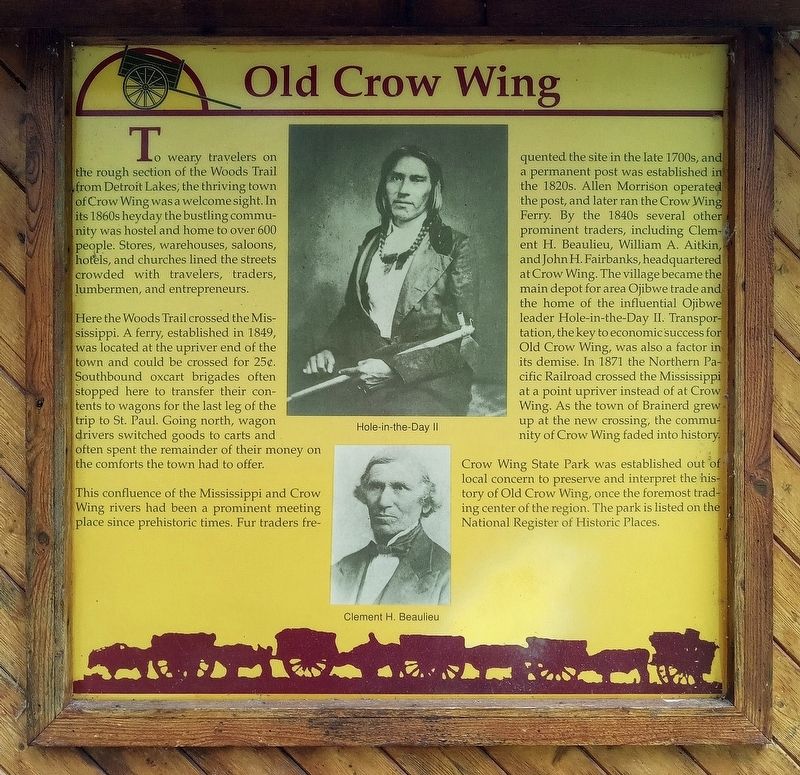
To weary travelers on the rough section of the Woods Trail from Detroit Lakes, the thriving town of Crow Wing was a welcome sight. In its 1860s heyday the bustling community was hostel and home to over 600 people. Stores, warehouses, saloons, hotels, and churches lined the streets crowded with travelers, traders, lumbermen, and entrepreneurs.
Here the Woods Trail crossed the Mississippi. A ferry, established in 1849, was located at the upriver end of the town and could be crossed for 25¢. Southbound oxcart brigades often stopped here to transfer their contents to wagons for the last leg of the trip to St. Paul. Going north, wagon drivers switched goods to carts and often spent the remainder of their money on the comforts the town had to offer.
This confluence of the Mississippi and Crow Wing rivers had been a prominent meeting place since prehistoric times. Fur traders frequented the site in the late 1700s, and a permanent post was established in the 1820s. Allen Morrison operated the post, and later ran the Crow Wing Ferry. By the 1840s several other prominent traders, including Clement H. Beaulieu, William A.
this page online
Crow Wing State Park was established out of local concern to preserve and interpret the history of Old Crow Wing, once the foremost trading center of the region. The park is listed on the National Register of Historic Places.
Hole-in-the-Day II
Clement H. Beaulieu
Erected by the Minnesota Department of Natural Resources.
Topics. This historical marker is listed in these topic lists: Indigenous Peoples and Communities • Roads & Vehicles • Settlements & Settlers • Waterways & Vessels. A significant historical year for this entry is 1860.
Location. 46° 16.442′ N, 94° 20.18′ W. Marker is in Crow Wing, Minnesota, in Crow Wing County. It
Photographed by McGhiever, June 28, 2025
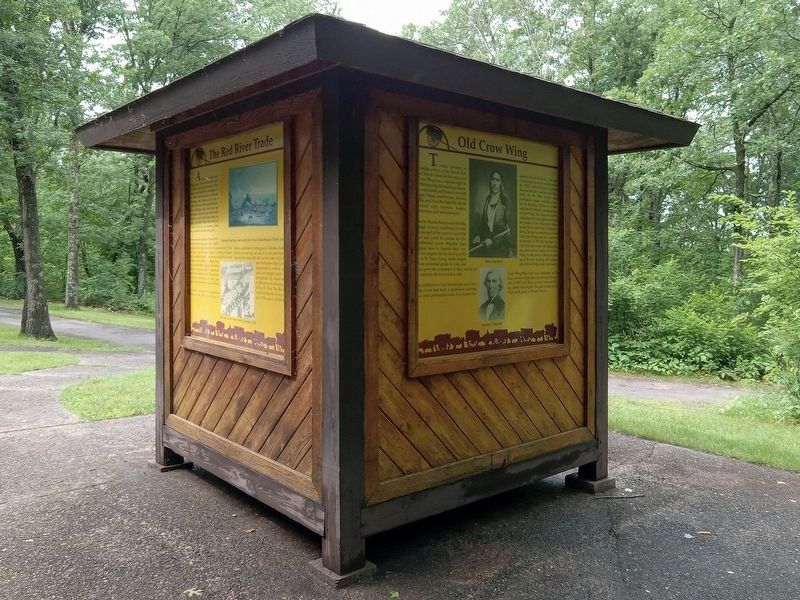
2. Old Crow Wing Marker (right) on the kiosk at Crow Wing State Park's south picnic shelter

Regionally, this marker is in the Northland. It is also in the American Midwest, in the Corn Belt, and in the Great River Road Region. Globally, it is in North America, the Great North Woods, the Western Hemisphere, the Western World, and the Anglosphere. Historically, it finds itself in what was once Rupert’s Land, the territory of the Mississippian Culture, and the Northwest Territory.
Other nearby markers. At least 8 other markers are within walking distance of this marker: The Woods Trail (here, next to this marker); The Red River Trade (here, next to this marker); The Red River Routes (here, next to this marker); Welcome to Main Street, Crow Wing (within shouting distance of this marker); Where Two Rivers Meet (about 300 feet away, measured in a direct line); William W. Warren (about 500 feet away); The Morrisons (about 500 feet away); Morrison Residence (about 600 feet away). Touch for a list and map of all markers in Crow Wing.
Credits. This page was last revised on November 9, 2025. It was originally submitted on November 9, 2025, by McGhiever of Minneapolis, Minnesota. This page has been viewed 98 times since then and 53 times this year. Photos: 1, 2. submitted on November 9, 2025, by McGhiever of Minneapolis, Minnesota.
